Get Full Government Meeting Transcripts, Videos, & Alerts Forever!
Get email alerts on the Early Childcare District topic
No spam. Unsubscribe anytime.
Garfield, Pitkin and Eagle counties approve service plan for Confluence early‑childhood special district
Summary
After a multi‑hour public hearing with parents, providers and legal counsel, the Garfield County Board of Commissioners approved the Confluence Early Childhood Development Special District service plan and authorized signatures so the plan can move to district court and, if validated, to a voter ballot for funding via a 0.25% sales‑tax.
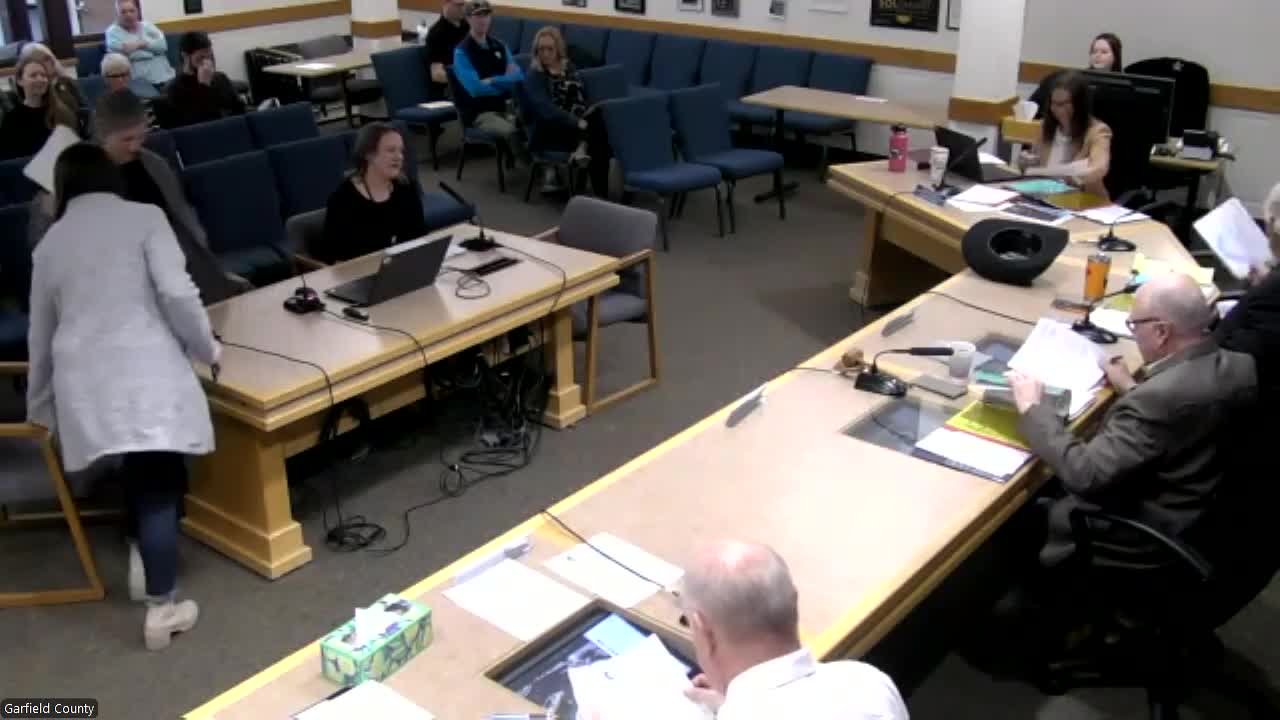
The Garfield County Board of Commissioners approved the Confluence Early Childhood Development Special District service plan on a unanimous vote following a public hearing that drew parents, early‑childhood providers, educators and business leaders.
The service plan would create a regional special tax district spanning Parachute to Aspen that proponents say would both expand licensed child‑care capacity and provide tuition assistance. The plan calls for a 0.25 percentage‑point sales tax, contingent on voter approval, that coalition presenters estimated would raise about $10 million a year.
The plan’s proponents framed the district as a regional, not a county‑only, response to a shortage of licensed child‑care slots and high family costs. "The district would be funded by a point 25% sales tax pending voter approval, which would raise an estimated $10,000,000 annually," said Maggie Tesconia, director of the Confluence Coalition, who presented the service plan to the board.
Why it matters: Supporters and multiple presenters said current public funding and provider capacity fall far short of local needs, creating economic strain on families and employers across Garfield, Pitkin and the Roaring Fork portion of Eagle County. Proponents said the district would be governed by an elected five‑member board and direct resources to tuition subsidies, provider grants to expand slots and quality, outreach/navigation services and minimal administrative support.
What the record shows: Legal counsel for the coalition, Trey Rogers, summarized statutory review criteria county commissioners must apply before approving a service plan. Rogers said commissioners must assess (1) whether sufficient existing and projected need exists; (2) whether the proposed services would address that need efficiently and sufficiently; (3) whether existing services are inadequate; and (4) whether revenues are adequate to cover any debt service (which Rogers said did not apply to this plan). "The four requirements are first, whether there is sufficient, existing and projected need for the services that the plan would address," Rogers told the board.
Speakers and evidence: Testimony included local parents describing difficulty finding licensed infant and toddler care, nonprofit and foundation officials describing the mix of state and local programs already in use, and economic arguments from employers and chamber representatives who said lack of child care obstructs hiring and retention. Kelly Esch, executive director of Early Childhood Network and a Garfield County Human Services Commission co‑chair, testified: "Simply put, early care and education in our region is just too hard to find." Valerie Carlin of Aspen Community Foundation presented the coalition’s financial analysis, including the coalition’s estimate of 5,120 children under age 5 in the proposed service area and roughly 2,272 licensed spots currently available.
Coalition financial outline presented to commissioners (figures presented by proponents): 5,120 children under age 5 in the region; estimated participation target of 60% (≈3,072 children); currently available licensed and staffed slots ≈2,272 (proponents described this as roughly 40% of need at the time of the survey); an estimated aggregate annual tuition cost to support the participation target ≈$52.2 million; currently‑available public and philanthropic resources estimated at about $6.5 million; family out‑of‑pocket payments estimated at roughly $31.1 million; resulting remaining gap ≈$20.9 million. The proposed 0.25% sales tax was projected to raise about $10 million annually, which proponents said would cover roughly half of the identified funding gap in year‑one projections and be split between tuition support and capacity development depending on board priorities.
Limitations and board discussion: County attorney and staff stressed the plan leaves detailed eligibility rules, contracting relationships and annual budgets to the district’s elected board and to subsequent legal and administrative processes. The county’s legal memo and counsel noted the plan does not fix specific eligibility tiers in the service plan text and that future agreements between the district and municipal governments would be negotiated after creation. Commissioners asked about ballot timing and the coalition said a district court review, signature collection by registered electors and fund‑raising for a campaign would determine whether the measure goes to voters in 2025 or 2026.
Board action and next steps: After public testimony and questions, a commissioner moved to find that the service plan satisfied the statutory standards and to approve the plan as presented; the board voted in favor. The county will sign the approval and the coalition will proceed to collect signatures and file in district court; if the court approves placement on the ballot, voters in the multi‑county district will decide on creation and on the funding measure. Legal counsel said the eventual ballot process will have three public votes: creation of the district, approval of funding, and election of the initial directors.
What proponents said they will do next: Coalition organizers said they will continue community outreach and fundraising to support a campaign and to refine operational details the elected board would later adopt. "We are ready to move forward and do the community organizing to seek voter approval," Hannah Berman of AspenOne told the commissioners.
Ending: The commission’s approval advances the proposal from review to the next stage of the statutory process — court validation and a voter decision. Whether voters approve funding and the district in a future election will determine whether the region receives the new, dedicated revenue stream advocates outlined at the hearing.