Get Full Government Meeting Transcripts, Videos, & Alerts Forever!
Get email alerts on the Zoning topic
No spam. Unsubscribe anytime.
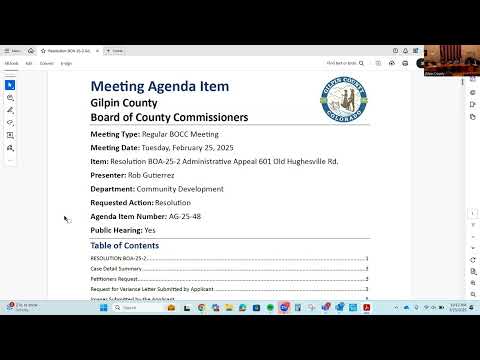
Board of Adjustment hearing ends with denial of variance request for 6010 Hughes Field Road
Summary
The Gilpin County Board of Adjustment closed a public hearing and denied a homeowner's request to allow part of a fence at 6010 Hughes Field Road to exceed the county's 8-foot height limit.
The Gilpin County Board of Adjustment closed a public hearing and denied a homeowner's request to allow part of a fence at 6010 Hughes Field Road to exceed the county's 8-foot height limit.
The request, brought by the property owner identified in the record as Mrs. McFarland, sought relief for about 40 feet of fencing that stands higher than the county's eight-foot maximum. The hearing included public comment from a local attorney and neighbors, staff presentations and repeated legal questions about how the board should treat topography and changes made to the parcel.
Why it matters: The board's decision clarifies how Gilpin County will apply its fence-height rules and variance standards in a compact three-member Board of Adjustment, where state law requires unanimous votes to reverse a director's decision. The case drew attention because it blended land-use rules, neighbor-conflict claims and questions about building permits and alterations to terrain.
Attorney Jeffrey Shepherd, who said he was speaking on behalf of “a concerned citizen,” urged the board to reject the application and referenced county ordinance language. “It is unambiguous,” Shepherd said during public comment. “A 12 or 14 foot privacy fence would constitute a grant of a special privilege to the applicant, which is inconsistent with every other property in the vicinity and zone district.”
Petitioner’s response: At the board's invitation, the petitioner (identified in the record as Mrs. McFarland) disputed several points raised by opponents, saying she has lived in the area for decades and that the fence was intended to address safety and harassment concerns. “They scream at them, yells homophobic slurs...He even gave the finger to an 11 year old girl,” McFarland said, describing incidents she said motivated the screening.
Staff position and legal questions: Community development staff recommended denial, saying the petitioner had not demonstrated a property-specific condition—such as unique topography—that would justify exceeding the 8-foot rule. Community Development Director Rob Gutierrez told the board staff “do not believe that there are conditions that are peculiar, that are attached to the property that would justify relief from the 8-foot maximum.” Staff also said permits on the property historically authorized 8-foot fences and that the record contained no county authorization for the higher sections.
County Attorney Todd Messenger advised the panel that actions taken by the petitioner can be considered in a variance analysis but also reminded members that, under state statute for a three-member Board of Adjustment, a reversal of the director requires a unanimous vote.
Board actions and outcome: The board first moved to adopt a resolution denying the variance; that motion did not carry. After votes and procedural motions, the board voted 2–1 in favor of an amended motion that would have approved only the existing roughly 40-foot extended section, but the board did not achieve the unanimous three-vote threshold required under state law to grant the variance. On the record the board’s decision defaulted to denial under Colorado Revised Statutes, and staff will issue written confirmation.
What the board left open: Commissioners debated whether artificially created berms or other land alterations by the petitioner should be counted in measuring fence height, and whether a prior verbal or email communication from an inspector had created implied permission. Staff said they had no record of county authorization above 8 feet. The board also discussed the option of continuing the matter for additional information but ultimately concluded the variance must be denied under the governing statute.
Next steps: The board will issue a written notice documenting the denial. The petitioner may return with new evidence or seek other remedies available under county procedures.
Ending: The public hearing was closed at 10:42 a.m.; the Board of Adjustment then adjourned and reconvened as the Board of County Commissioners to continue the regular meeting.