Get Full Government Meeting Transcripts, Videos, & Alerts Forever!
Get email alerts on the Flood Buyouts topic
No spam. Unsubscribe anytime.
Boulder County approves disposition of 14 flood-buyout parcels after public hearing; one commissioner objects
Summary
After a public hearing and executive session, Boulder County commissioners approved staff recommendations to transfer 14 of 16 post‑2013 flood-buyout parcels to recommended recipients, including tribal and conservation groups, while retaining two parcels; FEMA approval still required before conveyances.
BOULDER, Colo. — The Boulder County Board of County Commissioners voted 2-1 on April 8 to accept staff recommendations for the disposition of 14 of 16 flood-buyout parcels acquired after the 2013 flood, moving forward with transfers to a mix of neighboring owners, tribal groups and conservation organizations while retaining two parcels for county use or future consideration.
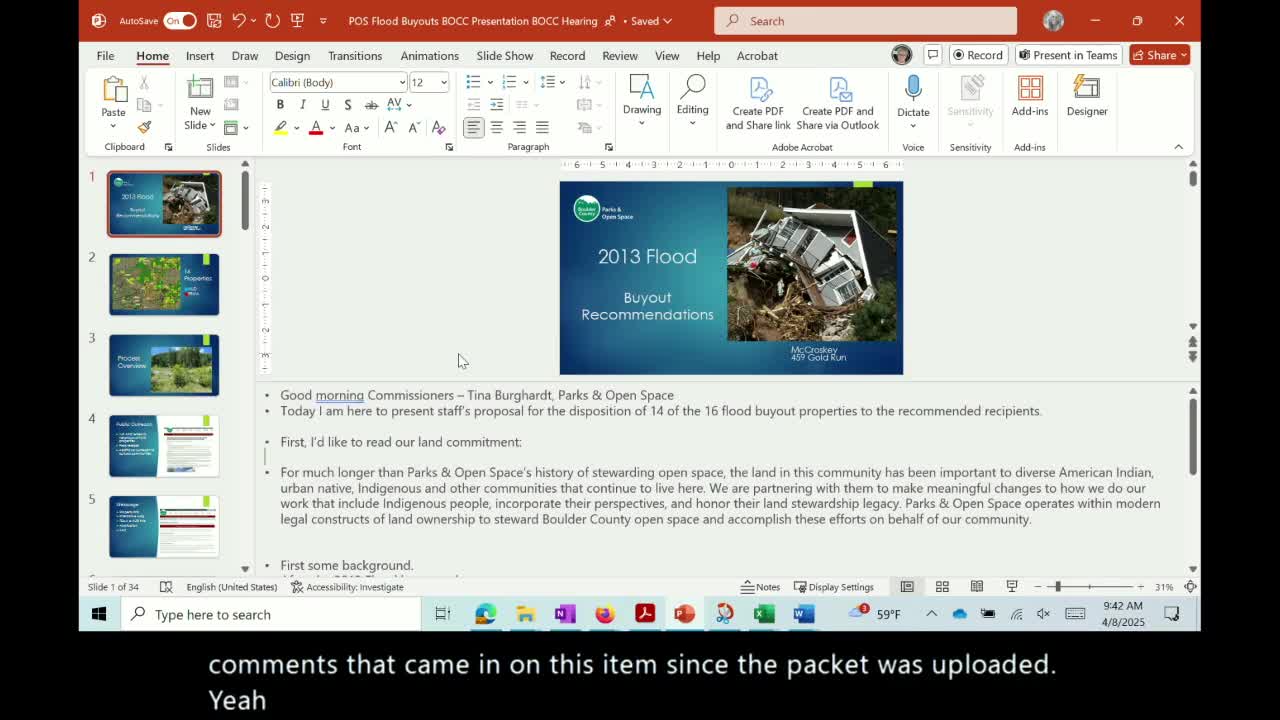
Staff presented the recommendations during a public hearing attended by neighbors, applicants and tribal representatives. Tina Burkhart, Parks and Open Space, told the board, “Today, I'm here to present staff's proposal for the disposition of 14 of the 16 flood buyout properties to the recommended recipients.” She summarized the county’s outreach, application review and legal constraints that shape how the properties can be used.
The applications process ran May 1–June 30; staff said it fielded more than 60 inquiries and received 228 applications, of which staff considered 189 eligible (176 for HUD-funded properties and 13 for FEMA-funded properties). Burkhart and Janice Westman, Real Estate Division manager, explained that FEMA-funded parcels have stricter deed restrictions: they may be conveyed only to public entities or qualified conservation organizations, require FEMA approval for transfers and must be monitored by the county every three years to confirm deed-restriction compliance. Westman said, “The intended use in the application was open space, so that's what the slide is intended to convey,” and reiterated that HUD-funded parcels do not require HUD approval for conveyance.
Staff recommended specific recipients for each parcel. Examples include: the Apache Nation of Colorado as the recommended recipient for several FEMA and HUD parcels (including the Thomas, Pitner and Brown properties), the Center for Snake Conservation for a FEMA parcel on North 83rd Street, the St. Vrain Estates Property Owners Association for two adjacent HUD parcels with flood resilience swales, and Harvest of All First Nations for a HUD parcel along Little Thompson Creek.
The staff memo and presentation noted that many parcels are small former residential lots (the smallest was listed at 0.11 acres; another parcel — the Thomas property — is about 4 acres), that the county initially acquired 45 flood-damaged properties after the 2013 event, and that five of those had already been transferred to municipalities while 10 in the Apple Valley area are set aside for discussions with the town of Lyons.
Public commenters raised concerns about access, trespass, parking and potential uses proposed by applicants. Diane Jones, an adjacent property owner in Canyon Park, told commissioners, “Canyon Park Drive is a private road ... We restrict access to the homeowners and their private visitors,” and asked why the county would not retain the steep, wooded Pitner parcel as open space given adjacent county holdings. Several neighbors near the Little Thompson Creek parcels said vehicular access and increased traffic on a narrow bridge and busy bike corridor were not adequately addressed in applicants’ plans.
Representatives of applicant organizations responded at the hearing. A representative identified himself as David with the Apache Nation of Colorado and said neighbors’ fears about changes were misplaced: “We're not gonna build anything. We're not gonna do anything. There won't be any ceremonies held on any of these properties. … Our approach and our relationship to property is that the property knows what it needs.” He described applicants’ intent as minimal stewardship and access rather than development.
Staff and legal counsel repeatedly emphasized constraints on use and transfer. Westman noted that “all of the flood buyout properties are subject to Boulder County's land use code” and that deed restrictions incorporated into title work — including a wetland mitigation plan referenced in several warranty deeds — limit allowable activity on portions of parcels. Westman and Burkhart also said county monitoring and coordination with Community Planning and Permitting would occur if a new owner sought permits or proposed activity affecting deed-restricted areas.
Commissioners held a brief recess, then convened an executive session citing CRS 24-6-402(4)(a) for real estate matters. After returning to open session, the board discussed both the staff recommendations and broader community questions raised during the hearing about land return to indigenous communities. One commissioner asked staff to explore retaining a subset of the parcels so they could be considered later in a broader tribal-land conversation; that commissioner voted against the final motion.
The motion that carried instructs staff to proceed with the recommended dispositions as presented, subject to deed restrictions and applicable county land-use rules. Westman reminded the board and the public that FEMA approval is still required before any FEMA-funded parcel may be conveyed, and that the county’s conservation-easement stewardship staff will continue periodic monitoring.
Votes at a glance - Disposition of the 14 flood-buyout parcels per staff recommendations: Passed, 2–1 (two ayes, one no). The no vote was cast by a commissioner who asked that the board consider retaining more parcels for a broader tribal-land strategy. - Additional actions on the April 8 consent agenda (recorded during the meeting): appointments to advisory boards and ratification of a NOFA grant signature for rapid rehousing (see Actions section below).
What this means now No FEMA-funded conveyance can proceed until the county obtains FEMA's approval of the recommended recipient for that parcel. County staff will continue title work, deed‑restriction review and step-up coordination with Community Planning and Permitting and the county’s conservation-easement stewardship team to monitor and enforce restrictions over time. Commissioners also signaled they want a separate, broader conversation about tribal land needs and possible county roles in land return and stewardship.
The board’s decision moves multiple parcels from county flood-buyout inventory toward community or organizational stewards but leaves open the timing and details of individual transfers while legal approvals and monitoring frameworks continue.