Get Full Government Meeting Transcripts, Videos, & Alerts Forever!
Get email alerts on the Climate topic
No spam. Unsubscribe anytime.
Oberlin sustainability coordinator reports progress on 2019 climate action plan; new 2025 plan to integrate adaptation and equity
Summary
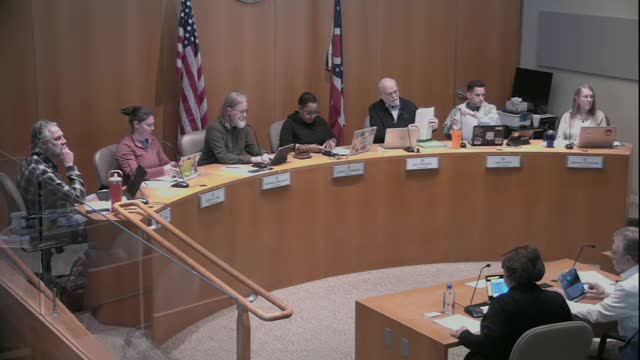
Linda Arbogast, Oberlin’s sustainability coordinator, updated council on March 17 on progress since the city’s 2019 Climate Action Plan and the work underway to produce a 2025 plan that will pair carbon reduction with climate adaptation and social equity.
Linda Arbogast, Oberlin’s sustainability coordinator, updated council on March 17 on progress since the city’s 2019 Climate Action Plan and the work underway to produce a 2025 plan that will pair carbon reduction with climate adaptation and social equity.
Arbogast told council the city’s electric grid is about 85% renewable and the city purchases offsets for the remainder so electricity use is effectively largely renewable. She said a 2021 greenhouse‑gas inventory showed emissions down about 50% from the 2003 baseline when accounting for the city’s grid purchases.
"So that that's pretty big," Arbogast said, explaining that natural gas still dominates the city's emissions profile and that commercial gas use is the largest single source. She added, "70% of our emissions, well, natural gas makes up 70% of our emissions total."
Nut graf: The 2025 plan will incorporate vulnerability and adaptation work completed since 2019, include community partners, and expand sector coverage to water, energy, economy, food, waste, education, transportation, land use and housing — with a consultant and a volunteer committee conducting interviews and data collection.
What the update covered
- Renewable energy and buildings: The city reported a high renewable fraction on the local grid, a K–5 school solar array funded by SRF money, and building efficiency work with Efficiency Smart.
- Transportation: Arbogast described a new electric bus route and a growing electric car‑share program now offering four shared cars for residents and students.
- Waste and materials: A residential and commercial compost program serves about 500 residents; the city now uses a glass crusher in public works projects.
- Vulnerability and adaptation: A climate vulnerability assessment and an 18‑month task force produced a report and prompted initiatives such as community cooling stations during hot summers.
- Emissions inventory and focus areas: Arbogast reported that commercial (business/industry) energy use accounts for roughly half of emissions, with transportation and residential following. She emphasized commercial gas use and residential gas as priority areas.
Council questions and context
Council Member McFarland asked whether the projected temperature increases shown in the assessment are "baked in." Arbogast replied, "Those temperatures are baked in," meaning short‑term near‑term increases are expected regardless of immediate local action, and stressed the value of Oberlin’s work as a model for other cities.
Council Member Lopez asked whether Oberlin looks to any single city as its model; Arbogast said multiple Ohio communities have useful practices but no single municipality exactly matches Oberlin’s context.
Arbogast also announced a $100,000 youth climate action grant program (youth 15–24) and a public session at Oberlin Public Library on April 2 at 6 p.m. to help applicants develop project ideas.
Ending: Arbogast asked council to continue integrating climate considerations into routine decisions and noted the 2025 plan will explicitly integrate equity with carbon reduction and adaptation measures.