Get Full Government Meeting Transcripts, Videos, & Alerts Forever!
Get email alerts on the Homelessness topic
No spam. Unsubscribe anytime.
Business owners raise safety, enforcement and Good Neighbor Agreement concerns over Project Homeless Connect operations; councilors discuss limits of city role
Summary
A downtown business owner urged the Hillsborough City Council on March 18 to clarify what consequences would apply if Project Homeless Connect failed to meet the terms of a proposed Good Neighbor Agreement, citing safety and parking problems near a temporary site.
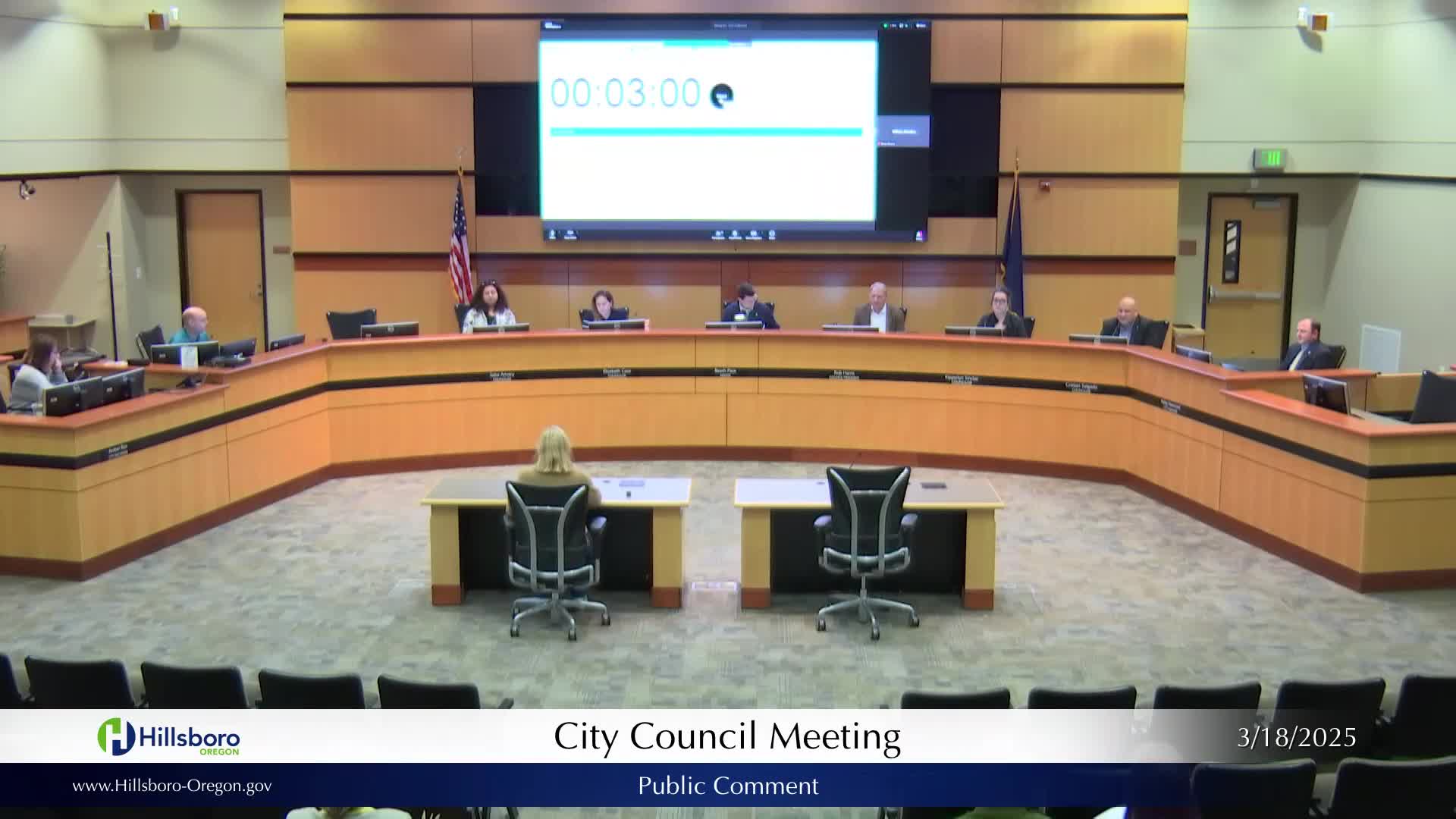
HILLSBOROUGH, Ore. — During the March 18 City Council meeting’s public-comment period, a downtown business owner urged councilors to spell out what consequences — if any — would apply if Project Homeless Connect (PHC) did not follow terms of a proposed Good Neighbor Agreement.
Kathy Miller, who identified herself as a local business owner, told the council she and other downtown merchants were concerned about safety, traffic and parking around the downtown site and the interim Yellow House operation. “We pay our taxes, our city licenses and everything, but there's no consequence for PHC if something goes wrong,” Miller said. She asked whether the city planned to withdraw funding, relocate the operation, or otherwise help businesses with security. She also suggested the city restrict parking on Sixth Avenue between Oak and Baseline to reduce conflicts.
Nut graf: Miller’s remarks prompted an extended council discussion during the work session about the city’s role in neighborhood agreements and the limits of municipal authority over privately negotiated “good neighbor” arrangements and county-run shelter operations. Staff said the city may provide support and facilitation but is not generally a party to private agreements between a service provider and neighboring property owners.
City staff answered questions from councilors during the work session and noted earlier outreach on the permanent year-round shelter being developed with county and regional partners; staff said the city will assist Washington County with neighborhood engagement around the new shelter but that the county will lead operator selection and front-line outreach for the year-round facility. Staff also described the Good Neighbor draft as a private agreement prepared by Project Homeless Connect and nearby businesses; the city does not enforce private agreements, they said, but residents and businesses remain able to contact the police for criminal activity or to request follow-up from county partners.
Councilors acknowledged the businesses’ concerns and asked staff to provide background on earlier episodes around the temporary shelter on Tenth Avenue, where some councilors said complaints and police responses led to tension between businesses and the shelter operator. Councilors also discussed whether homelessness and related neighborhood impacts should be elevated as a separate council priority; staff agreed to return with focused recommendations and background, and to include historical context about prior Tenth Avenue shelter impacts as requested.
Ending: Staff said they will compile a chronology of prior shelter-related neighborhood complaints and responses for council review, and reiterated that mediation or Good Neighbor Agreements between private parties do not create city-enforceable penalties; the city can, however, continue to participate in outreach and to coordinate with county and law-enforcement partners.