Get Full Government Meeting Transcripts, Videos, & Alerts Forever!
Get email alerts on the Climate Action Ghg topic
No spam. Unsubscribe anytime.
Hillsborough presents greenhouse gas inventory and draft mitigation measures; adoption targeted for fall
Summary
City sustainability staff presented a community greenhouse gas inventory (2.9 million metric tons CO2e), modeling that projects substantial emission reductions under state policies but shows additional local measures are needed. Staff outlined 17 mitigation strategies and a timeline to finalize a Climate Action Plan this year.
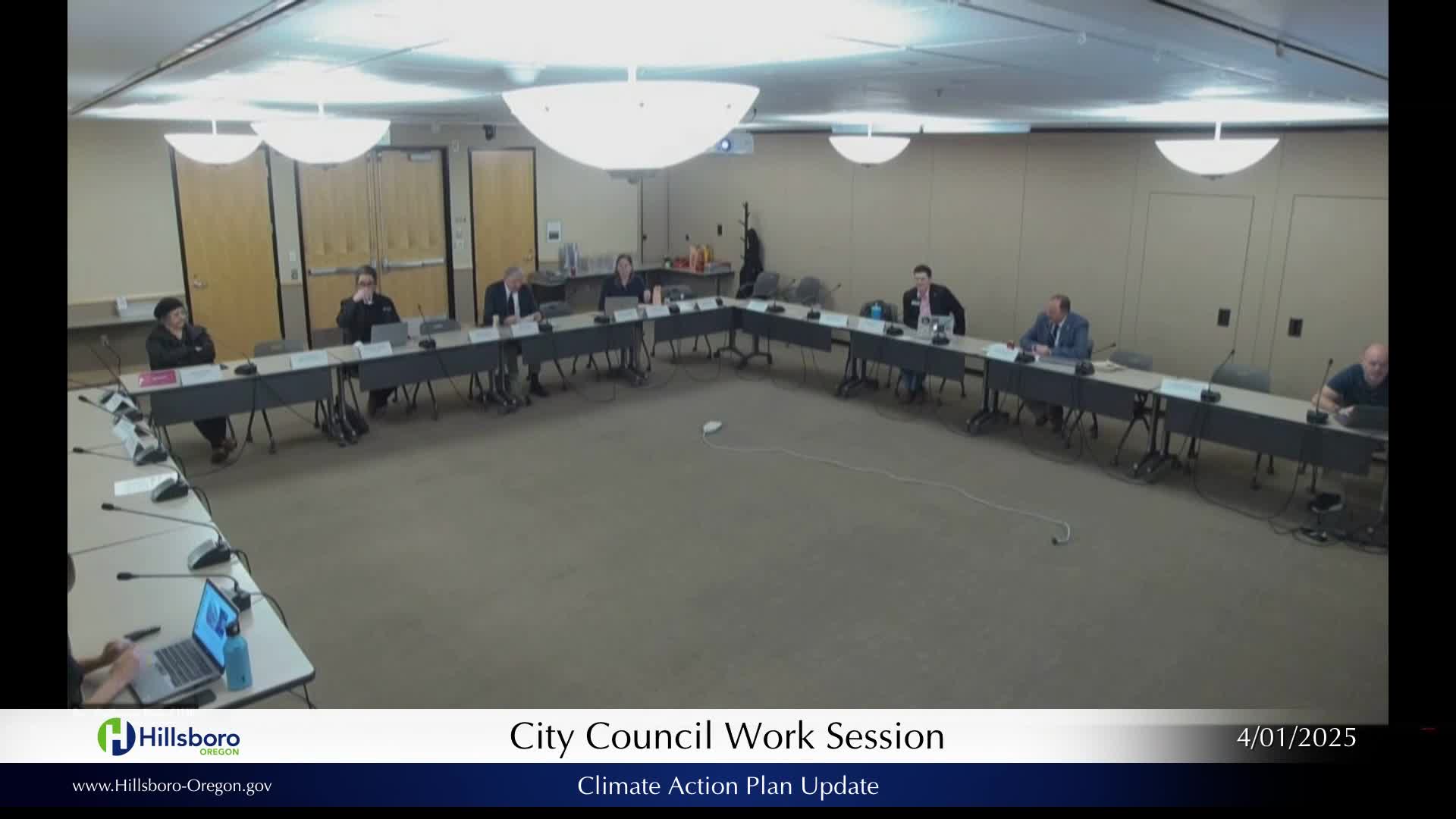
The City of Hillsborough gave a detailed Climate Action Plan update during the April 1 meeting, including a community greenhouse gas inventory, modeled emission projections and a summary of draft mitigation measures designed to cut local emissions over the next 25 years.
Robin Strahan, the city’s sustainability and resiliency manager, told councilors the community inventory counts roughly 2,900,000 metric tons of carbon dioxide equivalent (CO2e) and that the largest locally generated emissions come from building energy (electricity and natural gas) and transportation. “A metric ton of CO2 is equivalent to 1 car driven 2,500 miles,” Strahan said while explaining the CO2e metric.
Strahan summarized state policy impacts modeled in the inventory: the state requires electricity sector emissions to fall to zero by 2040, which substantially reduces projected building‑energy emissions, and the state's climate protection program will reduce natural gas and other stationary fuel emissions. The city’s forecast projects local emissions falling by more than 70 percent by 2050 under these assumptions, but Strahan said that even with those statewide reductions “that’s still not enough to hit the 2050 target,” and the city modeled additional local mitigation measures to close the gap.
Parametrix consultants and city staff have analyzed 17 candidate mitigation strategies. Measures with the highest modeled potential include: increased residential energy‑efficiency permitting and incentives, actions to boost transit ridership, switching community fleets and heavy equipment to renewable diesel, programs to reduce food waste and expanded reuse/repair initiatives, plus incentives for rooftop solar plus battery storage. Strahan said stakeholders identified consumption and transportation as sectors with the most potential for additional reductions. The city also reported more than 100 public electric vehicle charging ports in the community, largely Level 2 chargers with a small number of Level 3 fast chargers for fleet and a public Level 3 at the Civic Center.
Staff outlined next steps: a resilience and vulnerability assessment now underway, a stakeholder resiliency workshop planned for May, community outreach and a targeted plan adoption timeline aimed at fall 2025. Strahan noted existing climate work already in place — a Solarize Hillsborough and Cornelius campaign, an energy efficiency grant program for income‑qualified residents, an urban‑forester hire and a community wildfire protection planning effort — and said the Climate Action Plan will align city operations goals with community mitigation and adaptation strategies.
No adoption vote was held April 1; staff said they will return with a final plan and implementation commitments later in the year.