Get Full Government Meeting Transcripts, Videos, & Alerts Forever!
Get email alerts on the Economic Development topic
No spam. Unsubscribe anytime.
Hillsborough economic development team highlights semiconductors, bioscience, data centers and incentives in Hillsborough 101 briefing
Summary
City economic development staff and consultants summarized Hillsborough’s target industries—computer electronics/semiconductors, bioscience, advanced manufacturing and software—outlined workforce programs and small-business supports and reviewed enterprise zone and urban renewal incentives during a March 18 work session.
HILLSBOROUGH, Ore. — City economic development staff and outside presenters on March 18 briefed the Hillsborough City Council on local industry concentrations, workforce initiatives and incentive programs the city uses to recruit and retain firms.
The session, billed as “Hillsborough 101 — Economic Development,” listed four target industry clusters: computer electronics (including semiconductors), biosciences and medical devices, advanced manufacturing, and software and information technology. Jim Riley, a presenter for the session, said Hillsborough’s technical workforce is unusually concentrated: “Hillsborough has almost 28 times the national average of semi processing technicians,” he said, adding the city “is well above the national average” for total tech job concentration.
The city and its partners also highlighted data-center infrastructure. Riley noted Hillsborough has multiple categories of data centers and “about 15” data-center companies in the city, plus fiber “daylighting” where undersea cables connect onshore. Val Okada, who identified herself as being with the economic development department, told councilors that cable daylighting and a robust local fiber ring help reduce latency and are a recruitment advantage.
Nut graf: City staff framed the briefing as a mix of promotion and pragmatic planning — showing private-sector strengths, describing workforce pipelines and the incentives that support industrial investment — and asked the council for direction on priorities the city should emphasize as staff draft the budget for the coming year.
The presentation described workforce and training work the city supports. Val Okada and other presenters said Hillsborough facilitates industry–education partnerships and convenes Amtech, a local consortium of roughly 40 companies and education partners, including the Hillsborough School District and Portland Community College. Ken Christian, who spoke about small-business supports, said the city contracts with community organizations to provide targeted technical assistance; the slide deck cited about $412,000 in aggregate city contracts supporting that network.
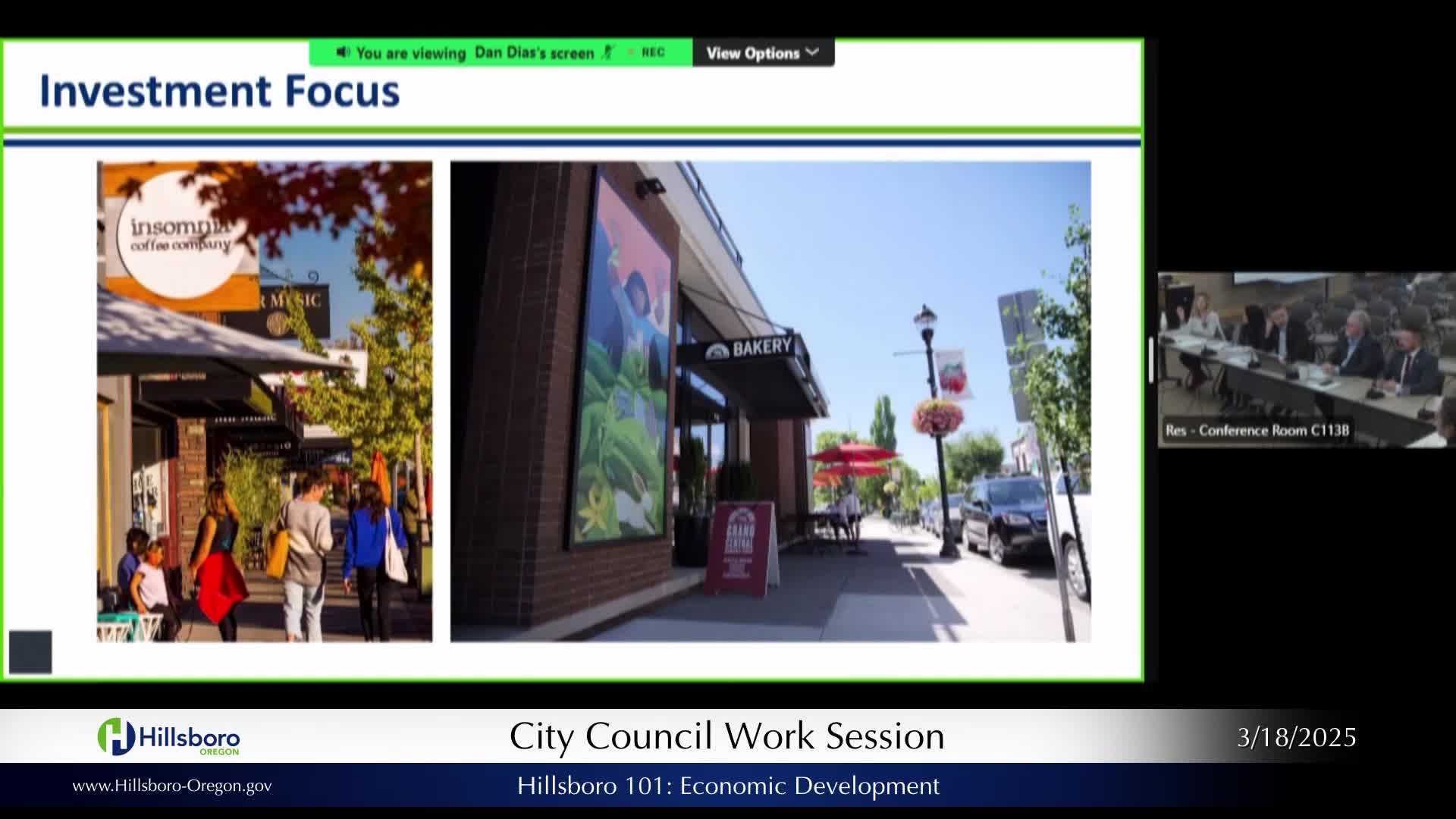
On incentives and sites, presenters reviewed the Hillsborough Enterprise Zone program and urban renewal activities. Staff said there are 45 active enterprise-zone applications with projected qualifying investment “over $9.5 billion,” about 3,000 associated jobs, average compensation shown on the slide as about $121,000 and a median compensation of about $103,000. City staff said the enterprise-zone program also funds a community-service fee used for workforce development and local programming. Carla Antonini, who said she works on downtown revitalization for the city, reviewed downtown urban renewal tools including storefront and tenant-improvement grants (a $40,000 maximum grant was described) and reported the downtown urban renewal district generated about $2,600,000 in tax increment in 2024.
Small-business and downtown supports were described in detail. Christian said the city funds a range of nonprofit programs — Adelante Mujeres, the Washington County Chamber small-business services, TiE/Thai Oregon-led entrepreneur supports, Central Cultural education, and others — and highlighted the Westside Pitch Competition scheduled for May 8. Antonini described downtown grants and programs: storefront matching grants (up to $40,000) and tenant-improvement grants; she said the city has approved 22 tenant-improvement grants since 2020. City staff also reviewed public–private projects the city helped seed, including a predevelopment matching grant and later a $670,000 rehabilitation grant for the Main Street Commons redevelopment.
On site readiness and infrastructure, presenters emphasized a continuing need for development-ready industrial land and for near- and long-term infrastructure capacity. Okada said, “A robust industrial land supply that is development ready and in a variety of sizes increases our competitive advantage.” Councilors and staff discussed how Hillsborough’s competitiveness competes with other regions and the importance of aligning local, regional and state efforts.
The presentation included an overview of workforce training grants supported by the enterprise zone’s community-service fee: a “customized job training grant” to reimburse training costs for new hires and a program to reimburse incumbent-employee skill training. Presenters also described the city’s downtown event programming, arts investments and a newly launched translation service (Wordly) for council meetings to improve inclusion.
Ending: City staff said they will take council feedback into account as they finalize the next budget; presenters asked councilors to email any in-depth questions so staff can reply with additional detail. The council did not take formal action on the briefing; staff said the slides would be distributed to councilors and posted online.