Get Full Government Meeting Transcripts, Videos, & Alerts Forever!
Get email alerts on the After School Programs topic
No spam. Unsubscribe anytime.
City funding keeps Champions after‑school scholarships running; council approves $400,000 amendment on consent agenda
Summary
The city has provided roughly $1.2 million since 2021 to subsidize the Hillsborough School District’s Champions after‑school program. City and district officials described the program’s meals, enrichment and scholarship structure and noted the council approved a $400,000 contract amendment on the consent agenda to continue scholarships.
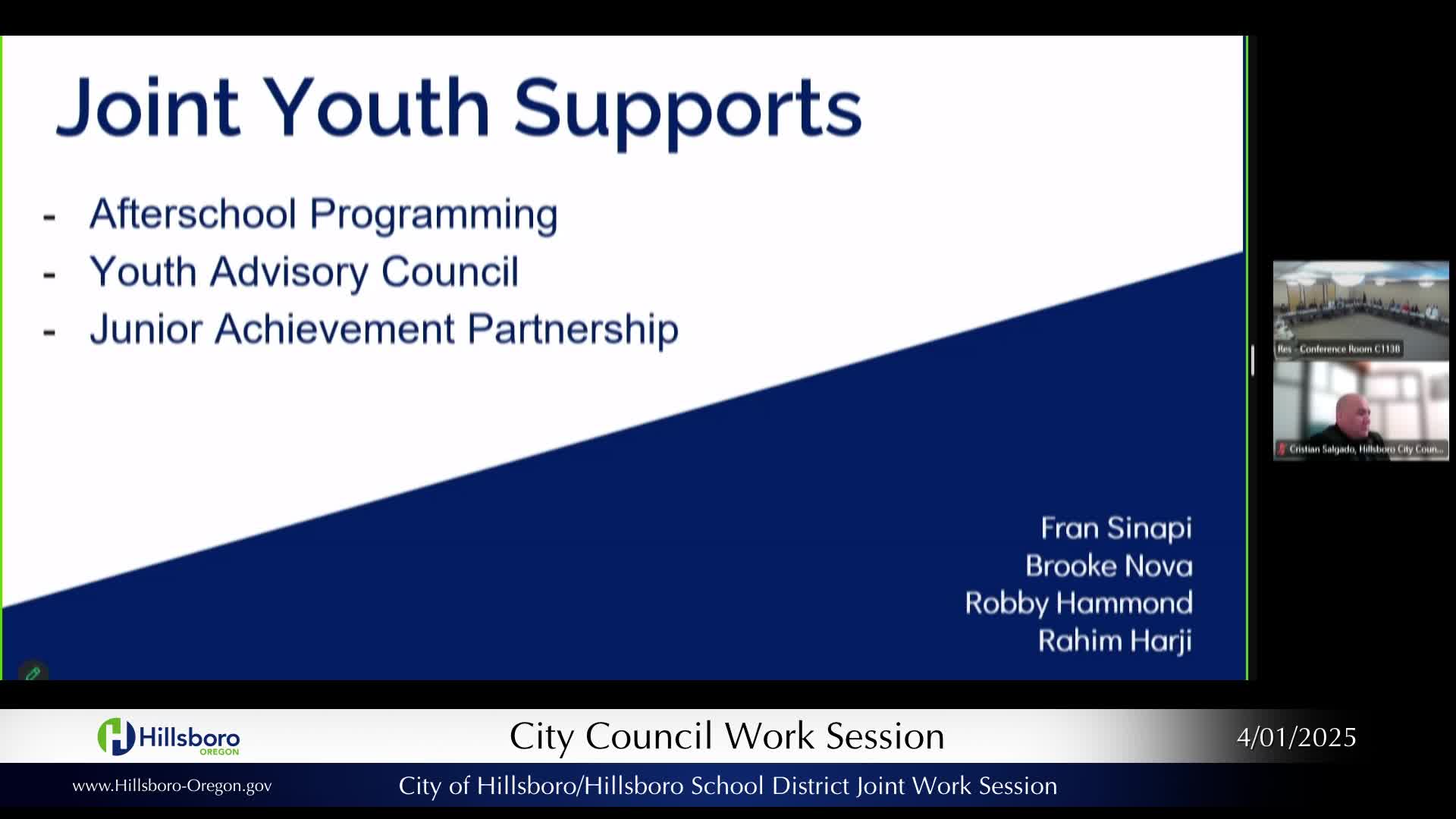
Hillsborough city and school district leaders told a joint meeting April 1 that the city has provided about $1,200,000 since 2021 to support after‑school programming delivered by the Hillsborough School District and its Champions partner, and councilors approved a $400,000 contract amendment on the consent agenda to sustain scholarships.
City Manager Robbie Hammond summarized the funding history during the joint session: “We have provided about 1,200,000.0 since 2021 towards, after school programming, and we're about to approve $400,000 tonight.” The $400,000 figure was listed as an amendment on the city council’s consent agenda, which passed by roll call later in the meeting.
District officials described how the Champions program operates. Franchesca Sinappi, equity access and engagement officer for the Hillsborough School District, said families asked for an extended‑day model that provides a meal and enrichment activities rather than traditional “day care.” Students receive a meal after school and then participate in school‑based enrichment (art, cooking, chess, sports clubs) followed by Champions‑led activities. Sinappi said the program’s aim is to extend and enrich the school day and to support academic gains: in a small sampling of students tracked from third to fifth grade, she said participants reached or exceeded grade‑level reading benchmarks.
Sinappi outlined the program’s scale and eligibility: the district uses a sliding fee scale with full and partial scholarships; ten sites are covered by the city‑funded scholarships out of 27 district sites. She described site capacity as typically 40 students and expandable to 60 with additional staffing, and said the program serves a mix of private‑pay and scholarship students. The district’s nutrition services provides meals; Superintendent Travis Reimann and Sinappi emphasized the district’s broader nutrition program, noting the district currently qualifies for the federal Community Eligibility Provision (CEP) so every student receives meals at school without individual free/reduced applications.
District and city officials said the Champions partnership was created using American Rescue Plan Act (ARPA) and ESSER funds early in the pandemic era and later sustained through city scholarship funding. Staff cautioned that some federal pandemic funding streams have ended and the district is seeking grants and other revenue to sustain capacity.
Councilors asked about the program’s reach, food partnerships and capacity; district staff said outreach is ongoing and many community food and faith‑based partners support meal distribution and weekend backpack programs. City and district leaders said they will continue to pursue grant opportunities and evaluate scholarship funding as part of the next budget cycle.
Votes: the city council approved the consent agenda — which included the $400,000 amendment to continue scholarships — by unanimous roll call. No separate council ordinance or separate substantive policy change was made about the Champions program during the meeting; the funding amendment was handled on the consent calendar.