Get Full Government Meeting Transcripts, Videos, & Alerts Forever!
Get email alerts on the Energy Infrastructure topic
No spam. Unsubscribe anytime.
Hall County tables rezoning request for Clean Eagle RNG natural gas injection facility until April 8
Summary
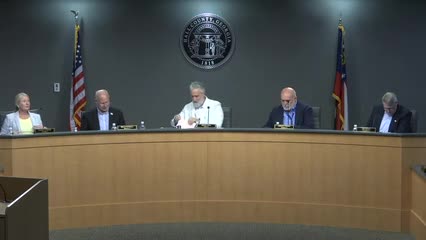
The Hall County Board of Commissioners on March 27 tabled a rezoning request for Clean Eagle RNG LLC’s planned industrial development, which the applicant says would accept compressed methane trucked from a Forsyth County landfill and inject it into the county’s natural gas pipeline; the board set the item for further consideration on April 8.
The Hall County Board of Commissioners on March 27 tabled a rezoning request from Clean Eagle RNG LLC for a planned industrial development on a 22.45-acre tract at 4212 Roy Parks Road until the board's April 8 voting meeting.
The rezoning would convert property zoned Agricultural Residential-4 and Highway Business to a planned industrial development to permit a natural gas injection facility that the applicant says would accept compressed methane transported from a Forsyth County landfill and inject that gas into the local pipeline. Planning staff told the board the Planning Commission had recommended denial; the applicant asked the board to remove the item from the table and then requested additional time instead, and the board granted the request.
Why it matters: Liberty Utilities officials and the applicant described the project as a supply-side fix for winter-day curtailments that affected industrial customers on the county's gas distribution network. Supporters said the site would provide a guaranteed volume of gas dedicated to Gainesville customers and help avoid higher commodity costs from buying additional interstate capacity.
Attorney Steve Gilliam, speaking for the applicant, described the site plan as a roughly 6-acre facility footprint for the injection infrastructure with the remainder of the 22.45-acre tract to remain undeveloped and wooded. Gilliam said the project is not a landfill processing operation: “This is not a waste related recovery facility. There's no processing, no combustion, no pollutants or landfill gas recovery. All of that takes place in Forsyth County, and then is brought over… into the trucks, and then injected into the facility.”
Clint Cox, representing Liberty Utilities, told commissioners the system needs additional dedicated supply to avoid curtailing large industrial customers in cold-weather peak demand: “Principally, because we need this gas. Gainesville needs this gas, for continued growth and economic development.” Cox said Liberty plans transmission and distribution upgrades over the next three years (including replacing portions of the transmission line and upsizing laterals) but that access to additional molecules is currently constrained on the interstate pipeline, making local dedicated supply attractive.
Project operations and truck routing were described by Ryan Albaachon, who identified himself as the project manager for Arkea Energy. He said the company proposed blackout hours when trucks would not operate — specifically school bus periods and Sunday church times — and estimated about 13 loaded truck trips per day for injection activities with additional trucks possible for emergency response. Albaachon also offered operational limits to reduce daytime church- and school-period traffic.
Commissioners asked for supporting documentation and demonstrated caution before approving the rezoning. One commissioner asked for the emails and letters the applicant said it had sent to 31 customers who had been notified of possible curtailment; the applicant agreed to provide those. Multiple commissioners noted there is only one comparable, larger facility in South Dakota and asked for more evidence, including the possibility of a site visit, before acting. After discussion the board approved a motion to table the item to the April 8 voting meeting so staff and the applicant could supply additional information and proposed conditions.
The matter was tabled to April 8; the applicant used its public-hearing time to present and agreed to follow up with requested documentation and proposed operating conditions.