Get Full Government Meeting Transcripts, Videos, & Alerts Forever!
Get email alerts on the Utilities Rates topic
No spam. Unsubscribe anytime.
Consultants present preliminary water and sewer rate findings; recommend phased 4% annual increases
Summary
Consultants from NewGen Strategies presented a preliminary water and wastewater rate study to Kent County commissioners, recommending phased annual increases (the firm used 4% as a baseline) and new reserve targets to cover operating, capital and a large wastewater program tied to a planned Millington treatment plant.
Consultants from NewGen Strategies told Kent County commissioners on the record that the county’s water and wastewater systems will require rate changes and explicit reserve-building to meet near-term capital needs and long-term maintenance.
Mike Maker, the consultant, said the firm modeled operating cost escalation at about 3% annually, assumed modest customer growth (about 2% per year for water and 1% for sewer) and separated recurring operating needs from capital. Maker identified the county’s capital program—particularly a planned Millington wastewater treatment plant—as the largest driver of future rate pressure and said the Millington project would create a one-time customer bump in 2028 and a much larger multi‑year spending profile for sewer projects.
Maker said the firm’s recommendations include two reserve targets: an operating reserve of at least 90 days (about 25% of operating expenses) and a capital reserve equal to roughly 2% of fixed asset value. He described the capital‑reserve target in dollar terms as about $3,035,000 per year for water and about $130,000 per year for sewer, based on asset valuations the firm used in the model.
On proposed rate action, Maker said the team’s baseline recommendation is a phased 4% annual increase in both user rates (recurring charges) and allocation fees (one‑time connection charges), with the allocation fees phased in annually rather than implemented all at once. He said an alternative scenario — 8% annual increases — would reduce future general‑fund subsidies, “and because of compounding the 8% scenario materially lowers future subsidy needs.” The consultant showed an illustrative household example: a quarterly bill for 12,000 gallons rising by about $13.50 under a 4% change.
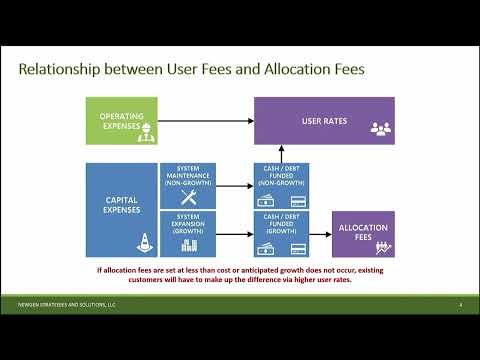
Maker explained the distinction the consultants used in the model: operating and non‑growth capital should be paid from user rates, while growth‑related capital is best funded with allocation fees, grants or developer contributions. He warned that if allocation fees are set below the cost of capacity and the anticipated growth does not arrive, remaining costs could fall back onto user rates and the general fund.
Commissioners and staff asked questions about alternative rate paths, the timing of the Millington plant, and whether the county could rely on grants to reduce the debt portion. Maker said the CIP for water is mostly cash‑funded replacements (PAYGO), while the sewer CIP anticipates larger debt funding; the top scale on the sewer chart he showed was about $12 million, versus $1.6 million for water projects in the same year.
The presentation did not include any formal decision; commissioners indicated the study will inform FY2026 budget deliberations and that final rate choices will be decided later as part of the budget process.
Ending: County staff and the consultant agreed to run follow‑up scenarios if the board requests different percentage increases, and to supply any extra detail commissioners want as they finalize the fiscal‑year 2026 budget.