Get Full Government Meeting Transcripts, Videos, & Alerts Forever!
Get email alerts on the Public Safety Training topic
No spam. Unsubscribe anytime.
Fife police outline 25-week leadership certificate, seek local cohort and tuition partnership
Summary
Fife Police Chief and Assistant Chief presented a new leadership-development plan centered on a 25-week certificate program from the University of Charleston; councilmembers asked about costs, staffing and funding.
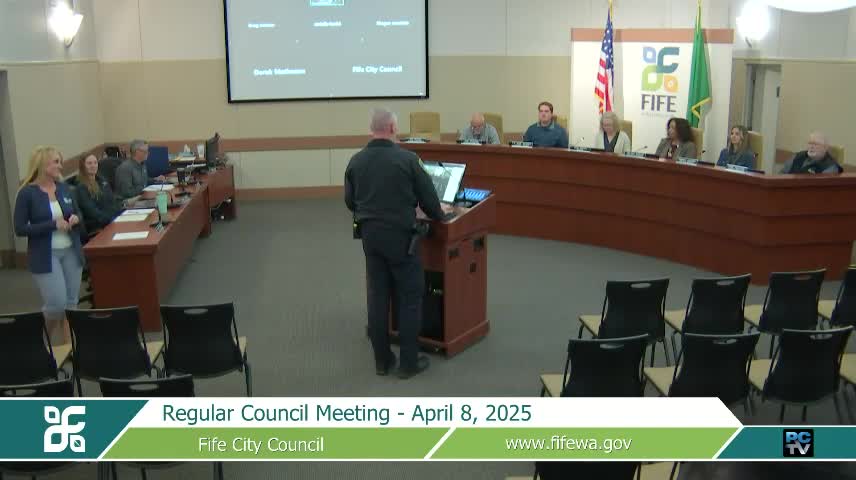
Fife Police Chief Fisher and Assistant Chief Newman told the Fife City Council on April 8 that the department is pursuing a local, credit-bearing leadership certificate program to expand promotion-from-within and training options for sworn and civilian staff.
The proposal centers on a 25-week, cohort-style certificate offered by the University of Charleston that would meet one evening per week. Assistant Chief Newman said the program is designed to produce credits that transfer into a bachelor’s or graduate track: “The maximum transferable credits is 90 credits,” he said, noting the school’s 120-credit bachelor’s requirement. Newman also read the department’s advertised minimums for command positions: “Minimum requirements include bachelor's degree in criminal justice, public administration, or related field with a graduate degree preferred,” language he said appears in the job announcement for the assistant chief position.
Why it matters: department leaders framed the effort as part of a broader retention and succession plan. Newman said the program is intended to combine “horizontal” technical training with “vertical” leadership development—emphasizing soft skills, political awareness and emotional intelligence for supervisors who must operate in what he called “VUCA” environments. He defined that acronym for the council as “volatile, uncertain, complex, and ambiguous environments.”
Program details and cost: Newman described an articulation agreement under discussion that would give public-safety students a roughly $250-per-credit discount and preferred admission with a dedicated advisor. He said the certificate costs about $5,700 per student before negotiated discounts and that the university has offered roughly a $1,200-per-student reduction for a Washington-only cohort. Staff emphasized the certificate uses a cohort model (one evening per week, recorded sessions if someone is called away) so it would not require a 10-week absence from duty as some national command courses do.
Funding and staffing questions: Councilmembers asked how the city would pay for participation and whether time in the program counted as compensable work time. Chief Fisher and Assistant Chief Newman said the department intends to treat the one evening per week as compensable time similar to other required training, and that initial enrollments would be funded from existing training budgets where possible. Newman said the city’s educational assistance policy exists but that department budgets would need to fund new incentives unless outside grants or state-level partnerships are obtained.
Interest and next steps: Newman said several staff have already expressed interest: “We now have 3 sergeants that are already talking to the school about matriculating to finish their bachelor's degree,” he told the council. The department reported it had an articulation agreement draft under review by the city attorney and planned to pursue a Washington-only cohort first; Newman said the chief supports sending the memorandum for attorney review this week. He also said the department is presenting the idea to Pierce County and statewide associations to build momentum and potential outside funding.
Council response: Councilmember Gathers described the plan as “phenomenal” and asked whether instruction would be in-person; Newman said the program would be live, cohort-based and could be delivered remotely to a central location in the region with a live instructor. Deputy Mayor Murphy and other councilmembers asked specifically about fiscal impact, accreditation, and whether credits would be regionally accredited; staff said the University of Charleston is a brick-and-mortar institution offering regionally transferable credits and that they were taking accreditation concerns into account.
What’s next: staff will finalize the articulation agreement for attorney review, continue outreach to Pierce County partners and report back to council about funding options and cohort timing.