Get Full Government Meeting Transcripts, Videos, & Alerts Forever!
Get email alerts on the Housing Infill topic
No spam. Unsubscribe anytime.
Bellingham council adopts interim ordinance to allow middle housing citywide, adds state FAR table
Summary
The Bellingham City Council adopted an interim zoning ordinance March 24 to expand the city's infill toolkit and allow up to four units per lot — with a fifth and sixth unit allowed if they meet state affordability requirements — and amended floor area ratio rules to match the state's model code for the interim period.
Bellingham City Council on March 24 adopted an interim zoning ordinance to expand the city’s “infill toolkit,” allowing middle-housing forms — including duplexes, fourplexes, townhomes and stacked flats — in areas zoned predominantly for residential use and updating maximum floor area ratios (FAR) for the interim period.
The ordinance applies the infill provisions citywide, excluding properties within Bellingham Municipal Code chapter 16.8 (Lake Whatcom Reservoir regulatory provisions). Planning and Community Development Director Blake Klein told the council the proposal would allow “up to 4 units per lot with the potential for a fifth or sixth unit, if affordable, as defined by the state.” The council voted to incorporate the state model-code FAR table into the interim ordinance and then voted to adopt the ordinance with that amendment.
Why it matters: The action is an early, local implementation of state housing changes enacted after the 2023 legislative session. Under state law tier‑1 cities (those over 75,000 population) must implement the model middle‑housing code by June 30, 2026. The council said the interim ordinance aims to accelerate additional housing options, preserve predictability for developers and create more choices for residents who cannot afford detached single‑family homes.
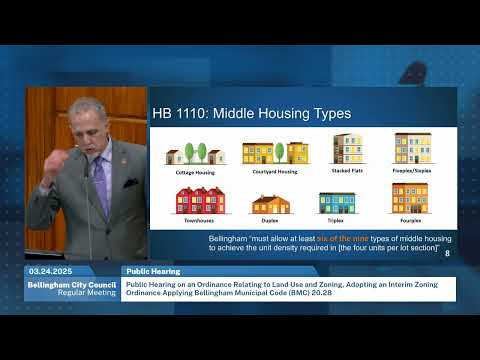
What the ordinance does: The ordinance makes the infill toolkit permissive in most residential zones (does not remove existing allowable uses), clarifies how FAR and per‑unit size limits operate (the more permissive of the FAR or a size limit applies), and exempts properties governed by Lake Whatcom watershed rules. The city’s packet and staff presentation state the ordinance implements at least six of the nine housing forms enumerated in the state law and preserves accessory dwelling units (ADUs) as an option.
FAR and unit counts: Staff used a 5,000‑square‑foot lot as the reference example. Under the adopted interim approach the FAR table tied to unit density follows the state’s model code (the council voted to insert the state table into the interim ordinance). Staff explained FAR as a three‑dimensional control of bulk and noted setbacks, height limits and other standards remain applicable. The staff report and presentation included example FAR values used in the existing infill toolkit (0.35 for small‑lot, 0.6 for several types, 0.75 for townhomes) and illustrated how unit count and FAR interact on a typical lot.
Public reaction at the hearing: Eleven speakers signed up for the public hearing. Public testimony included developers and residents who supported the ordinance as a tool to increase housing supply, several housing advocates urging the council to move early on middle housing and concerns from tenants and tenant‑advocacy groups about displacement, habitability and the need for stronger incentives for deep affordability. Colschen Community Land Trust Executive Director Rose Lathrop said the trust “strongly support[s] allowing middle housing citywide” and highlighted potential synergy with the multifamily tax exemption. Tenants advocates urged that retention, habitability enforcement and anti‑displacement protections accompany new development.
Council debate and votes: Councilmember Littlequist moved to amend the draft interim ordinance to use the state model‑code FAR table; Councilmember Stone seconded. The amendment passed on a preliminary voice vote (recorded by the council as 5–2). Council then moved to adopt the ordinance with the FAR amendment; that adoption passed unanimously in the roll call recorded on the final motion, 7–0.
Next steps and implementation: Staff said the ordinance will be followed by additional outreach and a Type 6 legislative process to refine permanent rules before the state’s June 30, 2026 deadline. Staff also flagged technical work ahead: aligning the multifamily tax exemption and other incentive programs with the adopted middle‑housing forms, clarifying how the city will treat existing homes converted to multiple units (staff said the net‑new units will be the basis for affordability triggers), and testing practical application of the state FAR table during the interim period.
Quotes: “We would move forward in there… to expand those opportunities, citywide,” Planning Director Blake Klein said, summarizing the staff recommendation to apply the infill toolkit across residential zones.
Taper: Council and staff emphasized that the interim ordinance is a temporary, testable step and that more detailed code work will follow during the permanent ordinance process. Staff asked council to consider additional refinements, including how the adopted FAR interacts with tree‑preservation, transition zones and waterfront/urban‑village design standards.