Get Full Government Meeting Transcripts, Videos, & Alerts Forever!
Get email alerts on the Land Use topic
No spam. Unsubscribe anytime.
Washougal staff recommend land-use Alternative 1; council schedules April hearings
Summary
City staff told the Washougal City Council that Alternative 1 — which concentrates new housing in downtown and the waterfront — meets county population and jobs allocations and poses fewer traffic and infrastructure risks than Alternative 2. Staff will bring a public hearing to council April 14 after a Planning Commission hearing April 8.
Washougal city planning staff recommended the city adopt “Alternative 1” as the preferred land-use alternative for the update to the comprehensive plan, saying it meets county and state allocation targets and poses fewer infrastructure and traffic risks than the denser, job-focused Alternative 2.
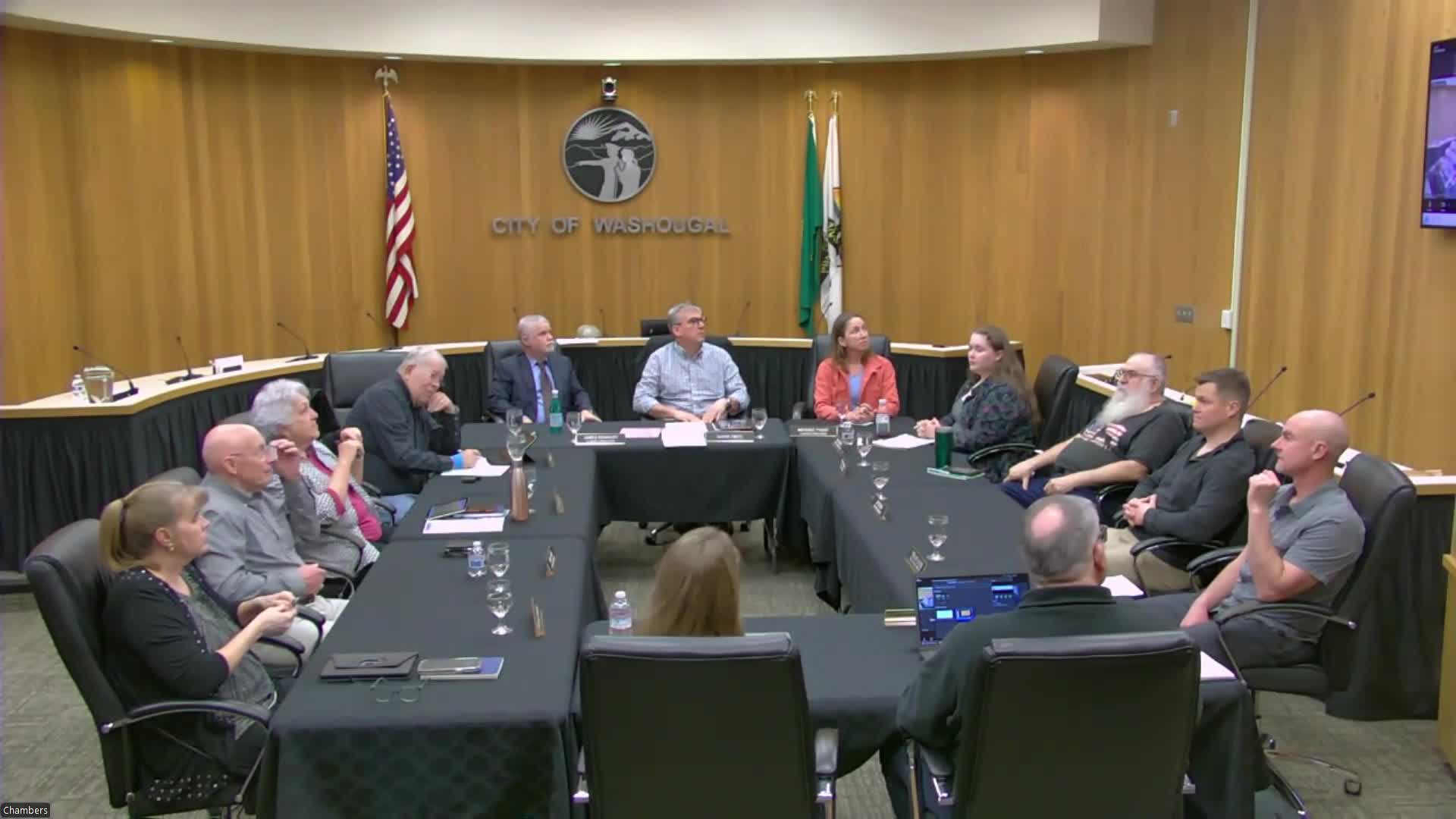
The recommendation came during a council work session Monday, March 24, where planning staff explained the two alternatives, an infrastructure assessment, public engagement results and next steps. Jessica, a member of the project team, told the council the city must plan to accommodate a population of just under 25,000 by 2045 — roughly 3,700 housing units — and an adjusted job target of about 2,100–2,500 positions supplied by county and state allocations.
Staff said Alternative 1 generally retains the existing zoning pattern but factors state middle-housing laws and accessory-dwelling-unit (ADU) allowances into capacity projections; the model assumes a substantial rate of middle-housing and ADU development and projects a larger possible unit count as a result. That approach, staff told council, concentrates more housing in the downtown and waterfront areas and reserves town-center parcels for a mix of housing and jobs. Under Alternative 2 the plan assumes more jobs in the town center and more high-density housing in the city’s Northeast area, producing a different split of housing affordability levels.
The project team walked council through a high-level utilities assessment for water, sewer and stormwater and a travel-shed transportation analysis. Water and sewer staff concluded both alternatives are serviceable under current plans but recommended updating utility plans on their normal cycles; the water system plan should be revisited by 2031, staff said. The stormwater analysis flagged a potential issue in already-developed neighborhoods if many ADUs or small infill projects increase impervious surface but said vacant lands would be mitigated at project level because stormwater is treated on-site.
On transportation, staff reported little difference between alternatives citywide but identified a capacity risk on 30th Street if the plan were to realize the largest, theoretical housing buildout used in the analysis. "In a worst-case scenario, 30th would need widening," Jessica said, while noting that widening is not a practical solution and that Alternative 1 reduces pressure on 30th by placing more housing downtown where multiple access routes exist. A transportation team member, Adam Miles, joined remotely to back up the analysis.
Council members pressed staff on affordability assumptions. Staff emphasized that the plan’s housing capacity is a projection, not a guarantee of construction or price levels, and that meeting affordability targets (units at or below 80% area median income) will require separate housing-element policies and incentives. Staff also described upcoming code work: the city will draft local middle-housing and ADU regulations concurrent with the housing element; if Washougal takes no local action, the state's model ordinance will take effect in June 2026, staff said.
Public engagement results were summarized: an in-person open house drew 82 attendees and 15 written comments; an online form open through March 12 produced 58 submissions. Of respondents who stated a preference, 39 favored Alternative 1, 14 favored Alternative 2, and 20 did not specify. Comments cited utility capacity, traffic congestion, environmental impacts, housing affordability and support for downtown business as primary concerns.
Council did not take a final vote at the work session. Staff said a resolution recommending Alternative 1 will appear on the council consent agenda to set a public hearing for April 14; the Planning Commission will hold its public hearing April 8 and forward a recommendation to council. Staff stressed monitoring and follow-up: annexation, development timing, state law changes and project-level permitting will determine when and whether capacity-driven problems arise.
William Carter, a resident who spoke during public comment, urged policies to prevent short-term rentals from displacing long-term housing and suggested programs to help existing property owners finance adding dwellings, and he voiced support for downtown lighting and activation.
Staff listed several next steps: finalize a preferred alternative for hearings, develop local middle-housing and ADU regulations alongside the housing element, update utility planning on regular cycles, and monitor transportation impacts — particularly on the 30th Street corridor.
While staff recommended Alternative 1, they told council that the housing numbers used in the capacity analysis are conservative (higher) projections and that further policy work — incentives, fees, and targeted programs — will be required to translate land capacity into housing that is affordable to households at or below 80% AMI.