Get Full Government Meeting Transcripts, Videos, & Alerts Forever!
Get email alerts on the Health Social Services Waivers topic
No spam. Unsubscribe anytime.
Senate approves human‑trafficking awareness posting, rejects multiple FSSA funding amendments and adds sunset for pathways providers
Summary
The Indiana Senate on April 10, 2025, approved a requirement that gas stations and convenience stores post human‑trafficking hotline information and rejected multiple amendments that would have immediately funded thousands of additional pathway‑waiver slots or authorized after‑session budget augmentations for FSSA.
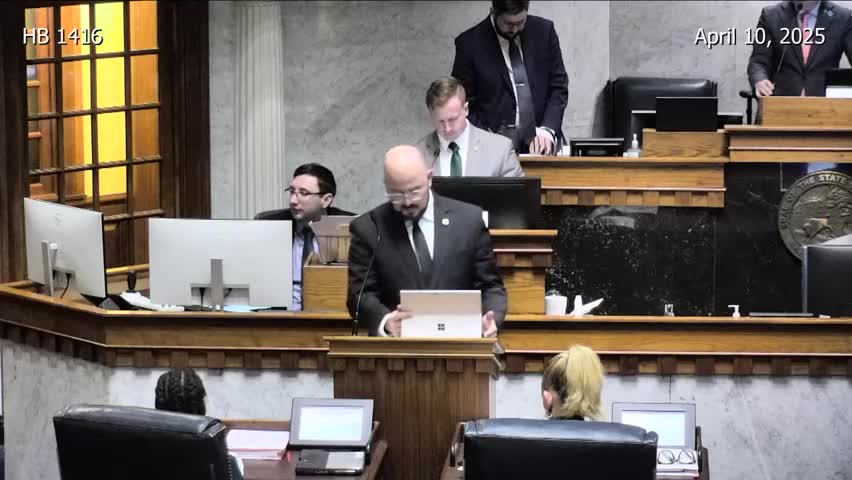
The Indiana Senate on April 10, 2025, considered several amendments to House Bill 14‑74, which includes changes to pathway waiver programs and related health and social services provisions. Lawmakers approved an amendment requiring gas stations and convenience stores with public restrooms to post human‑trafficking hotline information, but they defeated multiple amendments that would have authorized the Family and Social Services Administration (FSSA) to seek budget augmentations or immediately fund thousands of additional waiver slots to address wait lists.
Senator Michael Pohl presented an amendment that would require owner/operators of gas stations and convenience stores with interior public space to post the national human trafficking hotline and awareness information in a public restroom or a visible location on the premises. Pohl said implementing the signage led to a 400% increase in trafficking convictions in Texas, a statistic he and supporters cited as evidence the measure could raise awareness and aid identification and reporting. "If we're serious about stopping crime, particularly one of the most heinous crimes, human trafficking, this is how you do it," Pohl said. The amendment passed on voice vote after floor discussion and industry engagement.
Senator Robert Kidora offered multiple amendments seeking fiscal mechanisms to address long waiting lists for the Pathways waiver and related Health and Wellness waiver programs, including a motion to authorize FSSA after session to request budget committee augmentation in a crisis and a separate amendment to fund roughly 3,000 additional waiver slots immediately (the sponsor characterized this as an up‑front funding approach). Kidora said the status quo left nearly 10,000 Hoosiers on wait lists and that the state pays far more if people are placed in long‑term nursing care instead of receiving waiver services: "It costs $10,000 a month to admit a person into the nursing facilities … multiply $120,000 a year by 3,000 people, that's $360,000,000," he said, compared with a projected roughly $52,000,000 annual state share for 3,000 waiver slots assuming federal participation. Opponents, including Senator Charbonneau, said the amendments would create immediate and substantial fiscal impacts and urged defeat.
The clerk recorded votes on Kidora's proposals. A motion to authorize FSSA to seek budget augmentations (Amendment 2) failed 12 ayes to 33 noes; a later amendment to fund the 3,000 waiver slots (Amendment 3/6 depending on the floor numbering) failed 10 ayes to 34 noes. Senator Charbonneau and others argued the amendments would require additional appropriations in the current budget cycle, while supporters argued preventing cost shifts into higher‑cost institutional care is fiscally prudent.
Senator Charbonneau later offered an amendment that added a sunset date (June 30, 2029) for language authorizing willing providers for the pathways program; that amendment passed. The bill was ordered to engrossment after the series of amendments.
Votes at a glance: Pohl amendment requiring human‑trafficking signage — adopted (voice vote). Kidora Amendment authorizing FSSA to request augmentation — failed (roll call 12 ayes, 33 noes). Kidora amendment funding 3,000 waiver slots — failed (roll call 10 ayes, 34 noes). Charbonneau amendment adding 06/30/2029 sunset for willing providers — adopted (voice vote).
Floor debate emphasized the fiscal trade‑offs and the time sensitivity of serving people on waiver wait lists. Supporters of immediate waiver funding framed it as cost‑saving compared with institutional care; opponents warned the Senate could not responsibly add large, immediate appropriations without the budgetary process. Speakers repeatedly asked whether the budget committee and executive branch controls would provide sufficient checks on any post‑session augmentation requests.