Get Full Government Meeting Transcripts, Videos, & Alerts Forever!
Get email alerts on the State Of City topic
No spam. Unsubscribe anytime.
Norwalk mayor highlights school construction, climate action and infrastructure while stressing fiscal strength in State of the City address
Summary
The mayor outlined completed and planned school projects, climate and tree-planting initiatives, transportation and safety measures, and a strong fiscal position while urging careful budgeting after state motor-vehicle tax changes.
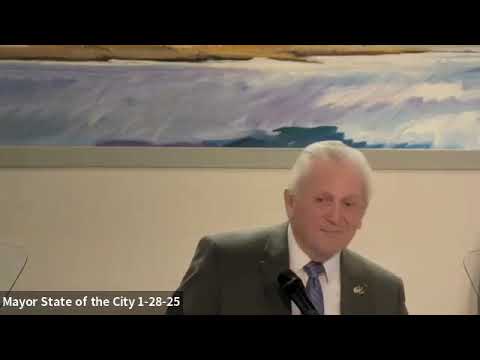
The mayor of Norwalk delivered the State of the City address, outlining major investments in schools, climate resilience, transportation and public safety while saying the city's fiscal position remains strong.
The speech summarized completed and upcoming school projects, including renovation work and new construction; announced climate and tree-planting programs and a green workforce initiative; described transportation projects and grants to expand sidewalks, a roundabout and complete-streets work; and highlighted public-safety trends and departmental upgrades. The mayor also reiterated Norwalk's AAA bond rating and said the city must identify revenue to offset a state change to motor-vehicle taxation that will reduce car tax bills by about one-third.
The address matters because the projects and budget decisions the mayor described affect capital spending, taxpayer burdens and public-safety and climate resilience across Norwalk neighborhoods. Several capital projects described rely on state or federal reimbursement or grants, which will affect local taxpayer costs and project schedules.
Schools and education: The mayor said the city has increased the Board of Education operating budget by roughly $78 million (about a 50% increase) since 2013 and listed recent construction and renovation projects. The address cited completed or near-complete projects at Ponus Ridge School and Jefferson Elementary School, and said Cranbury Elementary School opened as the city's first wholly new school in more than 50 years. The mayor said a new South Norwalk neighborhood school will open this fall and that the city has broken ground on a new Norwalk High School projected to welcome students in 2027.
The mayor said the city allocated $3,500,000 for site work around the South Norwalk school to address flooding, sidewalks and streets, and that a $2,500,000 state grant will fund a roundabout at Meadow Street, Wilson Avenue and South Main Street to improve traffic flow.
Capital funding and reimbursements: The speech said Norwalk is receiving higher state reimbursement rates for school construction under recent state programs — the mayor cited a 60% reimbursement rate for one project and an 80% rate for the new high school — and credited state legislators for support. The mayor also said the city secured $15,000,000 in city funding and a $21,000,000 state grant to upgrade heating and cooling systems across six schools; those projects were described as continuing into 2026.
Climate, trees and workforce: The mayor described the city's first draft sustainability and resilience plan and said the administration will hire a director of sustainability and resilience. The speech announced a new tree master plan and reported that public-works crews planted 454 trees in 2024. A $1,000,000 grant from the U.S. Forest Service will fund downtown tree plantings and a stewardship program, the mayor said, and the city will establish a green workforce program to train disadvantaged residents for forestry work; the mayor said that program will plant at least 100 trees in priority neighborhoods.
Transportation and complete streets: The mayor said the city adopted a complete-streets ordinance and installed 3.2 miles of sidewalk last year, including Rowayton Avenue. Upcoming work described included sidewalks on Laura, Austin, Knapp, Oxford and Meadow streets; a federal or state-supported sidewalk project on West Rocks Road; and a Route 1 corridor study coordinated with the Connecticut Department of Transportation and the Western Connecticut Council of Governments. The mayor also said the city is developing a safety action plan to support a Vision Zero policy and credited a Safe Streets for All grant for parts of that work.
Transit: Norwalk Transit District's on-demand microtransit pilot completed about 41,000 trips in just over nine months, the mayor said. The district is completing a comprehensive operational analysis and network design intended to bring very frequent bus service within a five-minute walk of about 37,000 Norwalk residents, the speech said.
Public safety and emergency response: The mayor said crime in Norwalk declined in the cited reporting period — offering a 7.7% reduction in crimes reported per 1,000 residents from 2022 to 2023 based on the Connecticut State Police report — and said crimes against persons and property declined in the city while some statewide property-crime categories rose. The mayor credited the police department's emphasis on self-initiated motor-vehicle enforcement, noting nearly 13,000 citations by December of the cited year, and reported that the fire department responded to more than 8,400 calls in 2024. The mayor said the fire department has new station-alerting software and the city purchased an attenuator highway-blocking truck to protect firefighters on highways.
Parks, recreation and cultural district: The mayor said recreation and parks programs served more than 10,000 people, the city opened a new skate park and increased pickleball courts to 22 outdoor courts. The mayor highlighted a newly renovated South Norwalk library first floor and described a $15,500,000 Norwalk Community Recreation Center (33,000 square feet) scheduled to begin construction in February and be completed by early next year; the mayor said the project is funded with a mix of state, federal and city funds. The state designated Norwalk's Wall Street and South Norwalk area as a cultural district in 2024, the mayor said, and the city reported record attendance at several downtown events in 2024.
Small business and community services: The mayor described the Norwalk Innovations initiative, which awarded $100,000 in grant money to 12 local entrepreneurs, and highlighted a community services hub that connected more than 1,200 households with services in 2024. The speech said the hub received a Municipal Excellence Award in 2024.
Budget and fiscal context: The mayor said major rating agencies reaffirmed Norwalk's AAA bond rating in February 2024 and credited well-funded pensions and a healthy rainy-day fund. The mayor noted the Board of Education budget accounts for more than 60% of the city's annual budget and said the city must address the budget challenge posed by a state-required change to motor-vehicle taxation that will reduce car tax bills by about 33%. The mayor said the city must identify other revenue sources to make up the resulting shortfall and work with the common council and board of education to strike a balanced budget.
Transparency and operations: The mayor said the city upgraded audiovisual systems in council chambers, rolled out a FOIA management system to track requests, launched an online inspections and licensing system for the health department and is digitizing land records. The mayor thanked department leaders by name for their roles in these efforts.
What the speech did not change: The address outlined plans and funding commitments but did not include formal votes or council actions during the speech itself. Project schedules and final funding amounts for some items depend on state or federal reimbursements and grants, which the mayor said will reduce local taxpayer costs but may affect timelines.
The mayor closed by thanking staff, first responders and residents and by reiterating a pledge to keep taxes as low as possible while addressing education and infrastructure needs.