Get Full Government Meeting Transcripts, Videos, & Alerts Forever!
Get email alerts on the Affordable Housing topic
No spam. Unsubscribe anytime.
Norwalk council reviews consultant affordable-housing plan; members debate tax abatements, ADUs and SROs
Summary
On Jan. 30 the Norwalk Common Council heard a consultant presentation on an affordable-housing plan that recommends zoning changes, tax incentives and public–private partnerships. Public commenters and council members pressed for ADU reforms, protections for existing single-room-occupancy housing and a fiscal analysis of proposed tax abatements.
The Norwalk Common Council on Jan. 30 reviewed an affordable-housing plan prepared by AKRF that lays out zoning changes, tax and financing tools, and public–private partnership strategies intended to expand affordable and workforce housing in Norwalk.
The plan, presented by AKRF lead consultant Ashley Lay and introduced by Michelle Andjesky, senior planner of Planning and Zoning, summarizes a housing needs assessment, a land-use and zoning analysis and an implementation matrix of prioritized actions. Council members and members of the Planning and Zoning Commission pressed presenters on the feasibility of higher inclusionary set-asides, the design of tax-abatement incentives and the omission of one existing deeply affordable SRO facility from the draft report.
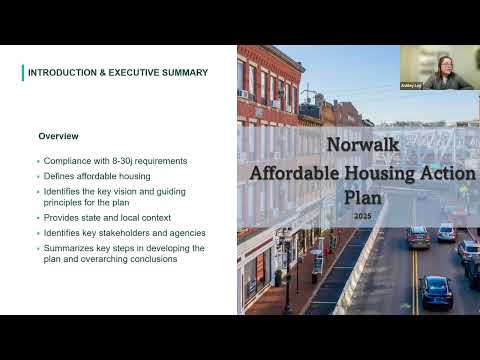
The plan identifies immediate priorities including targeted zoning changes, incentives (density bonuses, fee waivers, tax incentives), expanded inclusionary zoning, relaxed ADU rules and streamlined review processes. Lay told the council that the study "defines affordable housing" and "identifies the key vision and guiding principles of the plan," adding that Norwalk "strives to be a city with housing accessible to all, a place where residents can live and work because of the affordable, diverse housing stock that accommodates the diversity of its population." The plan documents that about 40% of Norwalk households pay more than 30% of income on housing and that the city’s median sales price for single-family homes rose from about $413,000 in 2015 to $700,000 in 2023.
Lay said the team ran pro forma modeling of inclusionary set-asides and found that "changing it at this point in time, it just didn't meet the, the minimum, profit requirements for the developer" for immediate increases above the current 10% set-aside, given high interest rates and construction costs; she recommended periodic review and a "carrot" approach of incentives and abatements to spur production now.
Public commenter Diane Keith urged faster ADU reforms and targeted incentives. "We need to make the process much less restrictive to address the affordable housing needs in our city," Keith said, citing her recommendations that the city allow ADUs up to 1,500 square feet with two or more bedrooms and offer property-tax abatements to owners who cap rents at "$2,300 per month and raise it no more than 5% per year for the first 10 years after completion." Keith also recommended incentives to convert underused commercial space along Route 7 and the Post Road into housing and opposed removing open space at an existing senior facility if additional stories are added.
A member of the Planning and Zoning Commission raised a substantive omission: 40 South Main Street, described in the meeting as a 44-unit single-room-occupancy facility operated by the Human Services Council that provides deeply affordable units (current rents for residents without vouchers were stated as about $860 per month). The commissioner requested that the facility be added to the final report. Ashley Lay acknowledged the address was not specifically listed and pointed to a section of the draft that recommends adding single-room-occupancy buildings to zoning as an allowed housing type.
Council members focused heavily on tax abatements and fiscal trade-offs. Councilman Josh Goldstein called the report "exhaustive" and asked for examples of municipalities that successfully used municipal tax incentives. Multiple council members and staff noted that abatements do not have to remove 100% of taxes and in some cases can raise net revenue on previously underutilized or vacant sites. City planning staff said they are preparing additional modeling and zoning-implementation tools, including GIS-based scenarios to show what increased density could look like at selected corridors and intersections.
Next steps described in the meeting: staff will refine the draft based on feedback, the plan will be integrated into the city’s Plan of Conservation and Development (POCD) as the housing component and the council’s affordable housing ad hoc committee will pursue follow-up work. Presenters and staff said further scope would be needed to produce the detailed fiscal analyses requested—tax-abatement thresholds, larger pro forma runs for developments above 100 units and infrastructure capacity studies—before adopting new incentive policies.
Votes at the meeting included a motion to adjourn. Councilman Lopez moved to adjourn; the motion passed on a voice vote with no additional tally provided.