Get Full Government Meeting Transcripts, Videos, & Alerts Forever!
Get email alerts on the City Budget topic
No spam. Unsubscribe anytime.
Norwalk CFO outlines mayor’s recommended 2025–26 operating budget, highlights tax pressures and offset plans
Summary
CFO Jared Schmidt presented the mayor’s recommended 2025–26 operating budget to the Norwalk Common Council at a special meeting on Feb. 11, describing it as “a challenging budget to develop” and outlining revenue losses, cost pressures and measures proposed to limit the tax impact on homeowners.
CFO Jared Schmidt presented the mayor’s recommended 2025–26 operating budget to the Norwalk Common Council at a special meeting on Feb. 11, describing it as “a challenging budget to develop” and outlining revenue losses, cost pressures and measures proposed to limit the tax impact on homeowners.
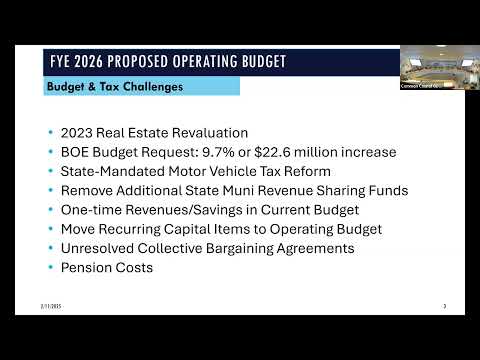
The presentation came during a special meeting called by Council leadership and chaired by Finance and Claims Committee Chair Councilmember Greg Burnett. Schmidt said the budget responds to three main pressures: the second year of a multi‑year real‑estate revaluation phase‑in, changes to state motor‑vehicle tax rules, and higher pension contributions following an actuary experience study.
Why this matters: The revaluation phase‑in shifts more of the tax burden to residential property owners, state changes to motor‑vehicle valuation and mill rates will reduce municipal motor‑vehicle revenue, and actuarial adjustments increase the annual pension actuarially determined employer contribution (ADEC). Together, those items create a budget gap the administration proposes to fill with a mix of one‑time and recurring steps that will affect reserves, capital funding and fee structures.
Schmidt told the council the budget as proposed limits the combined increase for the city and Board of Education to 3.3%, with city spending up about 2.5% and the board of education proposed at 4% (the board initially requested an increase the presentation said totaled $22,600,000, a figure representing a 9.7% request). He identified several revenue and expense items shaping the proposal: a prior one‑time tax‑sale windfall that is not expected to recur; $1.7 million of municipal revenue‑sharing that the administration did not budget because it depends on statewide sales tax growth; and roughly $12 million of motor‑vehicle related revenue loss driven by two state changes.
“We are not budgeting this grant,” Schmidt said about the municipal revenue‑sharing payment, noting that the payment depends on a high statewide sales‑tax threshold and is uncertain.
Schmidt said one recent state requirement forces municipalities to set the motor‑vehicle mill rate no higher than the lowest real‑estate mill rate, which in Norwalk’s example reduced the motor‑vehicle mill rate from roughly 32.4 to about 22 and generated an estimated $10 million revenue loss; an altered vehicle valuation method (straight‑line depreciation at 5% per year rather than blue‑book values) accounts for about $2 million of additional loss.
To blunt those and other pressures, the administration proposed several measures: using bond premiums to temporarily fund some recurring capital items and reduce debt service; a planned drawdown of fund balance of $8 million in FY26 (bringing the projected fund balance to about 16% of the budget); a 1% salary lapse applied across divisions; and a proposed increase in the personal‑property mill rate from 28 to 32 to generate revenue.
Schmidt said the city intends to continue using a targeted hiring freeze approach — not an absolute freeze — to realize savings through reduced refills and managed turnover. On the pension contribution increase he explained the change followed an actuary’s experience study and said the result should reduce future year‑to‑year volatility by more accurately funding liabilities.
Council members asked for clarifications about the mill‑rate table and contingency assumptions. Schmidt said the table shows medians and averages: “In this particular case, it’s a median,” he said, noting half of households would be above and half below the depicted value. On contingency, Schmidt said the administration reviewed historical contingency use and adjusted the budgeted contingency downward from prior levels to $1.3 million on the assumption that settlements and salary increases will be resolved before year end.
Other highlights included plans to launch a motor‑vehicle registration compliance program to capture locally domiciled vehicles, restructuring recreation and parks fees to generate revenue, and continuing a part‑time grant coordinator post rather than converting it to full time as the administration evaluates a new grant policy and procedures draft.
Schmidt said the overall proportion of the budget appropriated to education looks large at face value, but after accounting for city‑carried school debt service and internal service funds the effective split is closer to 61% for the Board of Education and 39% for the city. He closed by reminding council members of the schedule for next steps: the finance and claims committee and public presentations this week, a Feb. 25 common council vote to set the cap, and final mill‑rate action in May.
Looking ahead: Councilmembers and staff agreed the budget will move through committee review and public presentations. Schmidt said he will circulate an actuary report to members after the pension‑board presentation and provide additional detail on building‑permit and conveyance revenue estimates.