Get Full Government Meeting Transcripts, Videos, & Alerts Forever!
Get email alerts on the City Budget topic
No spam. Unsubscribe anytime.
Norwalk finance committee sets $450.48 million operating budget cap after public hearing dominated by school funding pleas
Summary
Norwalk’s Finance & Claims Committee voted unanimously to recommend a $450,481,977 cap on the fiscal 2025–26 operating budget after a public hearing in which dozens of residents and educators urged the council to increase funding for Norwalk Public Schools beyond the CFO’s 4% recommendation.
The Norwalk Common Council’s Finance & Claims Committee voted unanimously on Feb. 13 to recommend a fiscal year 2025–26 operating budget cap of $450,481,977, sending the cap to the full Common Council for final action. The committee’s vote followed a public hearing during which dozens of parents, teachers, school governance members and school administrators urged higher funding — many asking the council to approve the Board of Education’s 9.7% request rather than the administration’s recommended 4% increase.
The committee’s action sets the maximum total general-fund appropriation the city will consider for the coming fiscal year. The cap now goes to the full Common Council on Feb. 25; once the cap is set, the Board of Estimate and Taxation (BET) will hold departmental reviews in March and a public hearing on March 26 on the tentative operating budget.
Why it matters: committee members and speakers framed the vote around trade-offs between tax relief for residents and the immediate needs of schools. The administration’s recommended budget relies in part on drawing down $8,000,000 from the city’s general fund balance to limit mill-rate increases, while the Board of Education and many public commenters said the recommended 4% increase will force staff and program cuts that would hurt student services, special education, nursing and extracurriculars.
Committee and administration details Jared Schmidt, Norwalk’s chief financial officer, presented the recommended operating numbers the committee discussed. The recommended $450,000,000 operating budget includes a proposed 4% increase to the Board of Education budget (about $9.3 million) and a 2.5% increase to city departments (about $5.0 million). Schmidt told the committee that using a one-time drawdown of $8,000,000 from the fund balance was his recommendation to provide tax relief this year; he and the financial advisor told members they did not expect a one-year drawdown at that level to change Norwalk’s credit rating, but warned that repeated reliance on one-time revenues would “kick the can” to future budgets.
Public comments and school district concerns Dozens of residents and education staff spoke in person and online during the hearing. Parents, school governance council members, teachers and administrators described potential program and staff cuts if the Board of Education is limited to 4% rather than the 9.7% increase the board approved. Specific concerns raised by speakers included: - Cuts to assistant principals, deans and nurses, and reduced access to paraprofessionals and specialized special-education staff. - Larger class sizes and fewer 1:1 or small-group interventions. - Risks to student safety and to the district’s recent gains on graduation and attendance measures.
Speakers included: Jennifer Jeffries (parent), Mary Orden (Norwalk Federation of Teachers), Nick Zirzan (parent/SGC member), Brandylyn Fulton Williams (SGC member and parent), Abby Shiner (parent of a child receiving special education services), Lynn Moore (Norwalk High principal and president of the administrators’ union), Tara Nelson Bakey (Board of Education member), Melissa Matuska (parent), Isabel Owen (SGC member/educator), Stephanie Marinsky (parent and school nurse), Drew Todd (SGC co-chair), Sherry McCready Pritchett (Board of Education co-chair) and others. Many speakers asked the committee to consider funding closer to the board-approved 9.7% request.
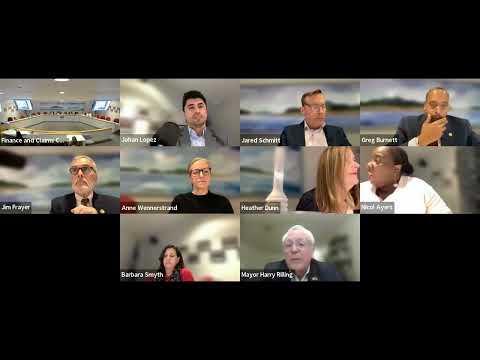
Committee discussion and vote Committee members discussed the budgeting trade-offs at length, weighing short-term tax relief and the city’s rainy-day drawdown against the risk of program cuts at schools. Councilmember Jim Frayer asked specifically about the long-term effect of drawing down $8,000,000 on borrowing and bond ratings; Schmidt said his advisors did not expect the single-year drawdown to change the city’s rating but cautioned against repeating one-time measures. After discussion, Finance & Claims members voted unanimously to recommend the cap of $450,481,977 to the full council. Committee chair Councilmember Greg Burnett noted the cap’s adoption would allow BET to conduct the line-by-line departmental reviews in March and to hold a public hearing March 26.
What the vote does not decide The committee’s cap recommendation is a procedural step that sets a maximum for total appropriations. It is not the final budget or a final determination of how funds will be allocated between the city and the school district. If the BET later requests a higher cap, the Common Council would have to vote again to increase it.
Next steps - Feb. 25: Full Common Council reviews and (expected) ratification of the committee’s cap recommendation. - March (BET): departmental reviews and a March 26 public hearing on the tentative operating budget. - If the cap changes, the Common Council must vote on any increase.
Sources and evidence The committee’s vote and the public hearing comments are recorded in the Finance & Claims Committee meeting transcript for Feb. 13, 2025. The public hearing was opened by Councilmember Greg Burnett and included presentations and questions by CFO Jared Schmidt and multiple Common Council members. Direct excerpts of the hearing appear in the official transcript and the BET schedule announced at the meeting.