Get Full Government Meeting Transcripts, Videos, & Alerts Forever!
Get email alerts on the Capital Budget topic
No spam. Unsubscribe anytime.
Norwalk CFO proposes 10-year capital plan, 4-year sunset for inactive authorizations
Summary
City CFO Jared Schmidt recommended charter changes to align capital-budget timing with the operating budget, expand the capital plan to 10 years, create an automatic four-year sunset for unused authorizations and codify a bond-sale committee. Commissioners pressed for clarity on the Board of Estimate and Taxation’s role and the timing of reviews.
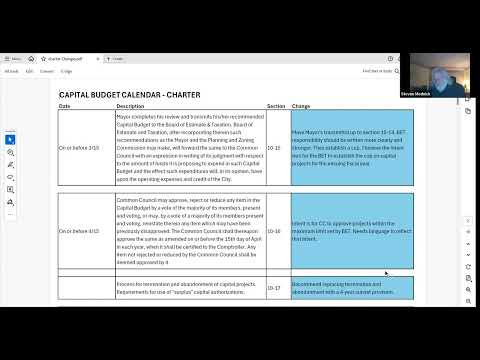
Norwalk’s chief financial officer, Jared Schmidt, told the Charter Revision Commission on Feb. 18 that he is proposing a series of charter amendments to the city’s capital-budget process intended to align timing with the operating budget and tighten management of long‑standing authorizations.
The changes Schmidt outlined would require departments — including Norwalk Public Schools — to submit capital requests by mid‑December, expand the current five‑year capital plan to a 10‑year capital improvement plan, add the mayor as a formal recipient of department submissions, and move some Planning and Zoning (P&Z) review steps so the commission looks at the mayor’s recommended plan. "I'm recommending that we expand from a 5 year plan to a 10 year capital improvement plan," Schmidt said.
Schmidt also proposed a four‑year automatic sunset for any unfunded capital authorization that shows no activity, saying the rule would help clean up numerous old authorizations that inflate the city’s reported authorized but unissued debt. "If there's no action on that authorization in 4 years, it's off the books," he said, adding that projects already bonded would not be subject to the sunset and that finance would provide notice and a report in advance of any expiration.
Other recommended changes would codify practices the city already follows: naming participants in a bond‑sale committee (typically the mayor, the CFO, the comptroller, the common council president and minority leader and the chair of the finance committee) and clarifying procedures for emergency or unforeseen appropriations, including common use of bond anticipation notes or bonding for property acquisitions.
Commissioners pressed Schmidt on how the proposed wording would change the Board of Estimate and Taxation’s (BET) authority. Several commissioners asked whether BET could set the overall cap on capital spending and whether the common council could increase or decrease amounts once that cap is in place. Schmidt and other commissioners agreed the charter text should make the roles and limits clearer, especially whether and how BET can revise the mayor’s recommendations and whether the council’s subsequent line‑item changes must remain within a BET cap.
Schmidt said the proposed sunset would apply primarily to unfunded authorizations and that finance would circulate a report—suggested to go to BET, P&Z and the council—well ahead of expirations to allow reconsideration. He cited other municipalities that use sunset provisions and said the four‑year period was a judgment call rather than a formulaic choice.
The commission asked Schmidt and the city attorney to produce draft charter language to reflect the proposals, including explicit procedural steps and notice timing for sunsets and the make‑up and role of a bond‑sale committee.
Proposed changes outlined by Schmidt will return to the commission as draft charter text for further review and redrafting.
Ending: The commission did not vote on any charter text on Feb. 18; members asked staff to draft specific language for future review and to clarify points about BET authority, P&Z timing and the sunset mechanism.