Get Full Government Meeting Transcripts, Videos, & Alerts Forever!
Get email alerts on the Harbor Management topic
No spam. Unsubscribe anytime.
Norwalk steering committee kicks off harbor management study, adds mooring and street-end reviews
Summary
Consultants from Indigo River and HR&A opened a virtual steering committee meeting to begin an audit of in-water harbor uses, a concurrent mooring study and a review of city-owned street ends; committee members were asked for feedback on a proposed definition of "water-dependent uses."
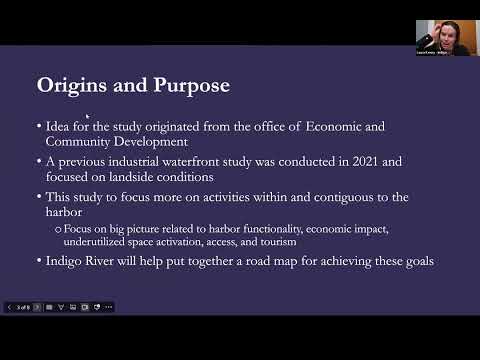
Consultants and local harbor users met virtually on Oct. 12 to launch a Norwalk Harbor management study that will audit current in-water uses, develop recommendations on mooring capacity and evaluate city-owned street ends for public access.
Laura Kenny, a consultant with Indigo River, said the firm was hired with HR&A Advisors to “conduct the harbor management plan for this contract,” and that the study will focus on marinas, boatyards, aquaculture, tourism and recreational uses as well as environmental and resilience goals. The consulting team said it expects to deliver a background audit of existing conditions for committee review by March and to present draft recommendations by September.
The study will run several concurrent tracks, including an audit of existing harbor uses led by Indigo River and TMS (physical/navigation analysis), an economic analysis led by HR&A Advisors and a separately scoped mooring study. “We’re hoping that the mooring study will actually run concurrently with the current harbor uses and harbor recommendations,” Kenny said, noting moorings have been a “hot topic.” The team also added a city-owned street-end study to evaluate opportunities to increase public access.
The consultants asked the steering committee to review and refine a proposed list of water-dependent activities that will be used to pull employment and business data. Anna Messer of HR&A Advisors said the team compiled a draft list of NAICS (North American Industry Classification System) codes to represent water-dependent uses and aligned that list with a short statutory definition in Connecticut. “In Connecticut, statutes…there is a definition for water dependent uses. It’s short. It’s paragraph long,” Messer said, and the consultants said they will cross-check the NAICS list with the city’s revised zoning code.
Committee members urged the team to ensure the NAICS list captures jobs and organizations that are not cleanly categorized in federal codes. Jason Patless, president of The Maritime Aquarium at Norwalk, asked whether environmental and education positions tied to shore- and water-restoration work were included. “I don’t see any of that captured in what you circulated,” Patless said; the consultants agreed to add conservation, restoration and coastal-education roles to the dataset where appropriate.
Several harbor stakeholders described long-term changes in harbor uses and local priorities. Alan Kimby, chairman of the Newark Harbor Management Commission, said Norwalk’s harbor economy has shifted away from traditional waterfront manufacturing and that the study presents an opportunity to identify new uses and to improve access for a diverse population. “We just have to find what the new opportunities are,” Kimby said.
Chris (no last name provided) offered to share existing materials and an inventory he compiled for the forthcoming street-end study to avoid duplicate effort. “I did the initial scoping for the street end study,” he told the committee; consultants said they would take any existing inventories and begin that strand earlier in the schedule if material was available.
Next steps outlined by the consultants include: refining the water-dependent uses memo with steering-committee feedback over the next one to two weeks, scheduling stakeholder interviews through March, producing the audit on current harbor uses, and hosting monthly steering-committee meetings to review deliverables. The team said they would send a scheduling poll to accommodate members who prefer daytime or evening meetings.
No formal votes or motions were taken at the kickoff meeting. Committee members and consultants closed by agreeing to circulate materials and to proceed with stakeholder interviews and the audit.
The consulting team emphasized sustainability, resilience and environmental protection as cross-cutting priorities; the consultants indicated recommendations on zoning would be limited to identifying where desired or existing uses appear inconsistent with current regulations and might warrant further zoning review by the city or planning staff.