Get Full Government Meeting Transcripts, Videos, & Alerts Forever!
Get email alerts on the City Budget topic
No spam. Unsubscribe anytime.
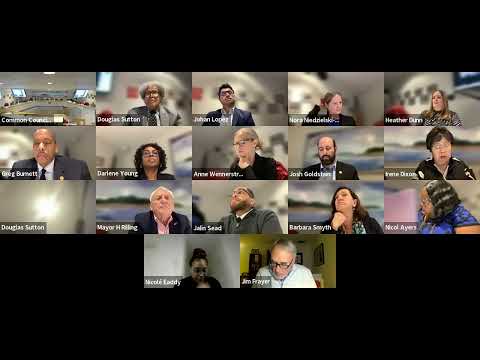
Norwalk council sets $450.48 million FY2025–26 budget cap after hours of public comment on schools
Summary
The Norwalk Common Council voted unanimously Feb. 25 to set a $450,481,097 cap on total appropriations for fiscal year 2025–26.
The Norwalk Common Council voted unanimously Feb. 25 to set a maximum limit of $450,481,097 on total appropriations for the city’s general fund for fiscal year 2025–26, a measure the council chair said represents months of departmental review and public input.
The cap — described to the council as a 2.5% increase for city departments and a 4% increase for the Board of Education — also includes a planned $8 million draw from the city’s general fund balance intended to temper the impact of reassessment-related residential tax increases.
The vote came after more than two hours of public participation focused overwhelmingly on public school funding. Dozens of parents, teachers, principals and students addressed the council during a long public-comment period, urging the council to increase the council’s recommended limit above the 4% figure or to use additional reserves to avoid cuts to student-facing positions and programs.
"I want those dollars to go to our kids," Jessica Cortez, a parent and attorney, told the council during public comment, urging greater transparency in school spending and line-item disclosure for prior spending cycles. Ashley Golias, a member of the Norwalk Board of Education, warned that "it's our students who lose out when we fail to fully fund the budget approved by the Board of Education."
Several school principals and parents gave specific examples of classroom and student impacts they say could follow a lower cap: larger class sizes, fewer paraprofessionals, reduced reading interventions and reduced related-arts offerings such as band and orchestra. Nathan Hale Middle School students and teachers described the role of their dean of students and related-arts teachers in student support and engagement.
Council members and the city’s chief financial officer, Jared Smith, answered questions from the dais. Smith described two state-driven changes that will affect local tax revenue and make the council’s deliberation more complex: an imposed requirement that the motor-vehicle mill rate be no higher than the lowest residential rate (prompting a reduction in Norwalk’s motor-vehicle rate) and a change in the valuation schedule for vehicles that shifts taxable values. Smith said those two changes together will reduce motor-vehicle tax revenue to the city by roughly $12 million — roughly $10 million from the rate change and about $2 million from the valuation schedule — which acts as an offset to residential assessment increases.
Council members repeatedly framed the vote as a balancing act between protecting school programs and limiting tax increases for residents. Councilmember Burnett, who introduced the item, said the next step is for the Board of Estimate and Taxation to conduct line-by-line reviews with city departments and the Board of Education before finalizing appropriations and the mill-rate distribution.
The council voted to approve the cap unanimously. Multiple other routine appointments and reappointments were approved later in the meeting, and the council approved a $20,000 agreement with the local prevention council (the Norwalk Partnership) after two council members recused themselves. The council president thanked parents and school staff for attending and encouraged continued engagement in the remaining budget process.
The cap sets the spending ceiling the Board of Estimate and Taxation and the council will use in the coming weeks as they complete line-item reviews and set the final budget and mill rate. Public hearings and additional votes are expected as the Board of Estimate and Taxation reviews department-by-department requests against the cap and as the Board of Education and city staff provide more detailed spending plans.