Get Full Government Meeting Transcripts, Videos, & Alerts Forever!
Get email alerts on the Ely Avenue Fence topic
No spam. Unsubscribe anytime.
Norwalk Arts Commission approves RFQ for Ely Avenue fencing project; limits applications to Connecticut residents
Summary
The commission voted to release an RFQ for public art on a 450-foot chain-link fence along Ely Avenue, requiring community engagement and giving preference to Norwalk-area artists; commissioners emphasized durability and budget constraints.
The Norwalk Arts and Cultural Commission on March 4 approved releasing a Request for Qualifications (RFQ) for the Ely Avenue fencing project, opening the opportunity to Connecticut residents with preference for Fairfield County and Norwalk-based artists.
Commissioners discussed the project scope, materials and community engagement requirements before voting. Sabrina (City staff) and commissioners described the site as a roughly 450-foot-long stretch of chain-link fence — between 6 and 8 feet tall in places — that borders Metro-North tracks near the corner of Ely and Franklin. The fencing project is intended to screen a blighted area behind the fence and to create a more inviting streetscape.
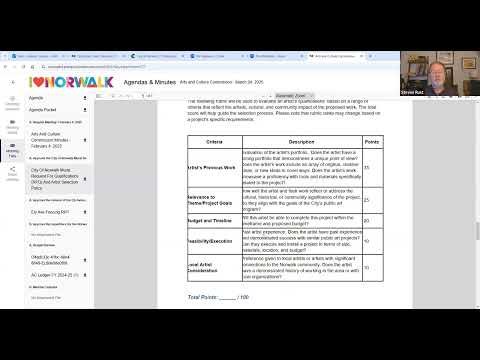
The approved RFQ requires applicants to demonstrate experience with outdoor, weather-resistant materials and to include a community-engagement component as part of their proposals. Commissioners noted the RFQ will specifically limit applicants to Connecticut residents, with preference given to Fairfield County and Norwalk artists for this location. Commissioners also agreed the commission will reach out to an artist who had previously worked on early design work for the site; the meeting noted that artist had been compensated for earlier work.
Speakers flagged practical constraints: the fence faces active train tracks on one side, which limits access and maintenance on the opposite face; proposals should be durable and mindful of budget limits. Commissioners encouraged applicants to consider designs that could engage both the neighborhood and passing rail riders, but said double-sided or heavy structural treatments would be constrained by available funds and the need to avoid liability for areas the city cannot access.
The commission approved the RFQ and authorized staff to publish it and begin outreach to potential proposers.