Get Full Government Meeting Transcripts, Videos, & Alerts Forever!
Get email alerts on the Public Art Selection topic
No spam. Unsubscribe anytime.
Norwalk Arts Commission adopts artist-selection RFQ guidelines, adds tie-breaker rule
Summary
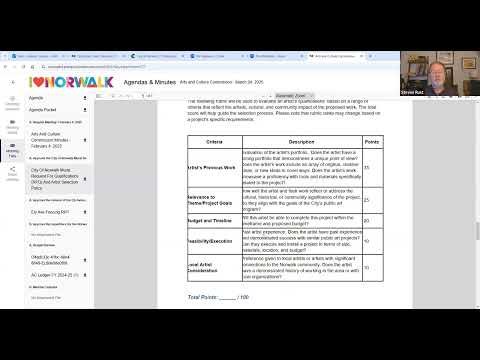
At its March 4 meeting the Norwalk Arts and Cultural Commission unanimously approved a guiding RFQ document that formalizes a selection rubric for public-art projects and adds language allowing the commission to break ties when public input produces no majority winner.
The Norwalk Arts and Cultural Commission on March 4 unanimously approved a guiding Request for Qualifications (RFQ) document that establishes a transparent rubric for selecting artists and adds a tie-breaker provision giving the commission the final decision if public input does not produce a clear winner.
The measure, introduced and discussed during the commission’s regular meeting, codifies an example scoring rubric the commission will use when reviewing applicants to public-art opportunities and clarifies that the document is an internal guiding policy rather than an ordinance. Sabrina, a City of Norwalk staff member who presented the legal review, told commissioners that legal counsel and the mayor’s office had reviewed the draft and concluded it is a commission guidance document; legal involvement will occur later at the contract stage.
Commissioners debated rubric detail and local preference weights before voting. Commissioners agreed to retain the rubric as an illustrative scoring tool that may be adjusted project by project; the approved language also specifies that if a public survey of finalists produces no clear majority, the arts commission will hold a tie-breaking vote. Chair Bridal Casper described the rubric as a method for “showing people this is sort of how we make some of these determinations.”
The document includes a public-engagement step: top proposals will be posted on the city website for resident review, with public feedback forwarded to the Economic and Community Development Committee of the Common Council and, after committee approval, to the full Common Council for final approval on projects that require such review.
By adopting the guideline, the commission expects to standardize selection practices across future RFQs while preserving project-level flexibility over weighting and local-preference definitions.
The commission voted to approve the RFQ guidance with the tie-breaker amendment; commissioners recorded no opposing votes.