Get Full Government Meeting Transcripts, Videos, & Alerts Forever!
Get email alerts on the Legislative Process And Floor Action topic
No spam. Unsubscribe anytime.
Senate adopts committee amendments and advances multiple bills to third reading in broad floor session
Summary
The West Virginia Senate adopted committee amendments across a wide range of House bills — from alcohol permits for nonprofits to changes in photo voter ID language — and moved many measures to third reading with the right to amend during a long floor session.
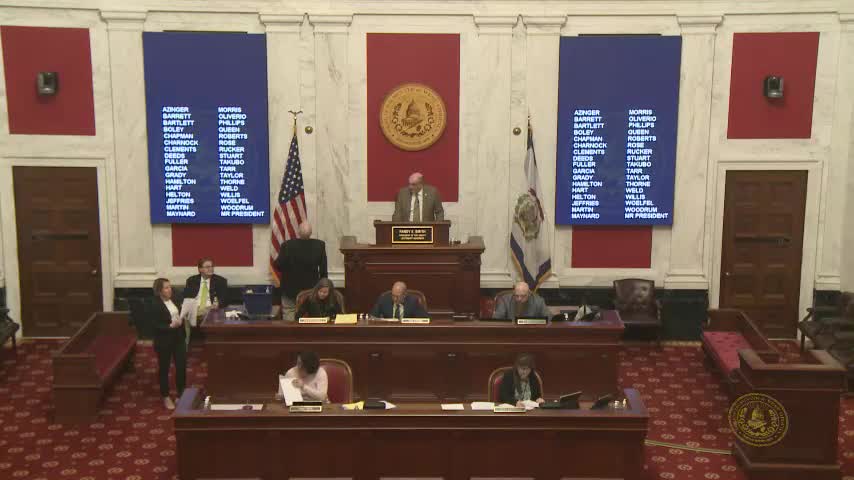
The West Virginia Senate spent a lengthy floor session taking second-reading action on a broad set of House bills, adopting committee strike-and-insert amendments and advancing many measures to third reading with the right to amend.
Committee on Judiciary, committee on Finance, committee on Health and Human Resources, committee on Transportation and Infrastructure, and other standing committees repeatedly presented strike-and-insert amendments that senators adopted by voice votes. Examples discussed on the floor included a Judiciary Committee amendment to House Bill 2,054 relating to vendor liability and private farmers markets that added a special permit for qualified nonprofits to serve alcohol in designated private outdoor areas; an amendment to House Bill 2,066 that clarified the new offense for damaging first-responder equipment applies to private emergency-response entities that contract with state or local governments; and a committee amendment to House Bill 30,16 (photo voter ID) described as clarifying in nature and not addressing citizenship designations on state IDs.
Other bills advanced to third reading with the right to amend after committees explained technical changes, including bills on certified microbusiness programs (House Bill 2014), a municipal water and sewer customer actions bill, counselor staffing ratios in schools (House Bill 3209), and an array of code-cleanup and program-specific measures. Committee sponsors repeatedly described their amendments as technical or cleanup changes and urged adoption; their amendments were adopted by voice vote or unanimous consent.
On procedural business the presiding senator accepted motions from members to move bills to the foot of the third-reading calendar and to advance measures to third reading with the right to amend. Near the end of the recorded segment, the presiding senator moved recess for 45 minutes and the Senate recessed by voice vote.
Because most committee amendments were adopted by voice vote, roll-call tallies were not recorded on the floor for those items in the supplied transcript. Where committees or senators cited code sections or agency responsibilities, the floor explanations characterized the changes as technical, language clarifications, or as aligning rulemaking authority with statutory text.