Get Full Government Meeting Transcripts, Videos, & Alerts Forever!
Get email alerts on the Economic Development Data Centers topic
No spam. Unsubscribe anytime.
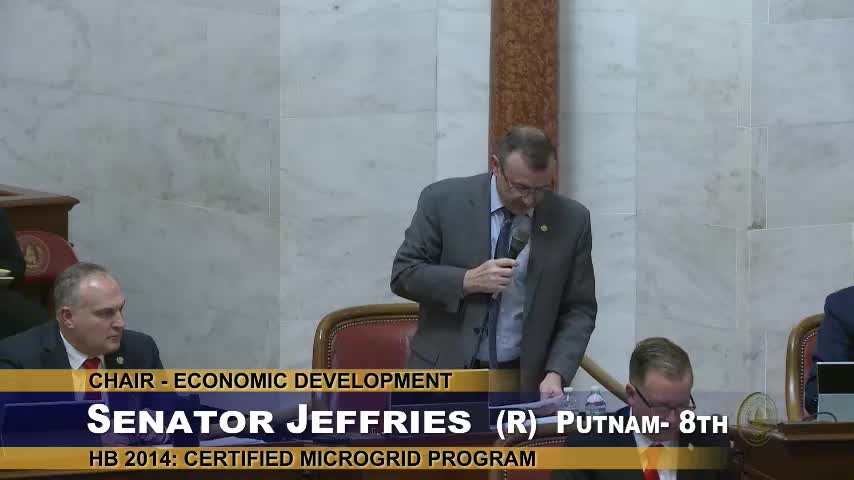
Senate approves bill creating microgrid program to attract data centers after hours of debate
Summary
The West Virginia Senate passed House Bill 2014, establishing a microgrid program designed to attract data centers and related industry, after lawmakers debated economic benefits and potential impacts to utility rates. The bill passed on a recorded vote, 32 yays, 1 nay, 1 absent.
The West Virginia Senate passed House Bill 2014, a measure creating a microgrid program intended to attract data centers and related high‑tech investment to the state, by a recorded vote of 32 yays, 1 nay and 1 absent.
Senior Senator from the eighth (name not specified), who spoke in favor on the floor, said the measure “is a very important bill” that “creates a micro bridal program” and “is a tool that we can use to be able to attract these data centers.” He urged passage and said the bill includes protections intended to ensure “the West Virginia taxpayer does not pay for any of the construction. None of the construction.”
Senator from Logan (name not specified) opposed the measure primarily on cost and rate‑payer concerns. “Ma’am, I can’t afford it. Bottom line, ma’am, I can’t afford it,” he said, warning of a potential deregulatory shift and describing worries about fixed costs remaining on the grid if microgrids proliferate. He noted the bill would allow microgrids to “sell back up to 10% back to the grid,” and said there was “no cap on micro grids” in the bill. He also cited local economic shifts—declines in coal employment and generation capacity—to explain sensitivity to utility costs among his constituents.
Senator from Harrison (name not specified) framed the bill as an economic opportunity for the state’s energy and technology sectors, listing likely new positions such as “data center engineers,” “grid technicians,” “cyber security analysts,” and other technical jobs. He said the bill “gives us the tools to grow” and argued it provides certainty to developers.
Junior senator from second (name not specified) asked for a Rule 43 judgment, noting a workplace conflict: the senator said they work for one of the two public electric utilities in the state and sought a ruling on whether they should vote. The chair ruled they are “a member of the class and be required to vote.”
On the floor, a committee amendment offered by the Committee on Economic Development was adopted before the final passage vote. The clerk later reported the machine vote on final passage as 32 yeas, 1 nay, 1 absent; the presiding officer declared the bill passed.
The record shows lawmakers debated both the bill’s potential to attract investment and the possible short‑term effects on electricity customers who remain on traditional utility service. Lawmakers supporting the bill highlighted contractual protections that would place construction costs on developers; opponents said potential long‑term cost shifts to legacy ratepayers were not adequately addressed in the bill text as presented on the floor.
The bill moves next through statutory steps for enrollment and any executive consideration required by state law.
Votes at a glance: committee amendment adopted (voice vote), final passage recorded 32 yays, 1 nay, 1 absent.