Get Full Government Meeting Transcripts, Videos, & Alerts Forever!
Get email alerts on the Trust Regulation topic
No spam. Unsubscribe anytime.
Peak Trust tells House Judiciary Committee Alaska's trust laws keep state competitive
Summary
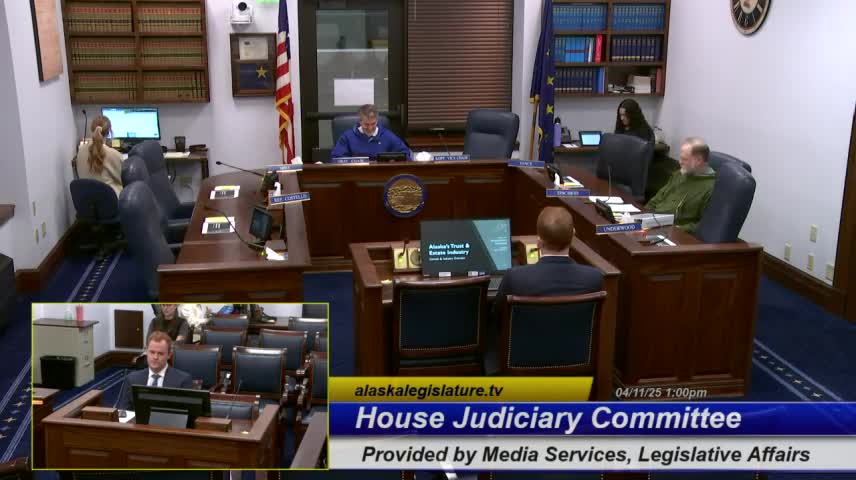
Peak Trust Company presented to the House Judiciary Committee on April 11, 2025, outlining the history of Alaska's modern trust laws, economic impacts of the trust industry and recent legislative activity, and answering lawmakers' questions about specific protections such as the 30‑day spouse-notice and decanting.
ANCHORAGE — Peak Trust Company representatives told the Alaska House Judiciary Committee on April 11 that Alaska’s modern trust laws, created beginning with the Alaska Trust Act of 1997, remain a competitive advantage for the state in attracting trust business and related financial services.
Peak Trust President and CEO Matthew Blomacher told the committee that “Alaska is now in a competitive, race if you will with pretty much every other state that has what we call modern trust laws,” and said Alaska’s combination of statute, case law, and local professionals supports long-term trusts, self-settled trusts and directed-trust structures.
The committee heard that the industry brings assets and jobs into Alaska. Blomacher summarized a 2021 commissioned report, saying the trust sector brought “$10,000,000,000 or I would say arguably much more than that now in the state” and employs “hundreds of Alaskans,” while the broader financial sector accounts for roughly 2% of the state economy versus about 4% nationally.
Why it matters: Committee chair Representative Gray said time was limited during the 1 p.m. session, but the presentation aimed to give lawmakers context for recent bills and the sector’s legislative history. Committee members asked about statutory safeguards and pending legislation that could affect the industry.
Key points from the presentation
- Origins and legal framework: Blomacher traced the modern industry to the Alaska Trust Act passed in 1997. He said the 1997 package authorized self-settled trusts and other modern features that enable estate- and transfer-tax planning. “The Alaska Trust Act was actually put in front of the legislature in 1996, passed unanimously. It was vetoed by Governor Knowles because of bad information he had gotten from the banking industry. It came back in 1997, was passed unanimously again, and was ratified by Governor Knowles,” Blomacher said.
- Tax and statutory features: Blomacher noted Alaska has no state income tax on trusts and supports dynasty (long-term) trusts, directed trusts, and other modern trust structures. He summarized federal transfer-tax mechanics in explaining why self-settled trusts became an important planning tool after 1997, and said safeguards in Alaska law and case law limit misuse of self-settled trusts.
- Safeguards discussed: In response to a question from Representative Ayeshaid about marital claims, Blomacher said Alaska’s law requires a spouse of an Alaska resident who creates a self-settled trust to receive at least 30 days’ notice and said consent may be required; he characterized that notice and related rules as a statutory safeguard against hiding marital assets.
- “Decanting” explained: When asked what “decanting” means, Blomacher said it is analogous to pouring wine from one vessel to another: a trustee can transfer trust assets into a new trust to modernize provisions (for example, to reflect changes in federal tax law), but Alaska’s law places limits and safeguards on using decanting to remove trustee liability.
- Industry organization and data: Blomacher described the Alaska Trust and Estates Professionals (ATEP), formalized in 2019 to provide an aligned industry voice to the legislature. He also summarized findings from a 2021 McDowell‑group report saying the industry brings assets to Alaska banks, supports local attorneys, CPAs and investment advisors, and contributes directly and indirectly to wages and tax filings.
- Pending and proposed legislation: Blomacher said a transfer-on-death (TOD) vehicle-title bill was before the legislature in 02/2025 and that an update to the Fiduciary Principle and Income Act was expected to be introduced, possibly by Senator Matt Klayman. He characterized the Fiduciary and Income Act changes as technical but important to keep statutes current.
Meeting context and next steps
The committee did not take action; the presentation was the sole item on the agenda, and the chair noted the meeting had a short time allotment and no quorum early in the session. Representative Gray closed the session after the presentation, and staff scheduled future hearings on other bills for later dates. Blomacher and Abigail O'Connor of Peak Trust left the committee with an offer to return for additional technical discussion if the committee desires.
Ending: The presentation provided lawmakers with a primer on the trust sector’s legal tools, economic footprint and industry organization; committee members signaled interest in statutory details and pending bills but did not vote on any measures during the April 11 session.