
Senate concurs in House changes to judges’ pay and pauses employer retirement contributions until funding falls
Get AI-powered insights, summaries, and transcripts
Subscribe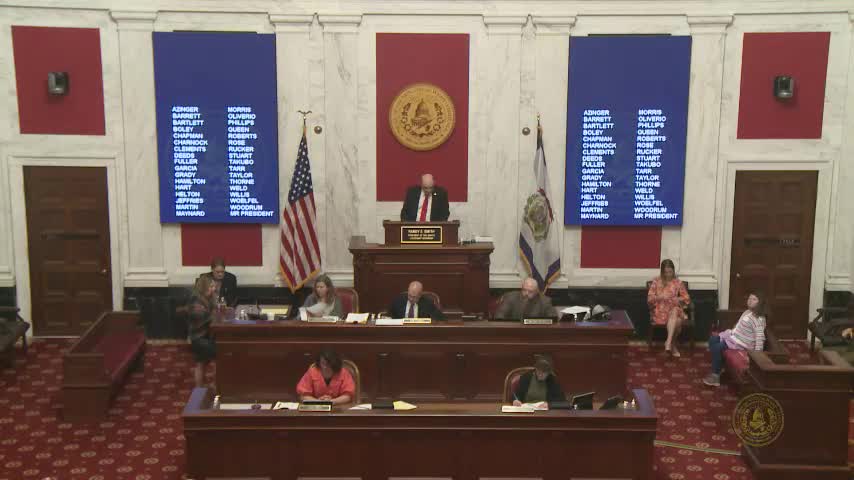
Summary
The Senate concurred in House amendments to a bill changing judicial compensation and pausing employer contributions to the judicial retirement plan while the plan remains highly funded. The measure passed and the Senate voted to make part of the bill effective July 1, 2025.
The West Virginia Senate concurred in House amendments to a bill that will pause employer contributions to the judicial retirement plan and authorize multi-stage judicial pay raises. The Senate recorded final passage by roll-call: 32 yeas, 1 nay, 1 absent. The Senate also voted to make part of the bill effective July 1, 2025 with the same roll-call result and stated it met the two-thirds threshold for immediate effectivity.
The clerk reported the House had amended and passed the committee substitute for the bill. Senator from Lewis moved concurrence in the House amendment. Senior senator from the Thirteenth explained the bill’s major provisions: beginning July 1, 2025, the employer will discontinue contributions to the judicial retirement plan; employee contributions will be locked at 7 percent. The senator said the employer contribution pause remains in effect “until the funded percentage drops below 125%,” and noted the current funding level is 243 percent.
The senator outlined pay increases across judicial classes: effective July 1, 2026, a $5,000 increase for the Supreme Court of Appeals justices, $5,000 for intermediate Court of Appeals judges, $5,000 for circuit court judges and $10,000 for family court judges; on July 1, 2027, an additional $5,000 pay raise for each of the four judicial classes.
Senator from Cabell echoed support in brief remarks, saying judicial officers are underpaid compared with other jurisdictions and urging passage. After brief discussion, the Senate concurred in the House amendment and passed the bill (32-1-1). The senator then moved that the bill be made effective July 1, 2025; the Senate voted 32-1-1 and the chair declared that more than two-thirds of those elected voted in the affirmative, making the bill effective on that date. The clerk will communicate the action to the House.
The transcript does not include the statutory text changes, actuarial analysis or fiscal-note details; those items are not specified in the spoken record.