Get Full Government Meeting Transcripts, Videos, & Alerts Forever!
Get email alerts on the House Bill 76 Education topic
No spam. Unsubscribe anytime.
House Education Committee continues review of governor's education bill, holds House Bill 76 for further consideration
Summary
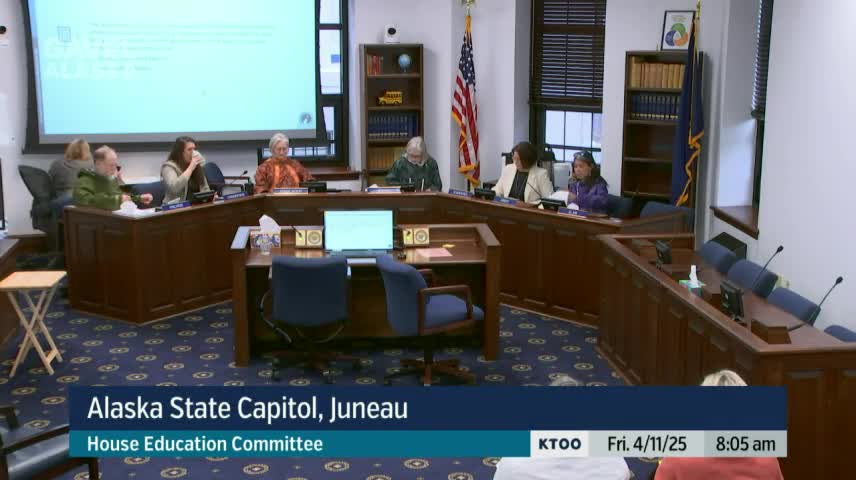
The House Education Committee met April 11 in the Bettye Davis Conference Room to continue work on House Bill 76, the governor's education package. Committee co-chair Representative Andy Story held the bill over for further consideration.
The House Education Committee met April 11 in the Bettye Davis Conference Room to continue work on House Bill 76, the governor's education package. Committee co-chair Representative Andy Story held the bill over for further consideration at the close of the hearing.
The bill packages multiple changes to K-12 funding and programs. Department of Education and Early Development Commissioner Dina Bishop and Deputy Commissioner Karen Morrison introduced the measure and answered lawmakers' questions. Heather Heineken, director of finance and support services, presented the bill's fiscal notes to the panel.
Why it matters: HB76 would change how the state funds several school programs and could shift budget exposures between the state and local districts. Lawmakers pressed department officials on how the changes would affect school planning, rural districts and long-term state obligations.
Major provisions and department summaries
- School bond debt reimbursement moratorium: HB76 would extend the moratorium on state school bond debt reimbursement until July 1, 2030, language the department described as tied to the state's capacity to pay. Commissioner Bishop said, "The reimbursement part is really based off of the state's ability to pay." The department's presentation noted past lump-sum payments tied to COVID-relief funds and described the program's historical 60/40 and 70/30 cost-sharing mechanics.
- Pupil transportation: Department testimony said the governor's proposal increases per-student transportation funding by about 20 percent; the presentation listed an annual transportation increase of roughly $14.5 million. Director Heineken's fiscal note recorded a transportation cost estimate of $14,517,000 and an example in-lieu reimbursement scenario estimated at $3,366,000 annually beginning FY2026, based on a $15 daily rate and 180 days.
- Residential (boarding) schools and career and technical education (CTE): The bill would increase annual funding for state-operated residential schools by $4 million to support regional residential centers and CTE programming. Committee members highlighted the role of residential schools as both CTE providers and, in some cases, safe havens for students.
- Correspondence (remote/homeschool) funding and CTE factor: The governor's draft would move correspondence students from a 0.9 factor to 1.0 in the adjusted average daily membership (ADM) calculation and raise the CTE factor (presented as moving from 1.015 to 1.04). Department slides said those formula changes would amount to about a $75.2 million annual investment; Heather Heineken's fiscal note referenced $75,213,000 recorded through the public education fund.
- Teacher recruitment and retention lump-sum pilot: The bill would create lump-sum payments intended as a three-year pilot to recruit and retain teachers in hard-to-staff areas. The department described a $55 million lump-sum package with tiered payments (examples given: $5,000 for large districts, $10,000 typical, up to $15,000 for very remote locations). The department said the lump sums would be included in retirement calculations.
Fiscal notes and budget mechanics
Heineken told the committee there are multiple fiscal notes attached to HB76; several items transfer general fund authority into the public education fund. She described the correspondence/CTE changes as recorded in the public education fund ($75,213,000) and the transportation increase as $14,517,000. The department's presentation also aggregated several student-achievement and program administration costs (positions, legal/regulatory costs, and one-time equipment or chargebacks) as part of the fiscal packages attached to the bill.
Concerns and discussion points raised by lawmakers
- Planning uncertainty and moratorium length: Several representatives said extending the reimbursement moratorium for five years raises planning questions for districts that hope to rely on a future state share when approving local bonds. Commissioner Bishop told members the extension appears tied to state fiscal capacity and said the department and the Bond Reimbursement and Grant Review Committee (BRGR) are exploring options, including a committed state funding allocation that would stabilize district expectations.
- Rural equity and application capacity: Lawmakers and department staff emphasized that rural districts and REAAs (regional educational attendance areas) face higher facilities deficits and have less capacity to prepare CIP/major maintenance applications. Committee members urged targeted supports for rural facilities planning.
- Correspondence funding and accountability: Members debated moving correspondence students from 0.9 to 1.0 in the formula. The department said the change is intended to better reimburse districts that operate correspondence programs for the services they provide (administration, testing coordination, part-time in-person services), while acknowledging that testing participation and proctoring remain barriers. Commissioner Bishop noted the department is working with vendors and districts to expand proctored remote assessment options and to incent participation through grants.
- Teacher lump-sum design: Representatives asked whether one-time pilot payments might produce short-term retention but leave longer-term salary and recruitment incentives unresolved. Several members suggested linking incentives to proven retention strategies (for example, national board certification targeting) and to prioritize an eventual base student allocation increase if lawmakers choose to increase recurring salary capacity.
Committee action and next steps
At the end of the hearing, co-chair Representative Andy Story announced House Bill 76 would be held over for additional hearings. The committee scheduled additional education presentations and bill work for the following week including testimony from the Bond Reimbursement and Grant Review Committee and a separate bill on Mount Edgecumbe and teacher housing.
Ending note: The department told the committee it will provide follow-up enrollment and trend data (for residential schools and correspondence programs) and clarified multiple fiscal-note line items upon request. No formal votes on HB76 were taken at this session.