
Council launches scoping for Pacific salmon EFH review; staff to issue call for information
Get AI-powered insights, summaries, and transcripts
Subscribe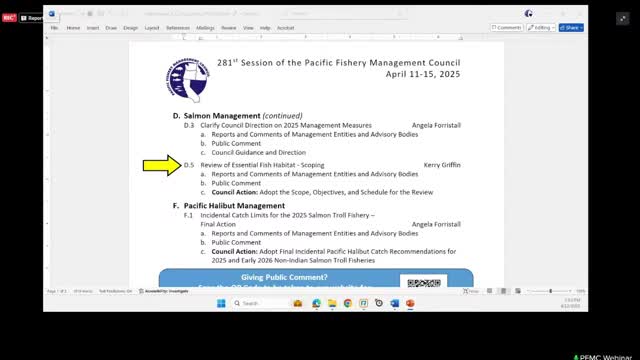
Summary
The council approved scoping and a draft call for information to start an essential fish habitat review for Pacific salmon, emphasizing a two‑phase information‑gathering process and the need for state and tribal participation, but noted that staffing and funding constraints may affect schedule.
The Pacific Fishery Management Council adopted a scoping plan April 12 to begin a review of Essential Fish Habitat (EFH) for the three Pacific salmon species the council manages (Chinook, coho and Puget Sound pink). The scoping document and a draft call for information in the briefing book set out a two‑phase review: an initial information gathering and synthesis followed by a phased evaluation of potential changes.
Staff overview: Carrie Griffin (council staff lead) outlined the work plan and explained the review must cover the 10 mandatory EFH components described in federal regulations, including identification of EFH, description of fishing and non‑fishing impacts, and recommended conservation measures. She said the council last completed a salmon EFH review in 2014 and that the council will follow the council operating procedure that calls for a phase‑1 report that documents new information and a decision on whether to proceed to a phase‑2 rulemaking and possible regulatory changes.
Maps and methods under review: council staff displayed maps showing the council’s current EFH footprint – coastal marine waters to U.S. EEZ limits south to Point Conception and inland freshwater waters described at the fourth‑field hydrologic unit scale. Staff explained potential refinements under consideration, including moving from large watershed (fourth‑field HUC) designations to finer‑scale sixth‑field HUCs or stream‑corridor delineations, and using new spatial tools to identify habitat accessibility and quality.
Participation and constraints: staff and the Habitat Committee urged state and tribal participation and noted that some tasks, such as a literature review and GIS analyses, will require assigned staff or contractor support; the committee and staff cautioned that current federal staffing and funding uncertainty could require schedule flexibility.
Next steps: the council approved circulating the call for information and instructed staff to publicize it and coordinate with advisory bodies, state agencies, tribes, NOAA Fisheries EFH coordinators and science centers. The draft schedule in the briefing book proposes a phase‑1 synthesis in April 2026 and a subsequent phase‑2 review if the council elects to proceed.
Ending: staff will post the call for information and begin outreach to states, tribes and research organizations; the council will revisit phase‑1 results and any proposal for changes after the information gathering concludes.