
Council sends Sacramento River work group measures to methodology review, asks staff for roadmap before applying changes
Get AI-powered insights, summaries, and transcripts
Subscribe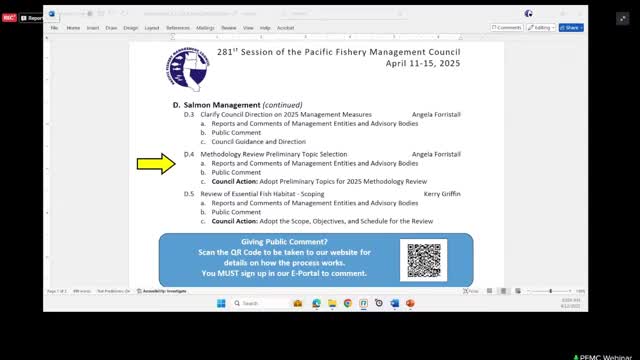
Summary
The council agreed to send the Sacramento River Fall Chinook work group's items for review but voted that any new reference points not be applied to management until the council receives a holistic package and a sequencing roadmap from staff and the work group.
The Pacific Fishery Management Council voted April 12 to send two Sacramento River Fall Chinook work group topics to the salmon methodology review but directed staff to hold off applying any outcomes directly to annual management until the council considers a holistic package of updated reference points, the conservation objective, and a harvest control rule.
What the council adopted: Council member Marcy Remco moved and the council approved adding the work group’s items 1 and 3 (derivation of natural‑origin SMSY and methods for setting total escapement objectives that combine hatchery and natural needs) to the preliminary list of topics for the October 2025 methodology review. The motion also directed council staff, in consultation with the Salmon Technical Team and the Sacramento River Work Group, to produce a document outlining steps and sequencing required to update the full set of Sacramento River Fall Chinook reference points and conservation objective. The motion passed with one recorded “no.”
Why the council paused implementation: several council members and advisory bodies urged that updated reference points be evaluated together so the escapement objective, SMSY and harvest control rules are coherent when implemented. Council member Mark Guralnick presented a data‑driven argument showing recruitment ratios and productivity have declined since brood years before 2004, and he said managers should “ground truth” any proposed new escapement objective against recent production conditions before changing how the stock is managed.
Scope and next steps: the Sacramento River Work Group proposed three items for review: (1) methods to derive natural‑origin S_MS Y for Sacramento River fall Chinook using juvenile production indices with flow covariates; (2) methods for evaluating consequences of changes in allowable exploitation rates and forecast performance (including bias/uncertainty); and (3) methods to derive combined hatchery+natural escapement objectives that meet natural production and broodstock needs. The Scientific and Statistical Committee and the Salmon Technical Team supported topics (1) and (3) for the 2025 review; the STT recommended topic (2) could be reviewed later given other priorities and workload.
Council direction: the staff roadmap requested by the council must describe sequencing, timeline and what products or additional analyses will be needed before any updated reference points are used in annual management decisions. That roadmap is to be returned to the council at its September 2025 meeting.
Ending: the council’s action sends the technical work forward for formal methods review while preserving a policy decision point: the council will not adopt or start using revised reference points without first reviewing a packaged, sequenced set of changes.