
Habitat Committee reports coho gains, Klamath dam effects and NEPA changes; council to consider committee recommendations
Get AI-powered insights, summaries, and transcripts
Subscribe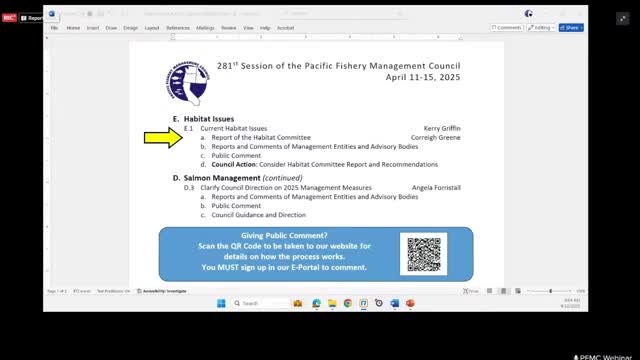
Summary
The Pacific Fishery Management Council was briefed April 12 by its Habitat Committee on state and federal actions that could affect West Coast habitat, including a California sea‑space report for wave and tidal energy, strong coho returns after stream restoration in Mendocino County, early biological gains in the Klamath following dam removals, and a delay in scoping for the Columbia River Systems Operations SEIS.
The Pacific Fishery Management Council’s Habitat Committee reported April 12 on multiple habitat issues affecting West Coast salmon and other managed species, including progress on California’s wave and tidal energy planning, results from restoration projects in Mendocino County, changing disease and hydrology conditions after removal of Klamath dams, and a delay in the Columbia River Systems Operations supplemental environmental review.
The committee’s chair, Dr. Scott Hapelle, told the council the committee reviewed a draft Phase 2 consultant report produced under California Senate Bill 605 on wave and tidal energy siting and that the California Energy Commission’s sea‑space analysis is out for a 45‑day public review. “The report included tidal and wave energy potential along the California coast, technology considerations, sea‑space conflicts, and protective measures for environmental and ocean user impacts,” Hapelle said.
Why it matters: the committee’s review flags both opportunities and potential conflicts from new ocean‑energy development and identifies points where the council can offer science‑based comment to state regulators.
The committee also highlighted habitat restoration results in Mendocino County, reporting that more than 5,500 adult Central California Coast coho returned in the 2023–24 spawning season, exceeding NOAA’s published recovery target of 3,700 for the first time. “Following six years of habitat restoration on the lower Ten Mile River in Mendocino County, endangered juvenile California coastal coho salmon are utilizing newly restored winter stream and floodplain habitat, including habitat not used in the last 70 years,” Hapelle said. The Habitat Committee noted partner organizations included NOAA’s Office of Habitat Conservation, The Nature Conservancy and Trout Unlimited.
Klamath system: the committee reported biological improvements as the river adjusts to removal of the lower four dams. In fall 2024, more than 2,000 fall‑run Chinook expanded into newly opened habitat and spawned upstream of former barriers. The committee described reductions in the polychaete worm that hosts the parasite Ceratonova shasta and said water samples through mid‑April detected no C. shasta spores. However the committee flagged management uncertainty: the Bureau of Reclamation (BOR) is reviewing how Oregon water adjudication and other legal considerations may affect releases to the Klamath main stem and a compliance point used in BOR operations has shifted upstream to Keno Reservoir following dam removals.
Columbia River systems operations SEIS: the Habitat Committee also reported the U.S. Army Corps of Engineers and the Bureau of Reclamation announced a delay in scoping for the Columbia River Systems Operations supplemental EIS. The committee said the delay follows an interim final rule and guidance issued with Executive Order 15154 directing changes to how the Council on Environmental Quality (CEQ) administers NEPA implementation. The committee cautioned the change “will likely affect all NEPA reviews” and said it will continue tracking the SEIS scoping process.
What the council will do: committee chair Hapelle told the council the Habitat Committee had produced two supplemental reports for the briefing book; the council will consider the committee’s recommendations and may provide guidance or submit comments on specific items such as the California sea‑space analysis or the CRSO scoping when the timing is appropriate.
Ending: committee members encouraged staff and council members to use the supplemental reports in the briefing book to inform any comment letters; the committee also reminded the council of outstanding positions on some habitat boards, such as a commercial fishing seat on the National Fish Habitat Board with a nomination deadline noted in the report.