
San Diego Community Power advisory committee reviews state, federal energy legislation
Get AI-powered insights, summaries, and transcripts
Subscribe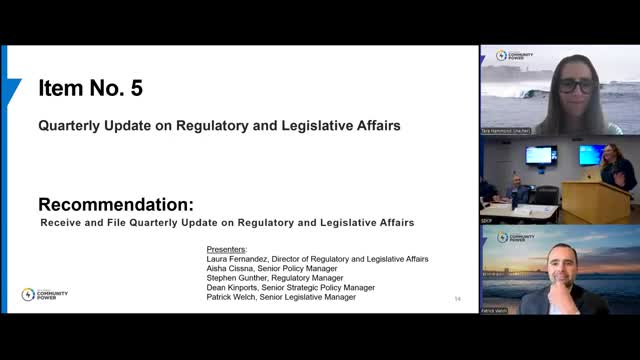
Summary
At its April 10 meeting the Community Advisory Committee received a regulatory and legislative briefing on state bills and federal tax-credit negotiations that staff say could affect financing, customer affordability and program funding.
At its April 10 meeting, the San Diego Community Power Community Advisory Committee heard a regulatory and legislative briefing on bills in the California Legislature and on federal tax-credit negotiations that staff said could affect financing and affordability for local clean‑energy projects.
The presentation listed several bills staff are tracking or supporting. Patrick Welch, senior legislative manager, described SB 239 as a proposal to modernize teleconferencing rules for subsidiary advisory bodies such as the Community Advisory Committee. He said SB 302 would align state rules with federal law for transferable tax credits, which staff estimate could lower project costs “between 1 to 6%.” Welch said SB 330 (identified during the briefing as a financing pilot) seeks to create a public financing tool for transmission, with the intent of lowering ratepayer costs through public capital; he described the measure as focused on financing, not on how new lines would be designed. He said SB 540 would allow the California Independent System Operator to participate in a regional electricity market and that SB 710 would extend a property‑tax reassessment exclusion for rooftop solar and battery storage installations.
Welch told the committee that affordability is “top of mind” in Sacramento, and that the group has been active on debates over whether ratepayer‑funded customer programs should continue. He said Community Power joined 38 organizations to defend energy efficiency funding and to advocate for a federal‑ and state‑level policy environment that preserves incentives for residential storage and electrification.
On federal issues, staff said they are coordinating with other community choice aggregators to protect investment and production tax credits and consumer tax credits for residential electrification and battery systems amid congressional budget negotiations. Welch said those credits reduce costs for both wholesale procurement and customer‑side electrification projects.
Why it matters: staff said the bills and federal decisions could change the cost of clean‑energy projects, the pace of transmission development and the availability of funds for local programs such as the Solar Battery Savings pilot. Committee members asked for clarifications about whether the transmission financing bill would require undergrounding (staff said it would not address design) and about how imports and exports would be treated under a regional market; staff said imports already amount to roughly 30% of California’s annual power and that any regional market would include mechanisms to account for greenhouse‑gas costs.
The briefing was presented by the community power regulatory and legislative team and followed by questions from committee members.