Get Full Government Meeting Transcripts, Videos, & Alerts Forever!
Get email alerts on the Commercial Solar Special Use topic
No spam. Unsubscribe anytime.
Lee County zoning board hears technical, health and property concerns over two Mount Hill Road solar projects
Summary
At an April 10 public hearing, residents questioned developers and engineers about corrosion, groundwater, drain tiles, glare, property-value impacts and decommissioning for two proposed commercial solar facilities on Mount Hill Road; the board recessed until April 14 for further testimony.
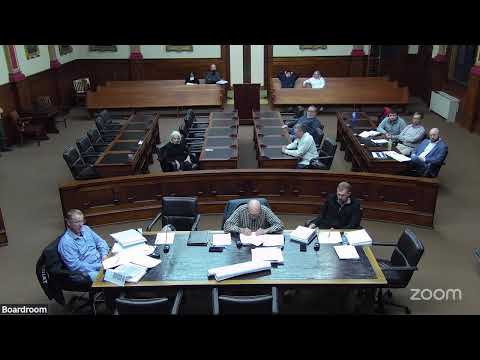
The Lee County Zoning Board of Appeals held a public hearing April 10 on special-use permit applications from Mound Hill Road North Solar LLC and Mound Hill Road South Solar LLC to construct and operate commercial solar energy facilities on Mount Hill Road.
Residents raised questions about potential soil and groundwater contamination from galvanized steel piles, the depth of pile driving, damage to agricultural drain tiles, traffic and visual glare, and the effect on nearby property values. Petitioners’ witnesses outlined design choices, permitting steps and decommissioning estimates and said some details will be finalized during later engineering and permitting.
The hearing matters because neighbors and the county must weigh potential long-term environmental and agricultural impacts, access and emergency-response planning, and whether mitigation measures in the application are adequate before any special-use permits are granted. The board recessed the hearing to continue testimony on April 14.
Petitioners’ lead witness, identified in the hearing as Mr. Schwer, said the two Mound Hill LLCs are lessees of the parcels and that Clean Capital Holdings is currently the LLCs’ owner. Asked whether a foreign government might purchase the projects, Schwer said, "It's unlikely that a sovereign nation would purchase the projects. It will likely be an asset manager." On radio interference, he said, "There would not be" interference with the nearby Midway Drive-In. Schwer also told the board that the project’s final pile type "will be determined in final engineering," and that piles would "likely" be galvanized steel.
Civil engineer Andy Gulone of Civil & Environmental Consultants (CEC) described site surveys and the revised site plans, and summarized the firm’s work on the application: ALTA boundary surveys, wetland delineations, correspondence with the U.S. Army Corps of Engineers and the Illinois State Historic Preservation Office (SHPO), the decommissioning report, an emergency-response plan and the site plan. Gulone said the Corps concluded no permit was required because the company found no stream or jurisdictional wetlands on the sites, and SHPO had cleared the projects for no further archaeological or structure study.
Gulone said moving both arrays east under the revised plan placed much of the South project on the downslope side of a ridgeline so "the natural terrain of the ground will block the majority of the solar panels." He said the North array was moved about 300 feet and the South about 600 feet from earlier layouts. He described access roads as stripped of about 12 inches of topsoil, layered with geotextile fabric and approximately 12 inches of IDOT class 6 aggregate; that topsoil would be stockpiled on-site and replaced during decommissioning.
On stormwater, Gulone said the project’s vegetative plan—"a pollinator seed mix"—is expected to reduce runoff compared with current row-crop conditions. "It'll reduce the flow," he said, explaining that conversion from row crop to deep-rooted vegetation lowers the curve number used in hydrology calculations. He also said preliminary stormwater calculations had been prepared and that final hydrology and geotechnical reports would be finished before building permits.
Residents pressed health and contamination concerns tied to galvanized piles. One resident asked whether zinc or lead from galvanization could leach into soil or groundwater; Schwer replied that the lease contracts contain "environmental remediation clauses that would govern that," and that the developer would not plan to test neighboring private wells as a routine project step. Gulone and other witnesses said groundwater-monitoring wells were not yet drilled and that a true groundwater table study would require monitoring wells.
On pile depth and longevity, Gulone said "typically, pylons are driven 7 to 8 feet in the ground." He said concrete-ballasted systems have been used on capped sites such as landfills but that driven piles are typical for agricultural sites. Gulone said the project team completed geotechnical borings the prior week and that final pile selection would follow those borings and the structural certification required for permitting.
The petitioner submitted a signed, sealed decommissioning report. Gulone summarized the report’s accounting categories: a total demolition and restoration estimate, a salvage estimate and a net demolition cost. He said applicants will be required to post a bond for decommissioning. In response to a resident’s question about the estimated quantity of steel, Gulone said the North project’s decommissioning estimate showed about 90 metric tons of steel for racking and piles.
On operations and community benefits, Schwer said construction would likely generate "15 to 30 construction jobs" and "one or two operations and maintenance jobs" and that any subscriber bill credits would be set by the operator and "have to be 10%." He clarified the bill credits would flow through the utility and be paid from project revenues, not by the federal government.
On interconnection and ownership, petitioners said each facility will have its own point of interconnection on-site and will feed along three-phase lines on Mount Hill Road back to a substation on River Road in Sterling, about 3.5 miles away; equipment beyond the point of interconnection will be owned by ComEd. Petitioners also confirmed they will finalize an ILR10 land-disturbance permit from the Illinois Environmental Protection Agency and a road-use agreement with the Palmyra Township Road District before construction.
Residents and the board asked about emergency-response coordination and whether site procedures had been provided to local responders; petitioners said updated emergency-response materials and an annual training provision were in the revised materials but that direct coordination with responders typically occurs before building permits are issued, not before special-use approval. Petitioners noted they had not yet delivered full materials to responders.
The hearing included cross-examination and multiple resident questions about drain-tile surveys (recommended and typical before a building permit), the risk of inadvertently missing tile locations, responsibilities to repair damaged tiles, and whether road entrances include long-term devices to trap aggregate. Petitioners said drain-tile surveys are typical and that drain-tile impacts must be repaired and addressed in agricultural-mitigation agreements. They said construction-phase measures such as a rock construction entrance and regular road cleaning would be required under the stormwater pollution prevention plan.
No final vote on the special-use permits was taken on April 10. The board recessed the hearing and scheduled continuation for Monday, April 14, 2025, at 6:30 p.m. at the Old Lee County Courthouse; petitioners said property-value witness Mike Marus would be available at a later session to present a property-value impact report and be subject to cross-examination.
Upcoming items planned for the resumed hearing include testimony from the property-value witness, additional technical detail from civil engineering and geotechnical reports, and any further questions from residents or board members.