Get Full Government Meeting Transcripts, Videos, & Alerts Forever!
Get email alerts on the Hazardous Waste Regulation topic
No spam. Unsubscribe anytime.
MassDEP to adopt selected parts of EPA generator improvement rule and add legitimacy criteria to recycling rules
Summary
The Massachusetts Department of Environmental Protection said it will adopt selected provisions of EPA’s 2016 Hazardous Waste Generator Improvement Rule and incorporate EPA legitimacy criteria into state recycling regulations, while leaving other GIR provisions out of the current package.
The Massachusetts Department of Environmental Protection (MassDEP) said it will adopt selected provisions of the U.S. Environmental Protection Agency’s 2016 Hazardous Waste Generator Improvement Rule and incorporate EPA’s legitimacy criteria for recycling into 310 CMR 30 as part of the next regulations package.
A MassDEP staff member said the agency expects to pick up provisions that MassDEP considers substantively useful for the state program: clearer marking and labeling requirements for tanks, containers and satellite accumulation areas; notification requirements for large quantity generators (LQGs) planning facility closure; a four‑year re‑notification requirement for very small quantity generators (VSDGs/SQGs); quick‑reference guides for contingency plans; arrangements between small/very small quantity generators and local emergency planning officials; and clarifications to the biannual report to require identification of all hazardous waste generated in the calendar year. “At this point, what we’re certain of, fairly certain of, is that we will be adopting some portions of the generator improvement rule, and then separately, the legitimacy criteria,” the staff member said.
MassDEP said it also plans to apply EPA’s legitimacy criteria (published at 40 CFR 260.43) to the state recycling rules in 310 CMR 30. The staff member described the legitimacy factors as: whether the material provides a useful contribution to the recycling process, whether the recycling creates a valuable product, how the recyclable material is managed while under control of the generator or recycler, and whether the recycled product is comparable to products made from analogous raw materials. The agency said adopting those criteria would strengthen existing state recycling rules by providing clearer standards to distinguish legitimate recycling from “sham” recycling.
The staff member gave examples EPA has used to illustrate sham recycling, including: adding a hazardous secondary material that does not meaningfully contribute to a product’s properties; using a material in excess amounts relative to need; creating products for which there is no market; and handling materials in storage or units inconsistent with raw material management (for example, storing material in a leaking impoundment instead of a properly designed tank).
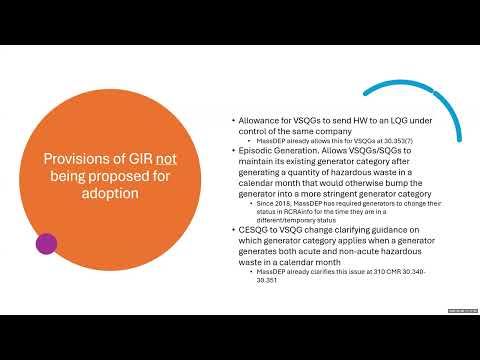
MassDEP noted two Class C recycling facilities in the state that recycle mercury; the agency said it would require facilities that recycle hazardous waste without storing to prepare a landfill plan for that material under the proposed clarification to the biannual report rules. The staff member also said MassDEP will not adopt the GIR allowance that would let VSDGs ship hazardous waste to an LQG under the same company because the state already permits self‑transport by VSDGs under 310 CMR 30.350(37) and similar provisions dating back to at least 1988.
MassDEP characterized other GIR elements — including episodic generation provisions and some generator‑status clarifications — as either not proposed for adoption or already addressed in state regulation or guidance. The staff member said the state’s electronic reporting system (since 2018) requires generators to change status and report temporary status changes, which the agency views as an adequate alternative to the episodic generation approach in the GIR.
The agency asked stakeholders to comment on the proposed selections and to identify any state‑specific rule language they believe should change; MassDEP said it will consider stakeholder input as it finalizes the draft regulations for public comment.
Ending: MassDEP said it expects to complete a finalized list of regulations, draft the public comment package and hold the required public hearings later in the rulemaking timeline, though the agency cautioned that authorization and internal review can lengthen the process and that the full package could take a year or more to finalize.