Get AI Briefings, Transcripts & Alerts on Local & National Government Meetings — Forever.
Caltrans outlines timeline and modeling approach for 2025 California Transportation Plan update
Summary
Caltrans presented its planned 2025 update to the California Transportation Plan, saying a draft will be released for public comment in July and finalized by December, and that the update emphasizes a fiscal analysis, a 20-year horizon and a modeling approach staff described as more 'feasible' than the prior plan.
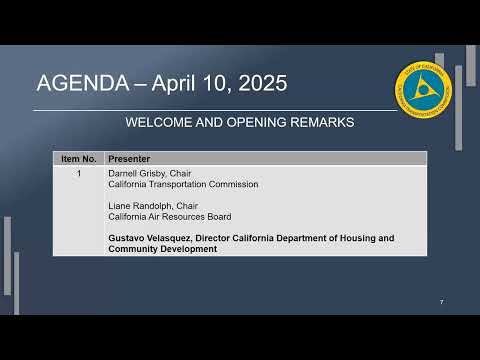
Good afternoon. Caltrans presented its planned 2025 update to the California Transportation Plan (CTP), telling the joint meeting of the California Transportation Commission, the Air Resources Board and the Department of Housing and Community Development that the draft will be released for public comment in July and finalized by December.
Hannah Walter, Deputy Division Chief for the Caltrans Division of Transportation Planning, said the CTP update covers a 20-year planning horizon and includes required sections on goals, strategies and a new fiscal element. "The California Transportation Plan is required by state and federal law," Walter said, and the update adds a fiscal analysis required by recent legislation to estimate the cost of implementing proposed strategies.
The department told commissioners the main technical focus for the update is threefold: greenhouse gas (GHG) reductions, vehicle miles traveled (VMT) goals and a fiscal assessment of revenues and costs over the next decade. Walter described the plan’s approach to modeling as an effort to present a realistic, feasible estimate of future conditions and then identify a suite of strategies to close the gap between that estimate and the state’s GHG and VMT targets. "We used our statewide travel demand model to do a technical analysis to support a look at where we think we'll be in the future for GHG and VMT," she said.
The modeling approach drew public and stakeholder questions. Sofia Ravikova of the Coalition for Clean Air, who also serves on the CTP Policy Advisory Committee, said the committee had promoted strategies such as increased transit access, pedestrian and bicycle infrastructure and pricing policies, but that Caltrans’ updated model showed those strategies as less effective than earlier runs. "This model not only undermines the strategies recommended by the PAC by labeling them as less effective, but is also not consistent with state law as it focuses on strategies deemed reasonable instead of looking at what is feasible and necessary to achieve GHG reductions," Ravikova said.
Greg McIntyre of the California Association of Councils of Governments told the panel he supports the use of more "realistic fiscal data and planning assumptions" in the model but urged that realism be paired with a commitment to implement and change policy. "Models are used to develop strategies and they help identify trends. They are not expected to predict exact futures," McIntyre said.
Caltrans staff said the difference between this and the prior CTP is methodological: instead of modeling a set of recommended strategies as if implemented, staff first ran a scenario intended to show a feasible future state and then evaluated what additional strategies would be needed to reach statutory targets. Walter said the plan will propose performance measures, strategy recommendations and a fiscal element to show costs and tradeoffs, and that staff will publish a draft for public comment in July followed by final approvals in September–December.
Commissioners and agency leaders pressed Caltrans on equity, health and on-the-ground implementation details; Walter replied that equity and public health are among the plan’s eight goals and that the draft includes proposed metrics and an implementation "dashboard" for tracking recommended actions. Several commissioners asked for additional briefings to examine modeling assumptions, the plan’s use of off-model tools, and the relationship between regional housing allocations and transportation needs.
Caltrans and the other agencies committed to continuing coordination. Director Gustavo Velasquez of HCD and others asked that the plan include stronger consideration of infill housing and align housing assumptions with the state’s housing accountability work. Caltrans reiterated it will release the draft for public comment and that the department welcomes input during the summer comment period.
The commission scheduled further briefings and public engagement before the plan is finalized later this year.