Get Full Government Meeting Transcripts, Videos, & Alerts Forever!
Get email alerts on the Elections Poll Management topic
No spam. Unsubscribe anytime.
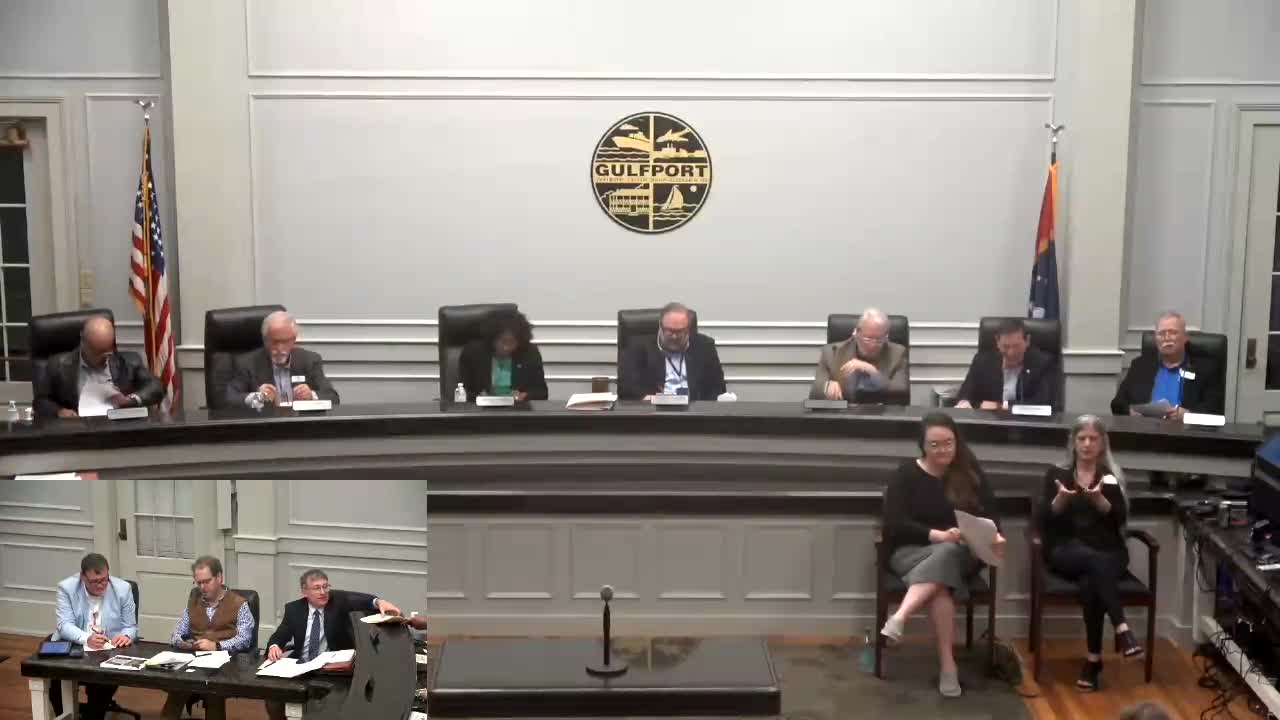
Gulfport debate over poll managers fails as council declines late ordinance ahead of primary
Summary
Election organizers asked the council to increase the number of Democratic poll managers ahead of the April 1 primary, citing manual check-in burdens after redistricting and high registration counts. The council declined the late-filed ordinance after public comment and statutory timing concerns.
Election officials and local party volunteers urged the Gulfport City Council to increase the number of poll managers for the Democratic primary because redistricting, an unusually large candidate list and manual check-in procedures would create heavy workloads at some precincts.
Sandra, who identified herself as a local election organizer, told the council she had reviewed voter rolls and trainings and asked the council to allow up to 150 poll managers citywide for the Democratic primary. "We want this to run as smoothly as possible," she said, describing large ward totals and the logistical challenges of handling paper books without the usual electronic check‑in. She and other volunteers requested the authority to expand staffing to avoid long lines and voter frustration.
City Attorney Jeff Bruni explained the statutory baseline: state law establishes a minimum of three poll workers per precinct and allows up to six without council authorization; any number above six requires council approval. Several council members and staff raised concerns about timing: an ordinance not passed unanimously would require a 30‑day waiting period to take effect, a window that would likely miss the April 1 primary. Budget implications were also discussed; staff noted the city had not budgeted for more than the standard level of poll-worker compensation and that increasing the cap could carry a near‑term cost in the low five figures depending on how many additional workers actually served.
Council members also pressed party leaders on practical details: how many trained workers were already certified, how precincts were distributed across wards and precinct-by-precinct staffing needs. Party organizers described a mix of experienced volunteers and newly trained workers, and they said some long-time volunteers had completed training but still needed municipal certification paperwork.
After more than an hour of public comment and council deliberation, a motion to adopt the ordinance as presented failed on the council floor; the clerk recorded the vote as a defeat. Councilmembers cited statutory limits, short notice for an ordinance change, and budget/timing risks as reasons to decline the late add-on, while the public commenters stressed the operational difficulty of a manual election process and redistricting effects.
The council and staff discussed alternatives: party executive committees can choose up to six poll workers per precinct without council intervention; local party executives and city election staff agreed to coordinate to redistribute available volunteers and prioritize high‑demand precincts. Councilmembers urged faster administrative planning and earlier notice if future changes will be needed prior to an election.