Get Full Government Meeting Transcripts, Videos, & Alerts Forever!
Get email alerts on the Affordable Housing Policy topic
No spam. Unsubscribe anytime.
Council reviews draft affordable-housing definition and fee-reduction matrix; staff recommends 30-year minimum restriction
Summary
Staff proposed revisions to the city's affordable-housing definition, suggested a 30-year minimum affordability restriction, recommended accepting DOLA-recognized affordability mechanisms, and presented a redrafted fee-reduction table tied to AMI levels; council asked for further data on senior housing AMI distribution and ADU fee impacts.
City staff presented proposed revisions to Brighton’s affordable-housing definition and a redrafted fee-reduction matrix, recommending a 30-year minimum affordability restriction, acceptance of Department of Local Affairs (DOLA)-recognized affordability mechanisms and fee-reduction amounts tied to AMI levels.
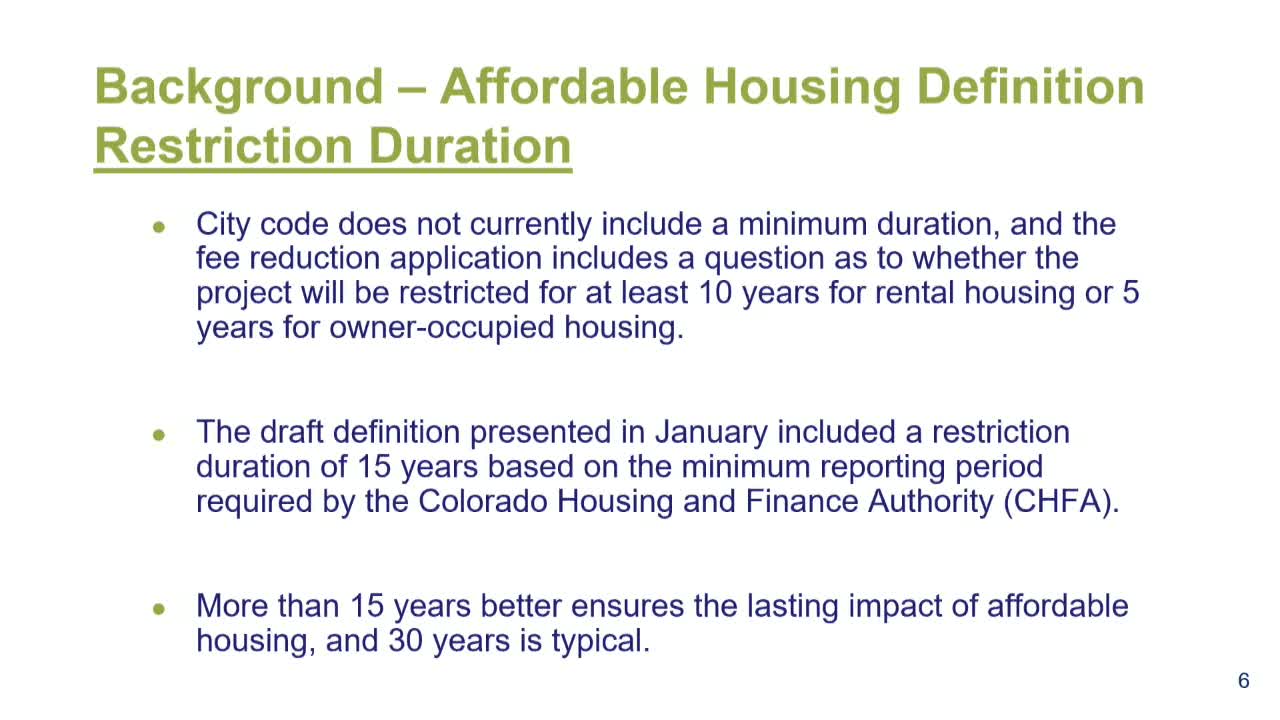
Sean Wayman, affordable housing coordinator, and staff explained that the city’s draft definition had previously used a 15-year duration drawn from CHFA guidance, but CHFA restriction agreements commonly run to 30 years. Staff recommended a minimum 30-year restriction and accepting either deed restrictions or CHFA land-use restriction agreements that DOLA recognizes. "Staff recommends...a minimum 30 year restriction and accepting affordability mechanisms that are recognized by DOLA," the presentation stated.
Staff showed a revised fee-reduction table where reductions are generally calculated as (100% minus the project AMI). Using the Ravenfield senior housing assumptions, staff estimated the city would forgo roughly $238,000 in use tax and $582,000 in impact fees — a combined $820,000 reduction — with an additional $176,000 transfer from the general fund to the enterprise fund to keep utility funds whole in that example. Staff said details not shown in the packet were added to clarify how enterprise fund fee reductions require a general-fund transfer to maintain utility fund balance.
Council members asked targeted questions. Mayor Putnam endorsed the 30-year restriction and asked staff to pursue potential ADU impact-fee reductions under Proposition 123 grant funding; staff confirmed an application was submitted to study ADU fee impacts and infill opportunities. Mayor Putnam also asked whether the 60% AMI senior housing discount matches actual senior incomes; staff responded Ravenfield averages were expected in the 50s AMI range and recommended further analysis. "Primarily, that was based on the proposed Ravenfield project, which is going to average less than 60% in the 50s AMI range," staff said.
Council discussed ADU size limits and terminology changes: staff proposed deleting "large family" as a population group, replacing "elderly" with "senior" (defining senior projects with a 55-year minimum) and replacing "disabled" with "persons with disabilities." Staff noted a maximum ADU size of 1,200 square feet and that ADU living area cannot exceed the primary residence.
Council did not adopt code amendments at the study session; staff requested direction and asked to bring draft code changes and a resolution adopting the fee table forward for first reading after further refinements.