Get Full Government Meeting Transcripts, Videos, & Alerts Forever!
Get email alerts on the Battery Energy Storage topic
No spam. Unsubscribe anytime.
Gratiot County holds public hearing on battery storage ordinance as residents raise safety, property and oversight concerns
Summary
At a March public hearing, planning staff outlined draft zoning language to regulate utility-scale battery energy storage systems; residents and emergency services raised fire-suppression, emissions, decommissioning and property-value concerns while planning commissioners discussed options under a recent state law.
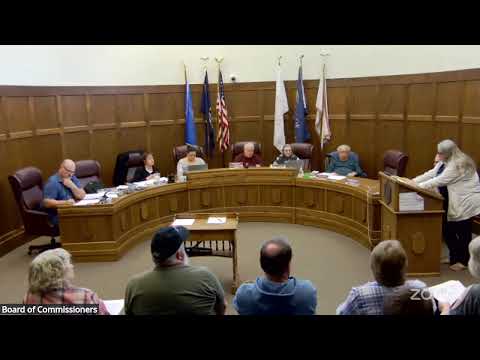
Gratiot County commissioners and planning staff held a lengthy public hearing and community discussion on a proposed zoning amendment to regulate battery energy storage systems (BESS) in the county, drawing more than a dozen public speakers and extended technical explanation from planning staff.
Deandra Messer, recording secretary for the county community development department, told the board the draft is a zoning amendment to add battery energy storage to the county's existing wind and solar ordinance. Messer said the change responds to a state law that now governs siting for large-scale renewable projects and gives counties three choices: adopt a local ordinance that mirrors the state; adopt no ordinance and cede siting to the state; or adopt a locally tailored ordinance that is as protective as the law allows. “We have 3 options,” Messer said, urging commissioners to consider a local ordinance that includes setbacks, decommissioning and emergency planning.
The hearing drew multiple residents who voiced opposition or asked for stronger protections. Tim Gustavison, who identified himself as a Gratiot County resident with health-care experience, warned of “toxic” gases and long-term health risks if battery systems catch fire or leak, saying the fumes can contain benzene and other hazardous compounds. “These batteries are known to emit gases upon recharging,” Gustavison said. Another resident, Steve Savage, pressed for clear siting near substations and robust fire suppression and training, arguing the county must require developers to fund equipment and training for local fire departments.
Dave Ringle, a member of the county planning commission who spoke during the hearing, pointed to draft ordinance language already addressing emergency coordination. He said the draft requires BESS owners or operators to provide an emergency operations plan and training for county emergency responders, to supply alarm and detection systems, and in some cases to fund equipment or training for affected fire districts. “The owner shall operate and coordinate with the entities above for further training and best practices,” Ringle said, summarizing provisions intended to limit first-responder risk.
Discussion among commissioners and staff focused on specific safeguards: setbacks, sound limits, alarms and detection systems, decommissioning and insurance. The draft includes setback proposals (examples discussed in the hearing: 400 feet from dwellings, 100 feet from nonparticipating property lines; some townships cited 1,000-foot buffers), a daytime sound cap (current draft 55 dBA with proposals for lower nighttime levels), and a requirement that the owner/operator carry substantial liability insurance. Messer and planning commission members noted draft language that a project owner must provide proof of public liability coverage naming the county and participating property owners and that the owner must guarantee decommissioning funds; the draft cited an example figure of $25,000,000 per occurrence as a model used in other ordinances.
Residents also pressed county staff on other protections: periodic review of decommissioning funds (planning staff suggested a review every three years), escrow or security deposits to cover county costs for consultants and potential decommissioning, and requirements that applicants pay for third-party post-construction noise or safety studies if complaints arise. Messer told the board applicant-funded escrow would cover consultant, engineering and legal review costs so the county would not bear review expenses.
Several speakers raised uncertainty about which agency regulates emissions and how building code and environmental authorities intersect with zoning. Messer said Michigan building code did not yet fully cover BESS structures and that building-code and state-level environmental and safety standards (for example, NFPA 855 and applicable UL component standards cited in the draft) will be listed in the ordinance as required standards for applicants to meet. Planning staff said specific safety and environmental approvals will be required from state building code, the health department or other state regulators as part of the special land use process.
The planning commission and staff asked the county board to treat BESS projects as special land uses with a public hearing and an applicant-funded escrow to pay for plan review. Messer and Ringle said special-use applications allow the county to require site-specific conditions (for example, additional setbacks or emergency-response requirements) beyond what a baseline ordinance would require.
BOARD ACTIONS AND NEXT STEPS: The planning commission will continue drafting the ordinance with input gathered at the hearing. Messer asked the board and attendees to submit specific written suggestions (setback distances, buffer types, water-runoff controls and required training/equipment for responders) so staff and the consultant can revise the text. Commissioners and staff signaled they intend to keep the process open for revisions, to consult local fire chiefs and the county emergency manager on emergency-response language, and to require applicant-funded third-party reviews where appropriate.
Votes at a glance: During the meeting the board approved several routine items and took votes unrelated to the BESS hearing, including approving the consent calendar, accepting the county equalization report, instructing staff to send a letter supporting a broadband BEAD grant application, authorizing purchase of IT equipment for central dispatch operations, and making routine appointments. Those votes were unanimous on voice votes or recorded as "aye"/"nay" without roll-call tallies in the public record.
Why this matters: The ordinance will shape where and under what conditions industrial-scale batteries, which are intended to store and dispatch grid electricity, can be sited in Gratiot County. Speakers at the hearing said the projects could affect firefighters' safety, neighboring property values, farmland loss, drainage and long-term site cleanup. Planning staff emphasized that state law constrains what local governments can do but also said a carefully drafted local ordinance can set stricter setbacks and safety conditions than basic state guidance.
The planning commission expects to continue work with its consultant and to return revised draft language to the Board of Commissioners. Staff recommended additional technical briefings with local fire chiefs, the county emergency manager, and third-party subject-matter experts before commissioners vote on a final ordinance amendment.