
House Education committee approves amendment to H.454 adding legislative members, debates tuition language for non‑operating districts
Get AI-powered insights, summaries, and transcripts
Subscribe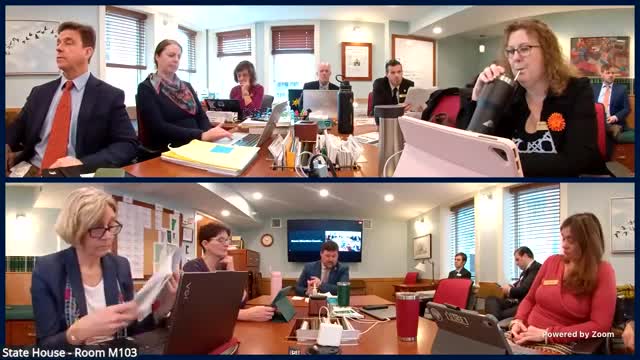
Summary
The House Education Committee approved an amendment to H.454 to add four nonvoting legislative members to a district boundary committee and to create a school‑district voting board task force; members debated a separate amendment addressing tuition and protections for small or non‑operating districts, including North Bennington.
Representative Casey Tufe, presenting an amendment to H.454 during the House Education Committee meeting in April 2025, said the changes add legislative, nonvoting representation to the district boundary committee and create a new school district voting board task force.
"It puts us in more of a driver's seat of building the governance and the wards within those districts," Representative Casey Tufe said, summarizing the intent behind the task force and the committee membership changes.
The amendment Tufe described would add four nonvoting legislative members to the district boundary committee: two House appointees and two Senate appointees, with restrictions that paired appointees not be from the same political party or the same school district. The amendment also makes a numeric change in the bill text (changing the number 5 to 9), creates a school district voting board task force charged with producing maps and a report by Oct. 15, and amends the bill’s effective date language.
The proposed task force, as described in the meeting, would include the Secretary of State or a designee, three members appointed by the Monmouth Municipal Historic Treasure Association, two members appointed by the Monmouth School Boards Association, and the director of the Law Center for Geographic Information. The task force is limited to 10 meetings under the amendment text presented to the committee.
Chair Conlon asked for clarification on the scope of the change and whether it was "making one study committee bigger and another study committee on top of that." Tufe confirmed that was the intent, saying the changes aimed to give elected officials a closer tie to subcommittee work even as the appointees would be nonvoting members.
Representative Phil Greer, speaking about a separate amendment focused on protecting small and non‑operating districts, urged care in any language that could force small or historically independent districts to merge. "We view this as opportunity," Greer said, describing Bennington’s long history as an independent district and warning that consolidation language should not erase long‑standing local arrangements.
Greer’s amendment would add language to preserve existing supervisory union structures where necessary, add kindergarten through grade 12 language to certain subdivisions, and create a new Section 27(a) addressing tuition payment structures tied to unique local governance arrangements. Committee members raised questions about how public tuition dollars could be used where a district is non‑operating and students attend independent schools; North Bennington was discussed as an example of a non‑operating district with historical arrangements that predate more recent consolidation efforts.
Representative Brady asked about the task force’s 10‑meeting limit and whether the work might require more time. Tufe replied committee members could return to the legislature if the task force needed additional meetings. Committee members also asked whether the Secretary of State’s existing budget would cover technical assistance; Tufe said she would consult with the Secretary of State’s office after the meeting about funding sources.
The committee took a recorded straw poll on Tufe’s amendment and the clerk reported a result of 10 in favor, 0 opposed and 1 abstention. A later straw poll on the amendment concerning tuition and protections for small/non‑operating districts produced a disputed tally during counting; committee members reported 11 participants but the transcript does not record a formal final outcome for that amendment.
Committee discussion referenced prior work, including language directing subcommittees to consider historic attendance patterns and the special status of districts that do not operate schools at all grade levels. Several members expressed concern about directing public tax dollars to private institutions and about ensuring transparency and standards for any public tuition arrangements.
No final floor motion for full committee adoption of H.454 as amended was recorded in the transcript provided; the committee proceeded through straw polls and discussion on the several amendments presented.