Get Full Government Meeting Transcripts, Videos, & Alerts Forever!
Get email alerts on the Building Safety Seismic Preapprovals topic
No spam. Unsubscribe anytime.
HCAI webinar explains ASCE 7‑22 changes for OPM/OSP preapprovals, urges manufacturers to update certifications
Summary
HCAI engineers reviewed ASCE 7‑22 updates to preapproval calculations for equipment supports (OPMs) and special seismic certification (OSPs), advised manufacturers to renew approvals to the 2022/2025 code, and said updated application forms will be available by July 1.
Timothy Piland, Senior Structural Engineer with the Department of Health Care Access and Information (HCAI), led a July webinar on incorporating ASCE 7‑22 Chapter 13 changes into HCAI preapproval programs for equipment supports and seismically tested components.
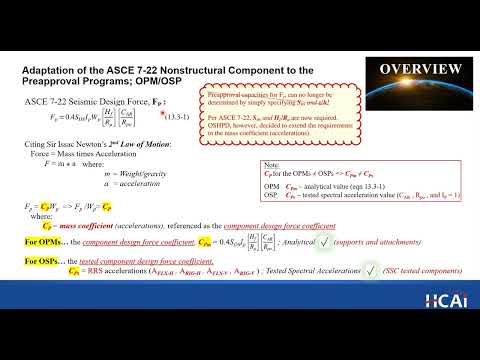
Piland said the session focused on changes to the horizontal seismic force equation (F_p) used for HCAI OPM (equipment support) and OSP (special seismic certification) approvals and how design professionals should apply the new variables. "The goal of the preapproval program is to reduce construction cost," Piland told attendees, adding that clearer, updated preapproval data will make it easier for project design professionals to compare project demands to preapproval capacities.
The presentation emphasized several technical shifts in ASCE 7‑22 adopted into HCAI preapprovals. Piland explained that preapproval capacities can no longer be derived only from SDS and z/h; the new equation requires SDS and H_f/R_u and (for HCAI materials) an expanded set of coefficients the presenter labeled a consolidated C_p. He drew a distinction between C_p values for OPMs (analytically derived coefficients) and C_p for OSPs (tested spectral accelerations): "You can't use the C_p interchangeably," Piland said.
Piland walked through new and renamed variables that affect component demand: C_ar (component acceleration amplification), R_p0 and R_u (overstrength and structural ductility factors), and H_f (a height/period factor that now uses 2.5×z/h in the default equation rather than the older 2×z/h). He noted R_u is now a function of the building lateral force resisting system and that R_u maximums for a single resisting system range up to about 1.71 while the minimum R_u used for unknown systems is 1.3 (and 1.0 at or below grade).
Several practical application points were highlighted. HCAI will update its OPM and OSP application forms and expects the revised application to be available online by July 1; Piland repeated that renewal and new preapprovals for 2025 must include updated calculations and drawings reflecting the current code. He said existing (nonexpired) OPM and OSP preapprovals and prior shake‑table tests remain valid for project use across CBC versions, but renewals should list the C_p design coefficients so project engineers can directly compare capacities to project demands without extra recalculation.
Piland urged manufacturers to update preapprovals to ASCE 7‑22/2025 CBC: "It is in your best interest to renew your preapprovals to the current code," he said, explaining that some forces decrease under the new provisions and updated preapprovals reduce extra steps for project design professionals. He also recommended manufacturers include topside post‑installed anchor configurations on drawings where feasible, to reduce reliance on through‑bolting in the field and lower change‑order risk.
On shake‑table testing and OSPs Piland reviewed the tested response spectrum approach (AC156) and described how OSP capacities are reported as tested accelerations (a_flex horizontal, a_rigid horizontal, and vertical values). He described the "hybrid" test option (horizontal above‑grade values with grade vertical values) that, if used, can make an OSP broadly usable across California sites.
The webinar included a Q&A with practitioners. Piland answered timing questions (HCAI will accept either older or current‑code renewals until a stated cutoff, then require the new code) and clarified implementation details such as using a 0.95 z/h for interior hospital components that cannot be suspended or roof‑mounted, and that distribution system supports are designed separately from distribution piping.
No formal votes or regulatory adoptions occurred during the webinar; the session was an informational presentation and question‑and‑answer forum. HCAI staff said slide handouts and a recording would be posted on the HCAI website within weeks and invited attendees to email technical questions to Piland for written responses.
The presentation is intended as guidance for HCAI preapproval applicants and project design professionals, not new law. Attendees were repeatedly reminded that project designers must still compute project demands under the 2025 CBC/ASCE 7‑22 and verify those demands are less than the listed preapproval capacities before using a preapproval on a project.