Get Full Government Meeting Transcripts, Videos, & Alerts Forever!
Get email alerts on the Hospital Seismic Compliance Water topic
No spam. Unsubscribe anytime.
HCAI webinar details water-rationing guidance, deadlines for NPC‑5 hospital compliance
Summary
The Department of Health Care Access and Information (HCAI) summarized water‑rationing plan expectations, timelines and review roles for hospitals seeking NPC‑5 seismic compliance, emphasizing documentation, vendor contracts and CDPH review where services are affected.
Kamal Kalsi, senior structural engineer in the Seismic Compliance Unit at the Department of Health Care Access and Information (HCAI), led a webinar that summarized water‑rationing plan guidance and the submission deadlines hospitals must meet to show compliance with NPC‑5 seismic performance standards.
Kalsi said HCAI filed final express terms for the 2025 California Administrative Code with the Secretary of State on Feb. 27 and that “there is no change to the NPC regulations” in the filing; those regulations were scheduled to take effect 30 days after filing (March 29, 2025). He contrasted that effective date with the 2025 California Building Code, which he said becomes effective Jan. 1, 2026, and reviewed the sequence of upcoming NPC‑related deadlines for hospitals with noncompliant buildings.
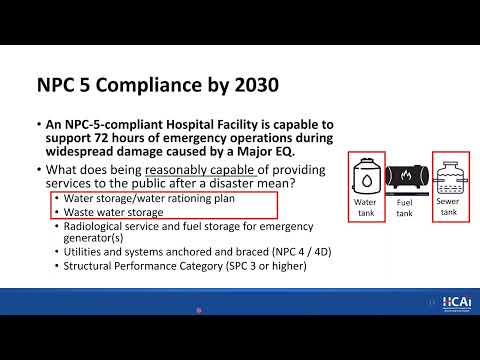
Why it matters: NPC‑5 rating requires not only structural and bracing measures but also on‑site supplies (water, wastewater, fuel) and systems to allow a facility to operate for the initial 72 hours after a major earthquake or other disaster. HCAI’s guidance explains how hospitals can show compliance when space or cost constraints make full on‑site storage impractical and when facilities propose partial rationing plus vendor resupply.
The webinar covered three broad topics: (1) statutory and code references and deadlines (HCAI pin guidance, AB 869, the California Administrative Code, California Building Code and related plumbing/electrical codes); (2) what should be in a water‑rationing evaluation report; and (3) examples and common review issues, including when the California Department of Public Health (CDPH) must review plans because proposed rationing affects patient care.
Key deadlines and submission items - HCAI said evaluation reports for noncompliant buildings already were required under the 2024 timeline for any building planning to remain in acute care beyond Feb. 1, 2030; a facility that plans to remove a building from acute care may submit a signed intent letter in lieu of a full NPC‑4 evaluation for that building. - HCAI noted that by Jan. 1, 2026, facilities planning to remain in service beyond Feb. 1, 2030 must submit a seismic compliance plan; construction documents for NPC‑4/4D/5 projects are due to the office by March 1, 2026 (a date moved from Jan. 1 in the 2025 Administrative Code); building permits for NPC compliance work must be obtained by March 1, 2028, except for limited exceptions listed in the 2025 Administrative Code.
What belongs in a water‑rationing evaluation report - Kalsi said reports should include the most recent annual water bill to establish baseline usage, an executive summary that lists existing on‑site water storage, the proposed emergency water source(s) (on‑site tank, well, vendor tanker), calculations of anticipated emergency water usage and a clear description of services affected if rationing reduces capacity. - He reiterated the code minimum for planning as “50 gallons per bed per day” (used to compute minimum on‑site storage for the first 24 hours), but noted normal hospital water use is typically much higher (HCAI cited a ballpark of 400–500 gallons per bed per day for many hospitals). Kalsi advised using the highest‑month average from billing records (not the annual average) when estimating baseline demand.
Examples and how HCAI reviews them - HCAI reviewed four example approaches used in submitted reports: no rationing (full on‑site supply), limited rationing (targeted reductions such as irrigation or non‑GAC buildings), temperature‑control rationing (reduced cooling outside essential clinical spaces), and significant rationing with direct impacts to general acute care (reduced OR capacity, dialysis, kitchen services, etc.). - Illustration from the webinar: one example facility’s normal usage was shown as about 61,600 gallons per day; under “no rationing” that yielded a three‑day on‑site water requirement of roughly 84,800 gallons and a larger usable tank (after accounting for unusable volume) up to about 205,000 gallons for both water and wastewater in the example. With vendor tanker resupply and significant rationing, HCAI’s example reduced on‑site water needs to as little as about 24,000 usable gallons (water) with corresponding wastewater volumes shown in the presentation. - HCAI said tanker truck contracts are a commonly used code exception for maintaining 72‑hour operations but emphasized contracts and logistics (vendor name, contact, contracted daily quantities, refill frequency and access points) should be in place before an NPC‑5 request. The webinar cited 4,000‑gallon tanker trucks as common and noted a practical maximum deliverable rate in the example discussion of about 48,000 gallons per day depending on refill frequency and site logistics.
When CDPH review is required - Kalsi and slides explained that CDPH reviews are required when water rationing would affect clinical or licensing‑sensitive services (operating rooms, pharmacy, ICUs, dialysis, sterile compounding, infection control measures). HCAI will refer plans to CDPH when submitted evaluations indicate impacts to services; otherwise HCAI’s review is focused on engineering calculations and documentation. The webinar included a CDPH checklist (in the A5 guide appendix) that shows the operational and infection‑control issues CDPH commonly queries.
Other technical points and recommendations - Wells: HCAI said wells can be a reliable emergency source but reviews are case‑by‑case; reports should identify ownership, location, well output (gallons per minute) and transition time from municipal supply to well. Pumps and filtration equipment serving wells should be connected to emergency power. - Wastewater: on‑site holding tanks should be isolated with backflow protection; HCAI said bagging of waste is not an accepted method to reduce calculated wastewater storage requirements for planning purposes. - Design stamps and signatures: facility representatives must sign rationing plans acknowledging facility input; detailed calculations and fuel/equipment designs must be signed and stamped by a licensed design professional.
Quotes and attributions - “There is no change to the NPC regulations,” Kalsi said when summarizing the recent Administrative Code filing and effective dates. - Kelli (webinar staff member) briefly confirmed audio during the session: “I’m having no issues hearing you, Kamal.”
What HCAI asked hospitals to do - Use the HCAI website and the A5 guide (May 2024 revision) for current templates and FAQs, include the highest monthly average water usage in calculations, list all campus buildings covered by a single NPC‑5 project number, include vendor contracts where relied upon, and clearly document any service impacts for CDPH review.
Ending HCAI closed the webinar by noting the slide handout will be posted on the HCAI website (roughly one week after the session) and that recorded materials are available. Kalsi and HCAI staff provided an email contact (seismiccomplianceunit@hcai.ca.gov) and Patrick Rogers was named as a contact for self‑declaration questions. The webinar emphasized that submitted evaluation reports remain under the same project number until reconciliation at construction completion, and that HCAI and CDPH review depth will depend on how much service alteration a plan proposes.