
HCAI outlines SPC 4D upgrade path and performance expectations for older hospitals
Get AI-powered insights, summaries, and transcripts
Subscribe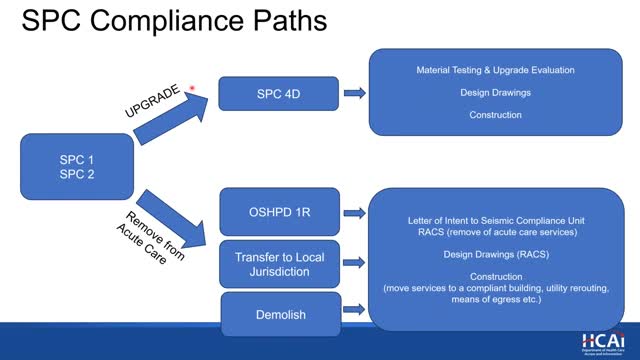
Summary
HCAI staff described the SPC 4D upgrade pathway—an intermediate retrofit standard based on ASCE 41‑13 or a 1980-code prescriptive route—and clarified eligibility, expected damage levels and the locked design standards.
The Department of Health Care Access and Information’s Seismic Compliance Unit reviewed the SPC 4D upgrade option for pre‑1973 buildings and explained the expected performance, eligibility limits and design standards for hospitals seeking to operate beyond the statewide deadline. The unit’s supervisor, Ollie Sumer, said SPC 4D is an upgrade route that sits between older SPC categories and a new‑building standard and is targeted at retaining service beyond the compliance deadline with controlled, repairable damage.
Sumer said SPC 4D is not the same as an SPC‑4 or SPC‑5 new building rating; rather, it is an upgrade classification that accepts some expected damage while keeping the hospital functional. The unit has locked SPC 4D evaluations to ASCE/SEI 41‑13 (commonly referred to in the webinar as ASCE 41‑13) and the corresponding ASCE 7‑10 seismic hazard maps, to avoid shifting design bases midstream. The webinar noted that a 1980‑code prescriptive route remains an alternative in limited cases, but HCAI staff said the 1980 route is rarely feasible due to prescriptive detailing requirements.
Eligibility and limits: HCAI listed three building types that are not eligible for the SPC 4D route as left unchanged: buildings on active fault rupture traces, unreinforced masonry shear‑wall buildings (URMs) and certain precast concrete buildings. The presenter noted owners can change a building’s lateral system behavior through retrofit detailing so that it is no longer classified ineligible, but left the option and feasibility to owner/design teams to demonstrate.
Performance expectations: under ASCE 41‑13 guidance accepted by HCAI, the design earthquake performance target for most retrofit components will be damage‑control; collapse prevention is evaluated for more severe events. Sumer warned owners that SPC 4D upgrades generally permit visible cracking and some localized damage even when the building remains operational after an event; the standard is intended to reduce life‑safety risk without achieving “new building” performance.
Administrative note: there is no separate intermediate SPC deadline; the final compliance date for SPC work aligns with the statewide deadline of Feb. 1, 2030. HCAI advised owners to coordinate SPC planning with NPC (nonstructural) deadlines so construction work is sequenced to reduce repeated opening and closing of ceilings and walls and to save costs.
Ending: HCAI advised hospital owners and engineers to consult early with the Seismic Compliance Unit about eligibility, and to plan whether the ASCE 41‑13 approach or the 1980 prescriptive route is the most appropriate for each building’s configuration and site seismicity.