
HCAI webinar details process, deadlines for removing hospital buildings from general acute care
Get AI-powered insights, summaries, and transcripts
Subscribe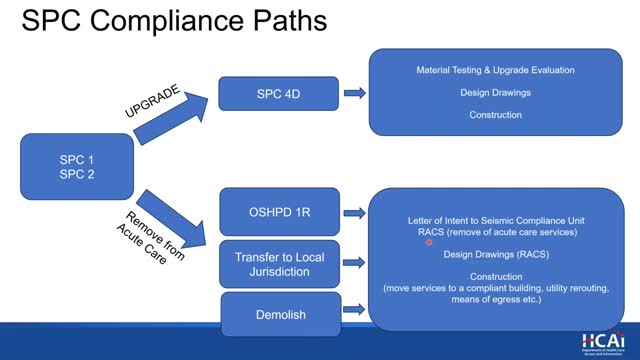
Summary
Department of Health Care Access and Information (HCAI) staff outlined the OSHPD 1R conversion path for hospitals that plan to remove buildings from general acute care use, including required letters, deadlines and technical separations.
Ollie Sumer, supervisor for the Seismic Compliance Unit at the Department of Health Care Access and Information (HCAI), told a statewide webinar that hospital owners who plan to remove a building from general acute care service must file a letter of intent and follow a defined code and review process.
The move to an OSHPD 1R designation begins with an owner’s letter of intent stating the building will not provide general acute care beyond the statewide compliance deadline. Sumer said, “First, we need to get a letter of intent that you are thinking to remove, from acute care.” The webinar reiterated two near-term administrative deadlines: seismic compliance plans are due Jan. 1, 2026, and construction documents for an OSHPD 1R conversion must be submitted by March 1, 2026. HCAI said construction for the conversion must be complete by Feb. 1, 2030, unless an owner has an approved AB 869 extension that revises that date for the building’s final construction.
Why this matters: owners of older hospital buildings face a choice—upgrade to a higher seismic performance category, convert the building away from general acute care, or demolish it. The OSHPD 1R pathway preserves HCAI jurisdiction while removing general acute care functions, but it requires a formal planning and construction program and specific separations so a 1R building cannot adversely affect remaining acute care operations.
Under HCAI guidance, a building becomes OSHPD 1R only if it remains under HCAI jurisdiction; HCAI cannot accept a building handed back from a local authority and then redesignate it 1R. Conversions commonly require design drawings and construction that separate structural systems and fire protection so that collapse or failure of the 1R building will not impair functioning acute-care buildings. The webinar stressed that a 1R building must meet separation and fire-safety rules in the California Existing Building Code (noted in the webinar as CEB 312.3.1) and related OSHPD requirements.
The presenter highlighted common technical constraints for 1R conversions: the OSHPD/ HCAI-controlled building cannot supply primary utilities to acute-care buildings (fire alarm control panels must be in an acute-care building), sprinkler mains that cross seismic joints must include isolation valves and tamper switches on the compliant-building side, and services such as patient access routes must not pass through an OSHPD 1R building. The webinar also explained the concept of “freestanding” for transfers to local jurisdiction: buildings must have structural and fire separation that satisfies the California Administrative Code and height/area limits on the same lot before a local authority may take jurisdiction.
HCAI staff said some services are permitted to remain in 1R buildings (outpatient services, skilled nursing, acute psychiatric care and related services) under the existing-code exceptions; the transcript referenced the CEB provisions that allow certain duplicative services when a building is adapted for these uses. HCAI also enforces signage and record-keeping requirements after conversion (entrance placards and inventory updates).
Sumer advised owners and design professionals to meet early with HCAI regional architects and the Seismic Compliance Unit to get project-specific guidance and preliminary comments, and to submit a preliminary OSHPD 1R project to the region for early feedback. He said the region architects can advise on site-specific requirements and help avoid surprises before construction documents are prepared.
Ending: HCAI’s Seismic Compliance Unit reiterated that the OSHPD 1R route is a legitimate compliance option for some hospitals, but owners should engage HCAI staff early, confirm whether their building is freestanding for transfer to local jurisdiction, and plan construction and utilities work to meet the stated regulatory deadlines.