Get Full Government Meeting Transcripts, Videos, & Alerts Forever!
Get email alerts on the Affordable Housing Development topic
No spam. Unsubscribe anytime.
Council approves $885,000 commitment for Liberty Apartments to secure affordable units under Prop 1-2-3
Summary
The council approved a development agreement and supplemental funding commitment for Aspire Residential’s Liberty Apartments project at 2651 Stacy Drive, tying city payments to completion of 72 phase-one units and to state Prop 1-2-3 award conditions.
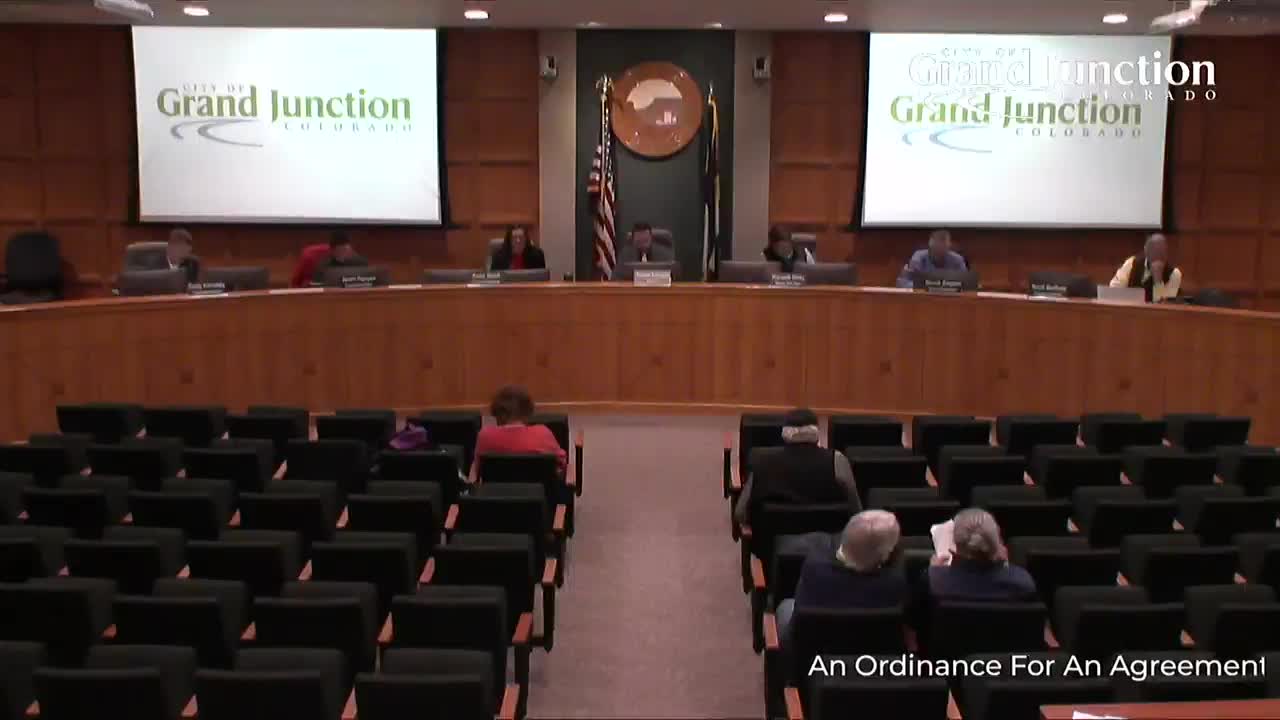
The Grand Junction City Council voted 7–0 on April 2 to approve a development agreement and city funding commitment for the Liberty Apartments, a 192-unit project proposed by Aspire Residential LLC at 2651 Stacy Drive.
City staff presented an agreement that commits roughly $885,531 in city support for phase one (72 units) of the Liberty Apartments project, subject to performance conditions in the agreement. Council adopted Ordinance No. 52 54 on final passage.
Why it matters: The city’s commitment is intended to leverage state affordable-housing programs (the transcript refers to state “Prop 1-2-3” equity or concessionary-debt programs) and secure long-term rent restrictions on a portion of the phase-one units. The development would count toward the city’s Prop 1-2-3 goals and, if financed as envisioned, increase available deed-restricted affordable housing in the city.
Agreement terms and conditions: Tamara Allen, community development director, explained the key provisions. The city’s support is conditioned on completion of the 72 phase-one units and issuance of certificate(s) of occupancy prior to any city disbursements. The agreement requires construction completion by Dec. 31, 2027, and also conditions payment on the project receiving either the Prop 1-2-3 equity award or a concessionary debt award.
Specific affordability commitments in the agreement differ depending on which state funding mechanism is awarded: - If awarded Prop 1-2-3 equity, the project is structured for 90% AMI (area median income) units with at least six units at or below 60% AMI; affordability restrictions last 30 years. - If financed through the concessionary-debt program, the agreement requires at least 15 units rent-restricted at 80% AMI and the remaining 57 units at 100% AMI, also with a 30-year term.
Developer presentation and risk allocation: John Gargas of Aspire Residential told council the developer has advanced site-plan and design work, submitted for Prop 1-2-3 equity funding, and is carrying front-end cost risk for land purchase, site improvements and the drainage/ditch relocation. The city’s funding is structured to reimburse or support these costs only after performance milestones are achieved (certificate of occupancy for phase-one units).
Breakdown referenced in the discussion: during the presentation staff and the developer referenced a consolidated city commitment that includes a land contribution (about $268,000), a drainage/ditch relocation contribution (about $382,000 estimated cost) and a partial waiver or contribution toward impact fees (approximately $234,000 in developer-calculated impact fees) — together producing the roughly $885,000 headline figure discussed in the meeting. The developer also indicated tap fees are not included in the city request and will remain the developer’s responsibility.
Council members framed the vote as an investment in workforce and attainable housing. “This contribution at only about $13,000 per unit, locking these in as affordable units over the long term ... is a really smart investment,” one council member said during discussion, noting that deed restrictions tied to the state program will help leverage additional state funding.
Vote and next steps: Ordinance No. 52 54 passed 7–0 (moved by Mayor Pro Tem Reitz; seconded by Council Member Kennedy). The development agreement will be executed and the city’s supplemental appropriation will cover the difference between funds already budged and the $885,531 commitment; disbursement will follow the agreement’s performance milestones and the developer’s receipt of eligible state awards.
— END —