Get Full Government Meeting Transcripts, Videos, & Alerts Forever!
Get email alerts on the Impact Fees topic
No spam. Unsubscribe anytime.
Grand Junction adopts revised impact-fee ordinance after multi-month review
Summary
Grand Junction City Council adopted an ordinance on April 2 revising the city’s impact-fee rules for transportation, police, fire and parks after a multi-month review and repeated public workshops.
Grand Junction City Council adopted an ordinance on April 2 revising the city’s impact-fee rules for transportation, police, fire and parks after a multi-month review and repeated public workshops.
The measure, finalizing changes to Sections 21.02 and 21.05 of the Zoning and Development Code, updates fee tables and implementation timing and modifies credits for right-of-way and active-transportation construction. The council voted 7–0 to pass Ordinance No. 52 50.
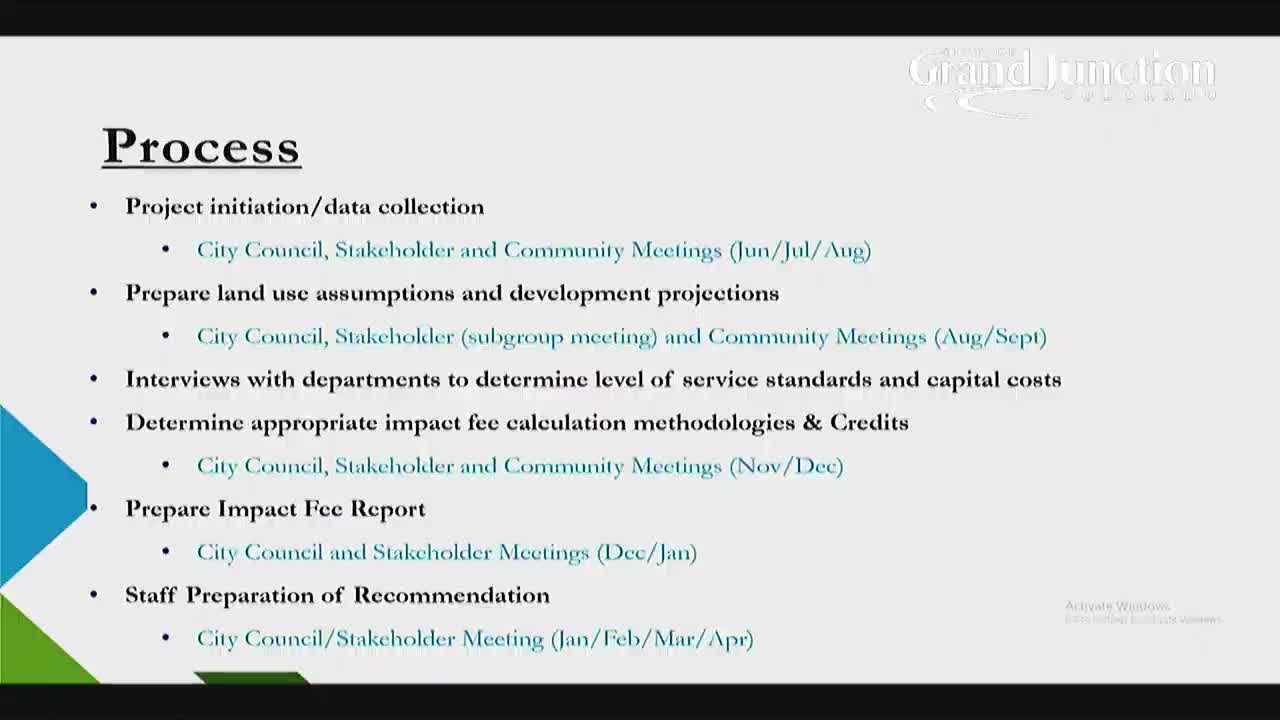
Why it matters: Impact fees are one-time payments collected from new development to fund growth-related capital facilities. City staff and consultant Tishler Bice told council the revised schedule is intended to more closely match the city’s capital needs and legal requirements under Colorado law and the city’s code.
Tamara Allen, community development director, summarized the legal framework and process. “Impact fees are one-time payments for growth-related infrastructure,” Allen said, noting the work required by Senate Bill 15 and the city code, and explaining that the city must show proportionality and benefit to fee payers.
The ordinance reflects several staff and consultant recommendations that were changed during the public process. Key policy and technical items discussed and included in the final ordinance: - Fees adopted: parks, police, fire and transportation were approved in full; municipal facility fees and an affordable-housing linkage fee were not adopted. - Phased implementation: council approved a phased (three-year, six-step) rollout of increases but directed that inflation be calculated using the full fee amount (the total amount from the March 5 study) multiplied by the inflation index, added to the current fee, then the phased step added — a change intended to avoid falling behind inflation during the phase-in. - Review cadence: council added language requiring council consideration of whether a new nexus study is needed at six years and requiring a full nexus study no later than eight years after adoption. - Cost baseline for transportation lane-mile calculations: staff used a 2004 lane-mile baseline for certain cost calculations rather than the 2024 Transportation Engineering Design (TED) standard; that choice reduces transportation fees in many use categories because the 2024 standard assumes wider right-of-way and higher per-lane-mile costs. - Credits and removal of duplicate charges: the revised code includes credits when developers dedicate right-of-way or construct active-transportation corridors so those costs are not charged twice; the longstanding 10% open-space dedication requirement was removed and its cost folded into the parks fee to avoid double charges.
Consultant Carson Bice of Tishler Bice explained technical choices and defended the methodology and datasets used to calculate per-acre park acquisition costs and per-unit park and transportation fees. “Standard practice or best practices is every five years,” Bice said when asked about review cadence, adding that the consultant’s firm has decades of experience performing impact-fee studies.
Public comment and stakeholder review shaped several edits. The Home Builders Association of Western Colorado, represented by Kevin Bridal, said his members support police, fire and transportation fees but urged further review of the parks fee. Parks and recreation advocates and many residents urged adoption and noted the city has park-deficient neighborhoods; Nancy Stripple, chair of the Parks and Recreation Advisory Board, said the proposal commits the city to purchase parkland as parts of the city develop.
Council discussion focused on two technical themes: 1) the park-land cost inputs that underlie the parks fee, and 2) the phased implementation’s treatment of inflation. Council members asked staff and the consultant to demonstrate that the land-cost inputs were defensible; staff responded that calculations used acquisition price data rather than appraised value because fees are intended to fund acquisition and acquisition price drives what the city would pay in the market. Tishler Bice said removing one flagged parcel (Appleglen West) would slightly increase the per-acre figure rather than reduce it, and staff recommended proceeding without re-running the full study on that single change.
On inflation, council adopted the staff recommendation that each phased step should incorporate inflation as if the full fee were already in force so the phase-in does not leave the city under-collecting relative to the policy decision to charge the full fee.
The council vote and next steps: Ordinance No. 52 50 passed on final reading, 7–0. Staff will publish the ordinance in pamphlet form and incorporate the revised fee tables and code text changes into Title 21. The ordinance directs staff to implement the phased increase schedule beginning January 1, 2026 (first step), with the inflation calculation method and the six-year/mandatory-eight-year review language added by council.
What the ordinance does not do: it does not create a dedicated tax or cover operating costs such as park maintenance or restroom repairs. Staff reiterated that impact fees fund capital capacity expansion only; operations and maintenance remain the responsibility of the general fund or other operating sources.
The council accepted the Planning Commission’s 5–2 recommendation supporting the code-text amendments and directed staff to track implementation, including separate accounting for parkland acquisition, park improvements and open-space elements included in the parks fee.
The revised fee tables, supporting documentation and the consultant’s impact-fee report are part of the city record for the ordinance and will be used to administer credits and collections going forward.
Votes at a glance: Ordinance No. 52 50 (Title 21 amendments regarding impact fees) — Motion to adopt by Council Member Stout, second by Council Member Wynne; final vote 7–0; outcome: approved.
— END —