City council adopts new rules for accessory dwelling units after months of debate
Loading...
Summary
After extensive debate and amendments, the Colorado Springs City Council approved an amended ordinance to allow accessory dwelling units (ADUs) in single‑family areas with limits for wildfire areas, parking and other conditions.
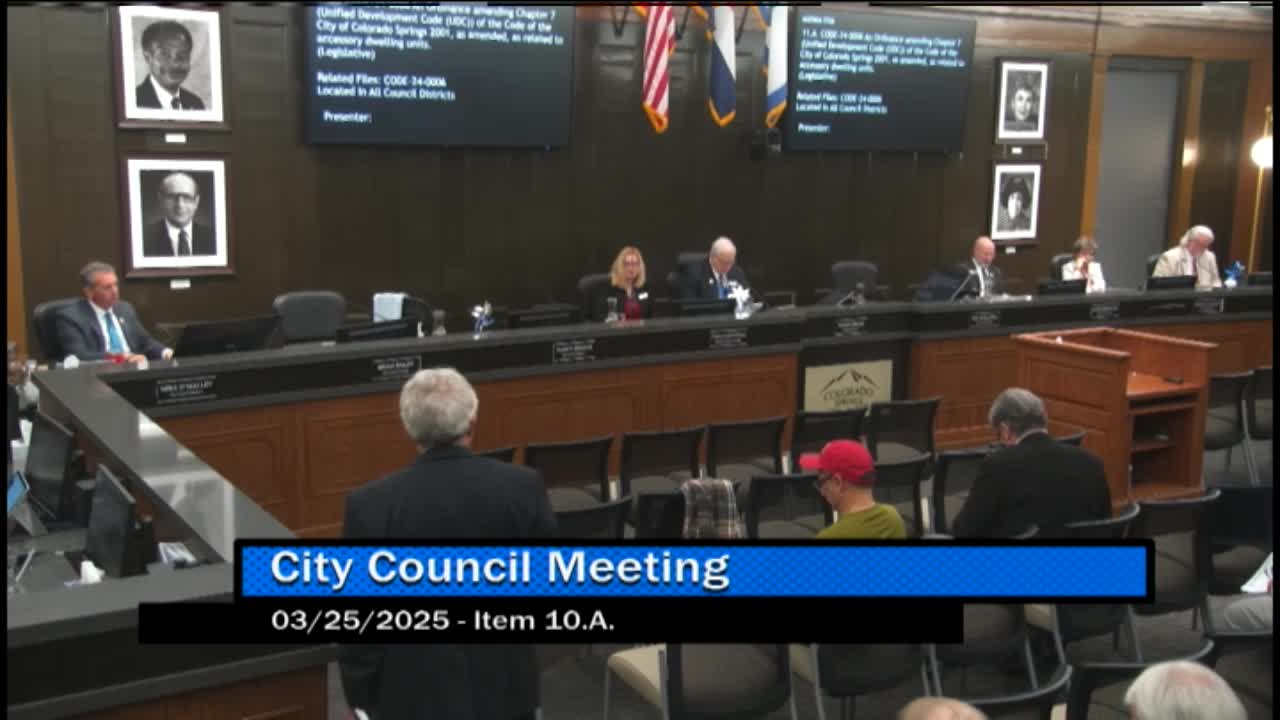
Colorado Springs City Council members approved a revised ordinance enabling accessory dwelling units, or ADUs, in single‑family residential areas on March 20 after a months‑long review, public comment and multiple amendments.
The ordinance (UDC Chapter 7 amendments) permits ADUs as an accessory use to single‑family detached dwellings across zones where those homes are allowed. The final measure adopted by council excludes detached and attached ADUs from the Wildland‑Urban Interface (WUI) overlay; it allows only integrated ADUs in the WUI. The council also added a requirement that property owners provide one off‑street parking space for each ADU in addition to the parking required for the primary structure.
Council discussion was extensive. Supporters, including housing advocates and the Colorado Springs Chamber & EDC, argued ADUs are a low‑cost, private‑market tool that can add modest amounts of housing without major public investment. Pikes Peak Housing Network executive director Jill Gabler told the council ADUs help families age in place and add needed smaller housing types in changing household demographics.
Opponents — including homeowner and historic‑neighborhood groups and some West Side residents — urged caution and said the city should not rush the ordinance. Speakers raised concerns about wildfire evacuation capacity, infrastructure impacts, the potential for investor purchases that convert owner‑occupied properties into two rentals, and privacy and neighborhood character. Several residents asked the council to define the WUI explicitly in the ordinance rather than leave the boundary to fire‑marshal discretion; the council amended the draft language in response.
Councilmembers debated several proposed changes at length, including owner‑occupancy requirements and a mechanism to allow appeals of ADU permits. The final package preserves administrative permitting rather than creating a new appeals pathway; staff said adding appeals could chill investment and add permitting complexity. The council also considered and rejected an amendment that would have required owners to reside on the property (not only at application time), after advice that state statute limits how municipalities can condition ADU approvals.
Vote and next steps: After an amendment clarifying WUI treatment and parking passed, the council voted to adopt the ordinance. The clerk recorded the final tally as the motion passing; the transcript records the vote outcome and the council will publish the enacted ordinance text in the city code. Staff said rule details and implementation guidance will be posted for homeowners and planning staff will track permit impacts.
Why it matters: The change expands homeowners’ options to add rental or family units on single‑family lots citywide, creating modest additional housing supply in the near term. Councilmembers and residents said they expect any major changes in deployment to emerge gradually; the city will monitor usage and infrastructure effects and may revisit the rules as needed.