Get Full Government Meeting Transcripts, Videos, & Alerts Forever!
Get email alerts on the Behavioral Health 988 Ccbhc topic
No spam. Unsubscribe anytime.
Mental‑health coalition presses for 988 fee, CCBHC and crisis continuum funding
Summary
Mental‑health organizations asked the Senate budget committee to preserve and expand funding for the 988 crisis continuum, certified community behavioral health clinics (CCBHCs), mobile crisis teams and related programs, and to adopt the telecom fee to sustain operations as federal dollars shrink.
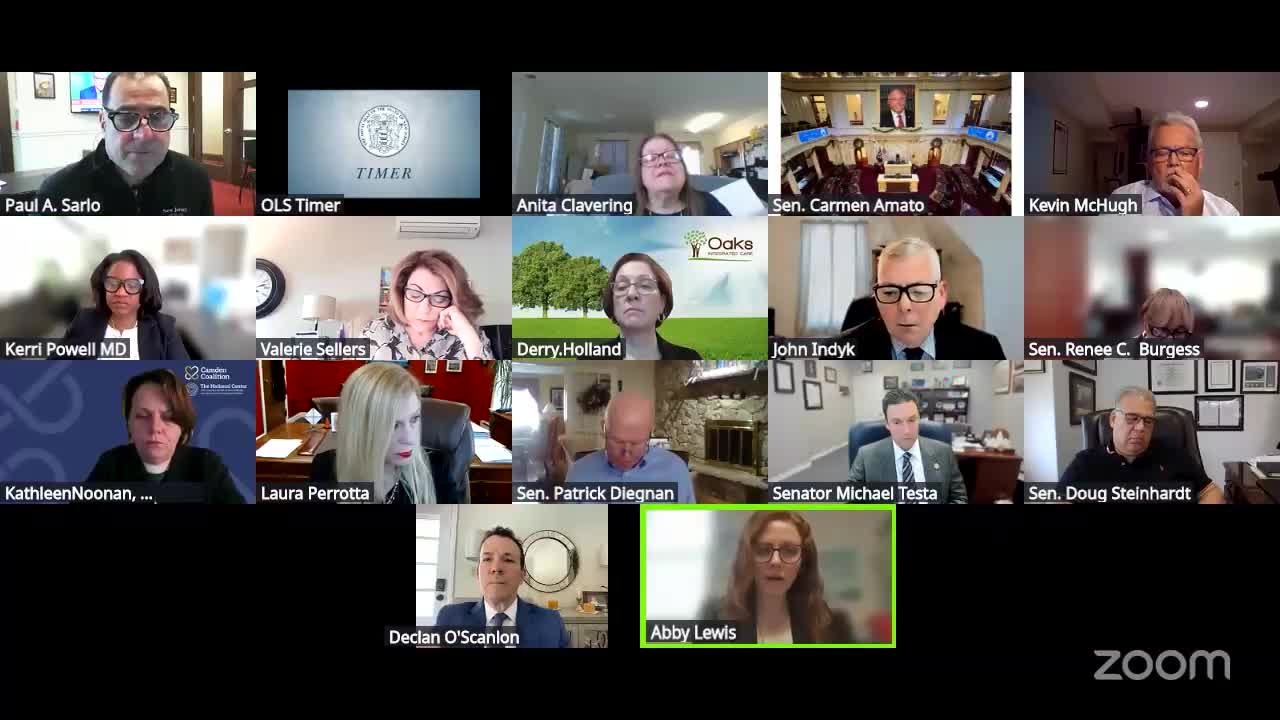
Abigail Lewis of the Mental Health Association in New Jersey told the committee the state should adopt the governor’s proposed 40¢ monthly telecom fee to sustain the 988 suicide and crisis lifeline and the broader 988 continuum of care. “The 988 continuum of care provides someone to call, someone to respond, and somewhere to go,” she said, describing elements that include 988 call centers, mobile crisis outreach teams, crisis receiving and stabilization centers, and crisis diversion homes.
Several CCBHC providers and allies asked the committee to preserve line items the governor proposed and to restore cuts. John Endyke of the Health Care Association of New Jersey, Derry Holland of Oaks Integrated Care, Mary Bohan of Rutgers University Behavioral Health, Vera Sansone of CPC Integrated Health, and others described CCBHCs as evidence‑based programs that expand access and reduce hospital and emergency room usage. Rutgers UBHC said a proposed $2.4 million line for CCBHCs supports workforce retention, expanded services, and reduced wait times for psychiatric evaluations.
Multiple speakers warned of looming federal Medicaid cuts. Endyke said language in the governor’s budget that referenced 2024 nursing home Medicaid rates appeared to be a typo but created confusion; speakers across sectors worried about potential federal reductions and urged state investments that would draw federal matching dollars. Pyramid Healthcare and other substance‑use treatment providers urged specific appropriations to raise Medicaid rates for residential SUD treatment so state dollars would trigger federal matching funds.
Several presenters asked for an across‑the‑board increase to Medicaid behavioral‑health reimbursement to support the provider workforce and sustain services. Deborah Wentz and others estimated a modest 8% increase would be needed to stabilize community behavioral health providers and said children’s partial hospital rates, care management funding, and other targeted increases were also necessary.
Witnesses asked legislators to protect existing pilot or demonstration programs (for example, Pledge to Connect and other data‑driven crisis response pilots) and to fully fund workforce incentives and the ongoing CCBHC demonstrations so the state could both sustain crisis response and expand community‑based care.