Get Full Government Meeting Transcripts, Videos, & Alerts Forever!
Get email alerts on the Higher Education Funding topic
No spam. Unsubscribe anytime.
Vermont State Colleges asks lawmakers to fund Freedom and Unity scholarships, new HVAC apprenticeship
Summary
Vermont State Colleges officials urged the Senate committee to back a proposed Freedom and Unity last-dollar tuition grant for students with family incomes up to $75,000 and requested start-up support for an HVAC apprenticeship, saying the measures would boost enrollment, retention and the state workforce.
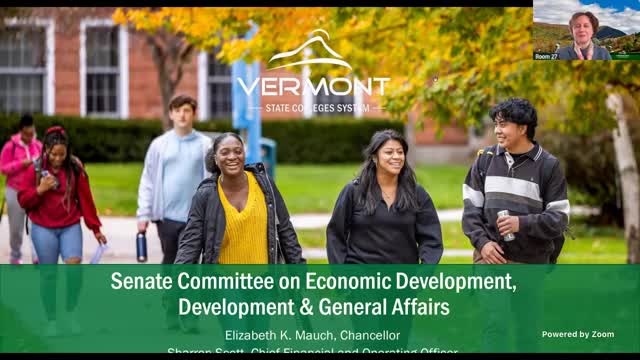
Beth Mauck, chancellor of the Vermont State Colleges System, and Sharon Scott, the system’s chief financial and operating officer, told the Senate Committee on Economic Development, Housing & General Affairs that expanded scholarship and apprenticeship funding would help retain students and meet Vermont employer demand.
Mauck said the system was created “for the benefit of Vermont” and framed the Freedom and Unity proposal as a tool to keep more Vermonters enrolled through to graduation. “This is so important, that it's not really only about the recruitment of students in programs. It really is about retaining them to graduation,” she said.
The Freedom and Unity grant would provide last-dollar tuition up to Vermont State University’s base tuition for individuals with family incomes at or below $75,000. Mauck told the committee that the House included $1,500,000 for the initiative and the system is asking the Senate for $2,500,000. She said VSAC’s initial, larger request would have been about $5.2 million to cover all eligible students and that $2.5 million would support roughly half of those students. “With $2,500,000, we'd be able to support about half of them,” Mauck said.
Scott described workforce and training programs the colleges operate and the proposed HVAC apprenticeship. She said the colleges served about 17,000 students across degree and workforce programs and graduated roughly 2,000 students last year. Scott cited specific program counts: about 415 nurses graduated last year, more than 250 students are enrolled in the university’s mental health counseling program with 33 graduates, and 46 dental hygienists graduated last year with 75 enrolled this year.
On apprenticeships, Scott said plumbing and electrical programs have grown more than 20 percent over two years and current enrollment for those apprentices is a record high of 870. The proposed HVAC apprenticeship would focus on certifications in propane, heating, air conditioning and refrigeration. Scott said the initial request included $1,000 in start-up funds and $273,000 in tuition support to assemble the first cohort and build employer and regional technical center partnerships.
Committee members asked whether grants would require graduates to remain in Vermont; Mauck said the Freedom and Unity grant “does not include a time that the student has to stay in the state.” She noted roughly 80 percent of Vermont State Colleges students are Vermonters but that the grant proposal is not tied to a post-graduation service requirement.
Committee members also asked how the $2.5 million translates per student and how Pell grants and other aid fit into the calculation. Mauck said Pell awards vary by household and household size but estimated that “for most students, you're looking at somewhere at a $75,000 income, around $2,500 would be … about the amount maximum that most of them would need.” She said the grant would cover the gap remaining after Pell and other aid; students would still be responsible for housing, food and books.
On timing, Scott said curriculum and partnerships would need work and that an early launch could be possible in January but a more realistic start would be late spring to enroll the first cohort.
Mauck and Scott fielded questions about fundraising and employer contribution; Scott said employers have been “tremendous partners” and the plan anticipates employers paying training costs after the initial cohort.
The session closed with the committee thanking the presenters and shifting to the committee’s internal budget-priority discussion.