Get Full Government Meeting Transcripts, Videos, & Alerts Forever!
Get email alerts on the Housing And Community Development topic
No spam. Unsubscribe anytime.
Mobile County presents draft 2025–2029 consolidated plan and 2025 annual action plan; opens 30-day comment period
Summary
Mobile County staff outlined priorities for HUD-funded CDBG and HOME programs, including public facilities and infrastructure, homeowner repairs, demolition of blighted properties, and funding for nonprofit services. The draft plan will be available for 30 days for public comment before submission to HUD.
Mobile County staff presented the county's draft 2025–2029 consolidated plan and the 2025 annual action plan and opened a 30-day public comment period on the county's application to the U.S. Department of Housing and Urban Development (HUD) for CDBG and HOME funds.
The plans, the presenter said, serve as Mobile County's official application to HUD and describe how the county would use Community Development Block Grant (CDBG) and HOME Investment Partnerships (HOME) program funds if allocated in the federal budget for 2025. "The consolidated plan and annual action plan serve as the county's official application to HUD for these funds," Staff member (presenter) said.
Why this matters: the consolidated plan sets five-year priorities that guide federal grant spending aimed at assisting low- and moderate-income residents. The draft prioritizes public facilities and infrastructure, public services, housing preservation and production, homeowner repairs, demolition of blighted structures, and fair housing activities — all of which determine which programs and projects Mobile County can fund if HUD awards the grants.
Staff outlined program scopes and examples of eligible activities. CDBG funds can support housing-related activities such as rehabilitation and land development (but not direct new housing construction), public facilities and infrastructure improvements (parks, sidewalks, lighting, ADA accessibility), economic development activities, nonprofit support, and up to an administrative allocation for county program management. "CDBG is really designed to be flexible as long as the county is using this funding to provide decent housing, a suitable living environment, or expand economic opportunity," the Staff member said. The presenter said HUD defines low- and moderate-income households as those at or below 80% of area median income; for Mobile County the presenter gave the area median income for a family of four as about $60,000.
HOME funding is dedicated to housing affordability and may be used for homeowner rehabilitation and repair, down-payment assistance or closing-cost assistance for homebuyers, and construction or rehabilitation of rental housing or owner-occupied housing when eligible. The presenter noted the county may also receive Emergency Solutions Grant (ESG) funding in some program years; ESG, when available, would be targeted to homelessness response and prevention, including emergency shelter, outreach, rapid rehousing and prevention.
The presentation summarized the engagement and planning process. Phase 3 of the plan makes a draft available for public review and comment for 30 days before the plan returns to the commission for approval and submission to HUD. Earlier outreach included four public meetings (two public hearings and two community meetings), a meeting with the Pritchard Housing Authority, stakeholder interviews of organizations that provide housing or related services, and an online survey. The presenter reported about 95 people participated across those engagement activities.
Five-year priorities and 2025-specific allocations: the presenter said public facilities and infrastructure represent one of the largest priority areas, with examples such as parks, community centers, roads, sidewalks, lighting and ADA accessibility to benefit low- and moderate-income neighborhoods and special-needs groups (seniors, youth, people experiencing homelessness). The draft anticipates reserving up to 15% of CDBG funds for public services; the presenter said Mobile County expects to use that full 15% for activities such as youth services, childcare, senior services, family violence prevention, food access, transportation, legal assistance and workforce development. The presenter also identified demolition/clearing of dilapidated buildings (spot blight) and homeowner emergency repair as priorities.
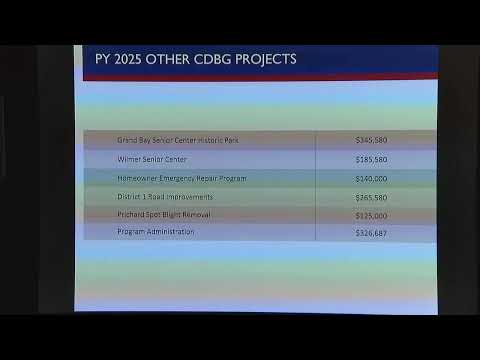
The presenter summarized expected outcomes for draft 2025 activities: public services were described as expected to assist about 1,000 people and 50 households; planned public facilities and infrastructure projects (including improvements at the Grand Bay Senior Center Historic Park, the Wilmer Senior Center, and road work in Pritchard’s District 1) together were described as anticipated to assist about 1,400 people; an emergency homeowner repair program was expected to help about nine households; the spot blight program was anticipated to fund demolition for about 12 buildings; HOME-funded activities administered through CHODOs (Community Housing Development Organizations) were expected to result in about four new affordable rental units and down-payment assistance for about two households.
Budget breakdowns in the presentation: the presenter said CDBG allocations over the five-year plan would dedicate roughly 15% to public services, about 51% to public facilities/infrastructure and blight clearance/homeowner rehab, and approximately 20% for program administration. For HOME funds, the presenter said about 14% would support homebuyer assistance and roughly two-thirds of HOME funds would be aimed at expanding the supply of affordable housing, with up to 10% reserved for administration. The presenter noted 2024 allocations to Mobile County were about $1,600,000 in CDBG and about $550,000 in HOME, and emphasized that grant amounts vary year to year and depend on the federal budget and HUD allocations.
Public comment process and next steps: the draft consolidated plan and annual action plan are available for review online, and comments will be accepted by mail or email to Gordon Bauer; comments received during the public comment period will be included in an appendix to the plan submitted to HUD. After the 30-day public comment period, the county will revise the draft as appropriate and seek Commission approval before submitting the plan to HUD.
No formal vote or commission action was recorded in the presentation portion of the hearing; the session consisted of the staff presentation and an invitation for public comments and questions.
The draft plan, links to supporting documents and instructions for submitting comments are posted on the county's website; the public comment period begins with this posting and runs for 30 days.