Get Full Government Meeting Transcripts, Videos, & Alerts Forever!
Get email alerts on the Parental Rights Social Media topic
No spam. Unsubscribe anytime.
Nebraska debate turns contentious over parental-rights social media bill; critics cite First Amendment and implementation concerns
Summary
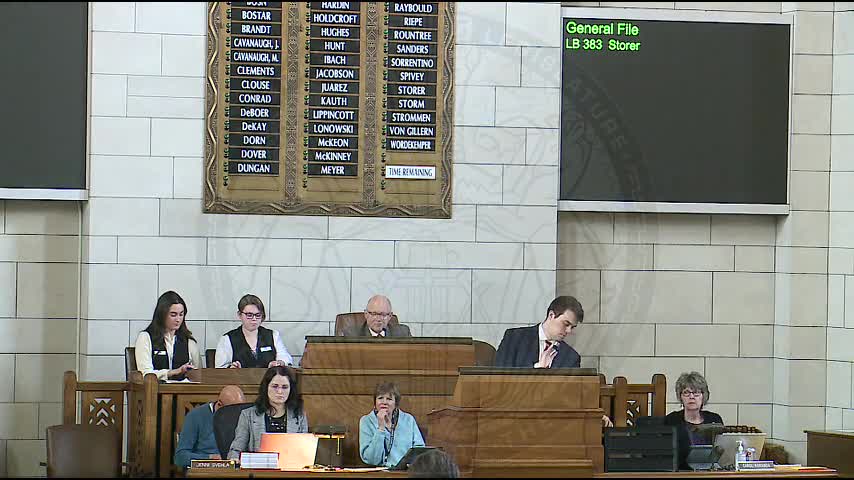
Senator Storer introduced LB 3 83, the Parental Rights and Social Media Act, and the Judiciary Committee amendment that incorporates LB 172 to update CSAM law was presented to the floor.
Senator Storer introduced LB 3 83, the Parental Rights and Social Media Act, and the Judiciary Committee’s amendment AM 08:37 (which incorporates Senator Harden’s LB 172 on computer-generated child sexual abuse material) was presented to the floor. The bill would require parental consent and commercially reasonable age verification for minors to create social-media accounts and would require platforms to provide parental oversight tools; the committee amendment also updates state law to criminalize AI-generated child sexual-abuse material (CSAM).
Storer, the bill’s sponsor, said the measure is content-neutral and modeled on age-verification laws in Tennessee and Louisiana. She cited the U.S. surgeon general’s advisory on youth mental health and social media and argued the state has a compelling interest in protecting children from demonstrable harms. Senator Harden spoke for the incorporated LB 172, saying the bill expands definitions of CSAM to cover computer-generated and AI-manipulated images and clarifies prosecutorial tools.
Opponents raised constitutional and practical objections. Several senators—including Senator Duncan, Senator DeBoer and Senator McKinney—said the definitions of “social-media platform” were too broad or vague, creating due-process and First Amendment risks; they cited a federal court decision from Arkansas that enjoined a similar law in that circuit. Concerns included whether age verification would chill adults’ speech, how verification would be enforced, privacy of verification data, the scope of covered platforms (which critics said could sweep in non-social apps), and how foster or emancipated minors would be handled.
Committee and floor maneuvers followed: the Judiciary Committee amendment AM 08:37 (white copy) was introduced and described on the floor; Senator John Kavanaugh offered AM 10-07 (an amendment to the committee amendment) to clarify that fines assessed under the measure would be apportioned to the common school fund in accordance with the state constitution. The body also voted to divide the question so the chamber will take up the online age-verification portion first and the CSAM amendment second. Senator Duncan moved to divide the question and the chair determined the first piece would be considered first.
Senator Hunt moved to bracket LB 3 83 until June 9; the motion failed on the floor. The clerk recorded 4 ayes and 26 nays on the bracket motion. During the bracket debate Senator Hunt made an extended floor statement urging broader attention to suicide risk and warning against pairing child-protection rhetoric with other bills she said harm LGBTQ youth; several senators responded with emotional and policy-focused remarks.
The debate left open procedural and legal questions: multiple senators asked for clearer definitions and further drafting to address constitutional vagueness and enforcement mechanics. The committee amendment and several floor amendments remain pending as the bill proceeds through the Legislature’s process.